The Price of Intelligence in 2026
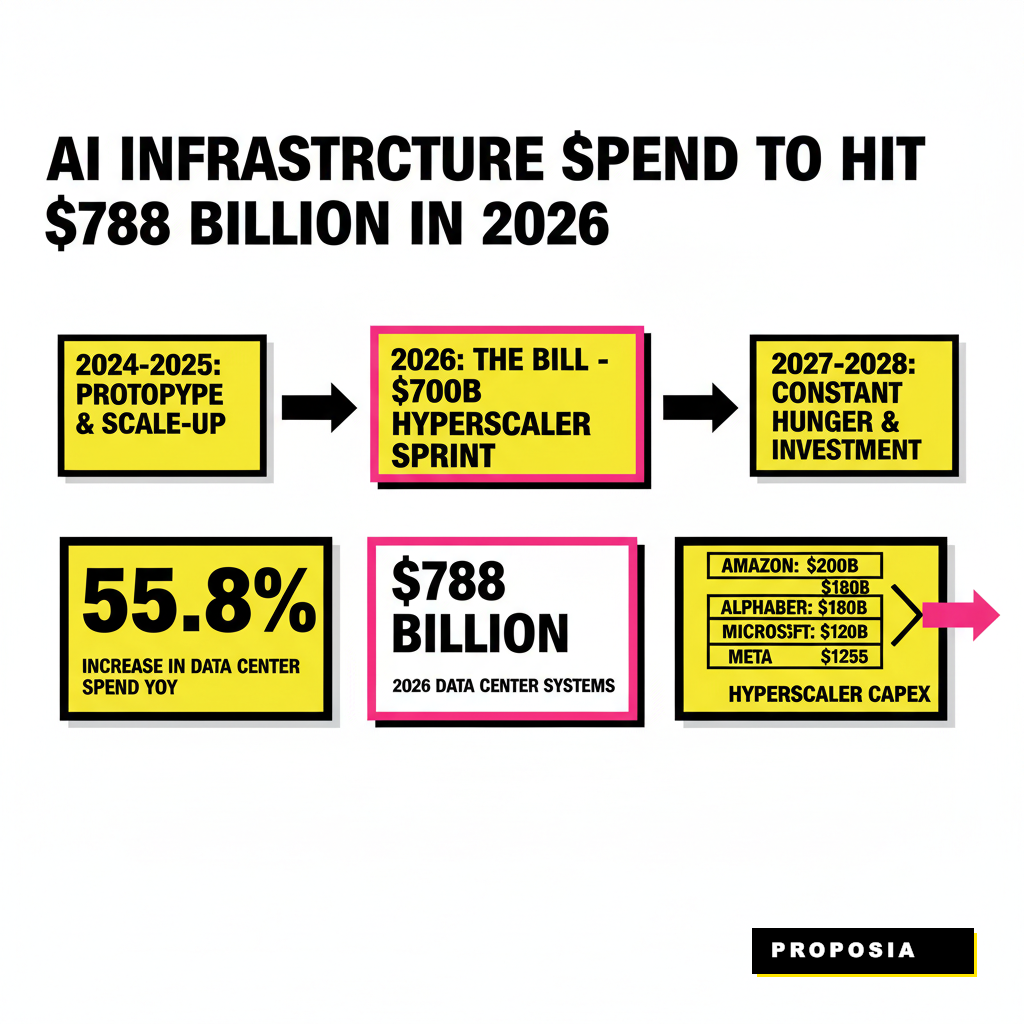
We've officially reached the point where the cost of AI is no longer a theoretical line item on a balance sheet. As of April 2026, the honeymoon phase of small-scale pilots has evaporated, replaced by a brutal reality of infrastructure demands that few predicted three years ago. If 2024 was the year of the prototype and 2025 was the year of the scale-up, 2026 is the year of the bill. Companies are finding that keeping up with the rapid evolution of large language models requires a financial commitment that rivals the build-out of the national highway system or the early telecommunications boom.
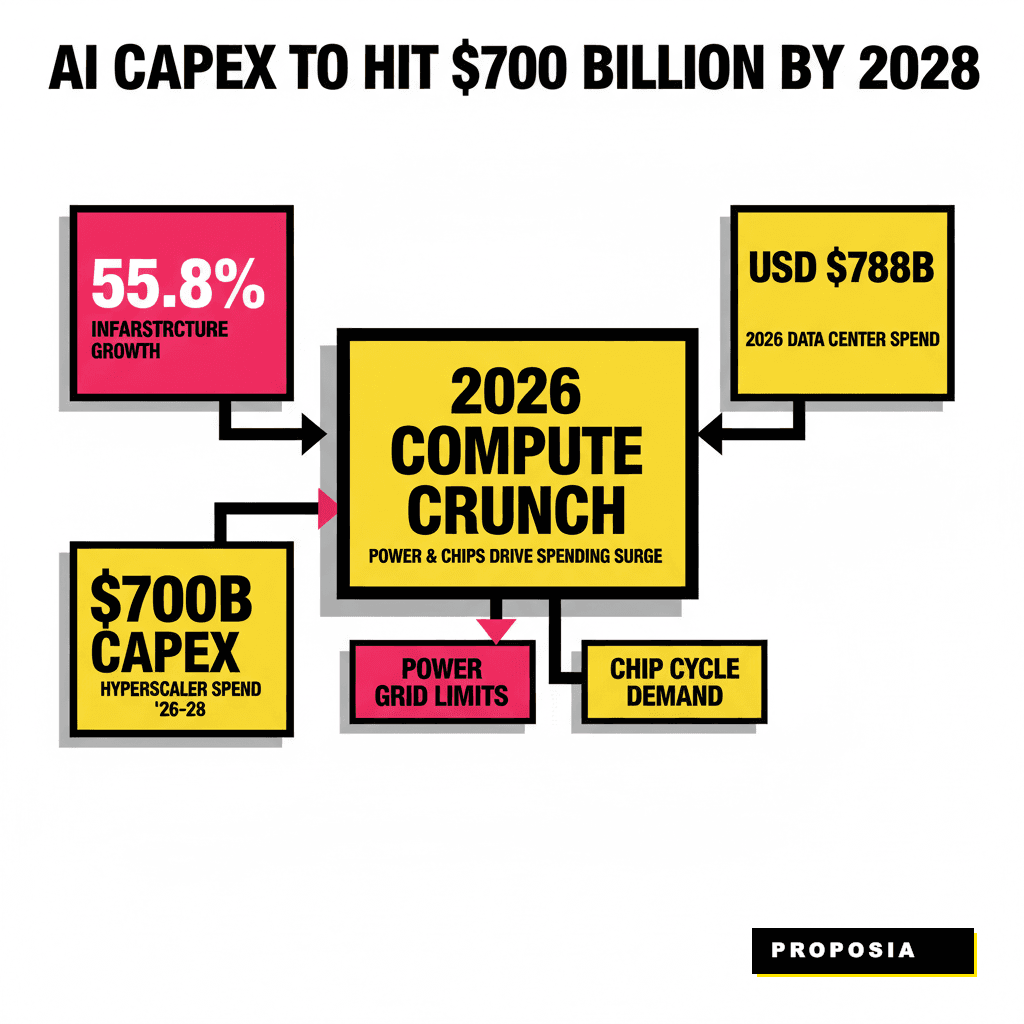
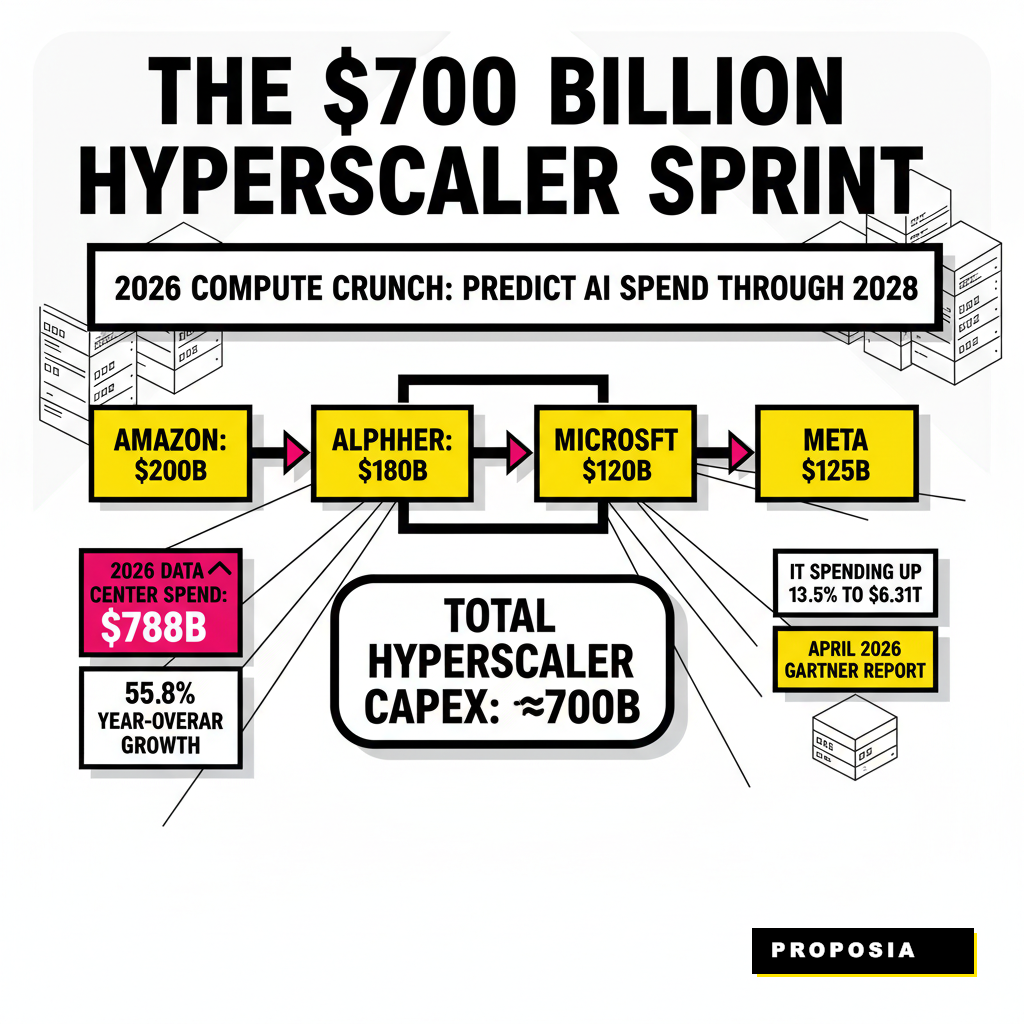
Billions of dollars are currently flowing into a very narrow set of physical assets. According to a recent April 2026 Gartner report, global IT spending is projected to hit $6.31 trillion this year, representing a 13.5% jump from 2025. While that growth is impressive, the real story lies in the data center segment. Spending on data center systems alone is set to explode by 55.8% to roughly $788 billion. This isn't just incremental growth. It is a structural shift in how capital is allocated across the entire global economy.
The $700 Billion Hyperscaler Sprint
Hyperscale cloud providers have become the primary architects of this new era. Microsoft, Meta, Amazon, and Alphabet are effectively in an arms race where the only way to win is to outspend the competition. Recent financial disclosures show that these companies are on track to deploy nearly $700 billion in capital expenditure in 2026 alone. This massive tide of cash is earmarked for massive-scale facilities that can house the next generation of silicon.
Amazon leads the pack with a projected $200 billion in capex for the year, focusing heavily on expanding its AWS footprint. Alphabet follows closely at approximately $180 billion, while Microsoft and Meta are tracking toward $120 billion and $125 billion respectively. These numbers are staggering when you consider that just a few years ago, a $30 billion annual spend was considered aggressive. Executives now realize that being compute-starved is a greater risk than overinvesting. Meta CEO Mark Zuckerberg noted earlier this year that their advertising and ranking systems are operating in a state of constant hunger for more compute, driving the need for "notably larger" investments through 2027.
Managing these costs requires more than just a large checkbook. Many organizations are turning to rigorous financial oversight to ensure their investments actually yield a return. We've seen how some leaders are navigating the 2026 AI audit to claw back millions in inefficient spend. Without this kind of discipline, the sheer scale of the 2026 compute crunch can swallow a company's entire R&D budget before a single model is deployed to production.
The Silicon Shift: Nvidia Rubin and Beyond
Silicon cycles are moving faster than the industry can build the buildings to house them. Nvidia recently confirmed that its new Rubin architecture has entered full production, with volume shipments expected in the second half of 2026. This launch represents a significant leap over the Blackwell series that dominated 2025. The Rubin GPU features 336 billion transistors and utilizes HBM4 memory to deliver 50 petaFLOPS of FP4 inference performance per chip. This is not just an incremental improvement. It is a fundamental redesign aimed at the agentic AI era where inference efficiency determines commercial viability.
Hardware upgrades of this magnitude create a secondary crunch. Every major cloud provider has already committed to these chips, which has tightened the supply of critical components like high-bandwidth memory. SK Hynix and Samsung have ramped up HBM4 production, yet yields remain a concern for the broader market. You can read more about why this specific hardware shift is fueling the rise of Nvidia Rubin and Sovereign AI as a strategic moat for nations and corporations alike. The move to a custom ARM-based Vera CPU paired with Rubin GPUs signals that the future of the data center is integrated, liquid-cooled, and incredibly expensive to maintain.
The Invisible Wall: Power and the Grid
Energy has become the ultimate arbiter of AI progress. While we often focus on chips and transistors, the ability to actually plug these machines in is the real constraint of 2026. The International Energy Agency (IEA) recently projected that global data center electricity consumption will double to 945 TWh by 2030. In the United States alone, demand is expected to triple by 2030 compared to 2021 levels. This has forced hyperscalers to become energy companies, investing directly in nuclear small modular reactors and massive solar farms to secure their own power supply.
Local grids are struggling to keep pace with these demands. In hubs like Northern Virginia and Dublin, the time it takes to get a new data center connected to the grid has stretched from months to years. This "power wall" is driving a geographic shift in infrastructure spending. We are seeing a move toward regions with stranded power or underdeveloped grids where tech giants can build their own generation capacity. Consequently, the capex for a modern data center now includes a significant percentage for electrical substations and cooling systems that didn't exist in the legacy server era.
Predictions for 2027 and 2028
Most analysts are asking if this spending level is sustainable. While some fear a bubble, the data suggests that we are still in the early stages of a multi-year supercycle. Barclays analysts recently noted that current market forecasts for 2027 and 2028 might be underestimated by as much as $225 billion. Their framework suggests that capex will likely peak in 2028, driven by the shift toward recursive self-improvement in AI models. This phase will require even more infrastructure to be deployed before the efficiencies of self-training models can actually reduce costs.
| Metric | 2025 (Actual/Est) | 2028 (Projected) |
|---|---|---|
| Hyperscaler Capex | $448 Billion | $850+ Billion |
| Data Center Energy Use | ~200 TWh (US) | ~350 TWh (US) |
| AI Chip Performance | 20 PFLOPS (Blackwell) | 100+ PFLOPS (Rubin Ultra/Feynman) |
Future spending will likely become more decentralized. While the Big Five will continue to dominate, we expect a rise in sovereign AI clouds as nations seek to protect their data and build domestic compute capacity. This will add another layer of demand to the silicon and power markets. By 2028, the distinction between a "tech company" and a "utility provider" will be almost non-existent. If you're a business leader planning your budget for the next three years, you must account for a world where compute is a scarce, expensive commodity that requires long-term procurement strategies rather than just-in-time purchasing.
The Bottom Line
Navigating the 2026 compute crunch requires a shift in perspective. It is no longer enough to have the best algorithms. Success now depends on your ability to secure the physical infrastructure necessary to run them. We are seeing a transition from a software-first world to a hardware-constrained reality. Organizations that secure their energy supply and silicon allocations today will be the ones that define the market in 2028. The numbers are big, but the cost of inaction is even bigger. Those who fail to invest now may find themselves permanently locked out of the next phase of the intelligence revolution.
Sourcing Log
- Statistic: Global IT spending to reach $6.31 trillion in 2026 (up 13.5%) - Gartner (April 2026)
- Statistic: Data center systems spending projected to reach $788 billion in 2026 - Gartner (April 2026)
- Statistic: Combined hyperscaler capex (Big 5) projected at ~$700B for 2026 - The Futurum Group (Feb 2026)
- Data Point: Nvidia Rubin specs: 336B transistors, HBM4, 50 PFLOPS FP4 - Nvidia Newsroom
- Statistic: Global data center electricity to double to 945 TWh by 2030 - International Energy Agency (IEA)
- Quote: "Demand is increasing... we do need to spend." - Amy Hood, Microsoft CFO (Nov 2025 Earnings Call)
- Forecast: AI capex for 2027/2028 could be $225B higher than consensus - Barclays (March 2026)