The Rise of the Autonomous Coding Agent
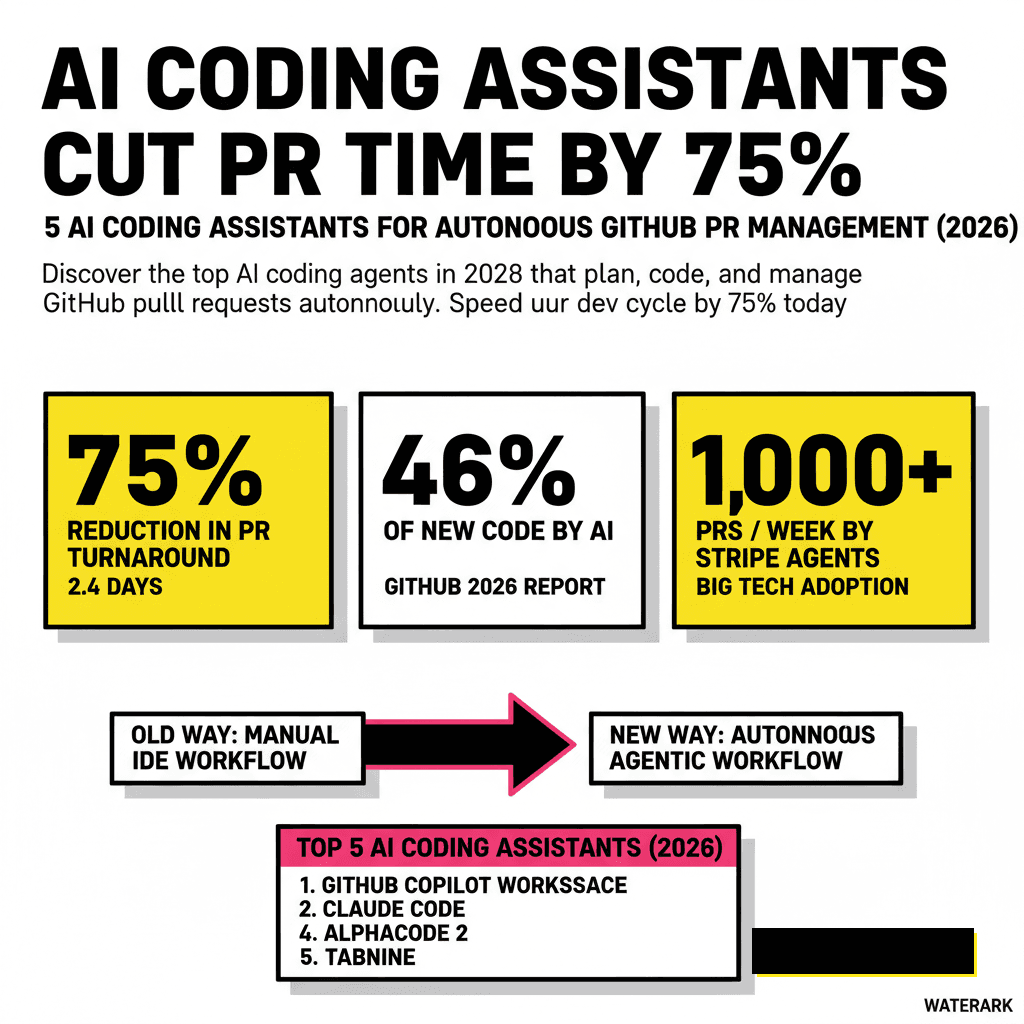
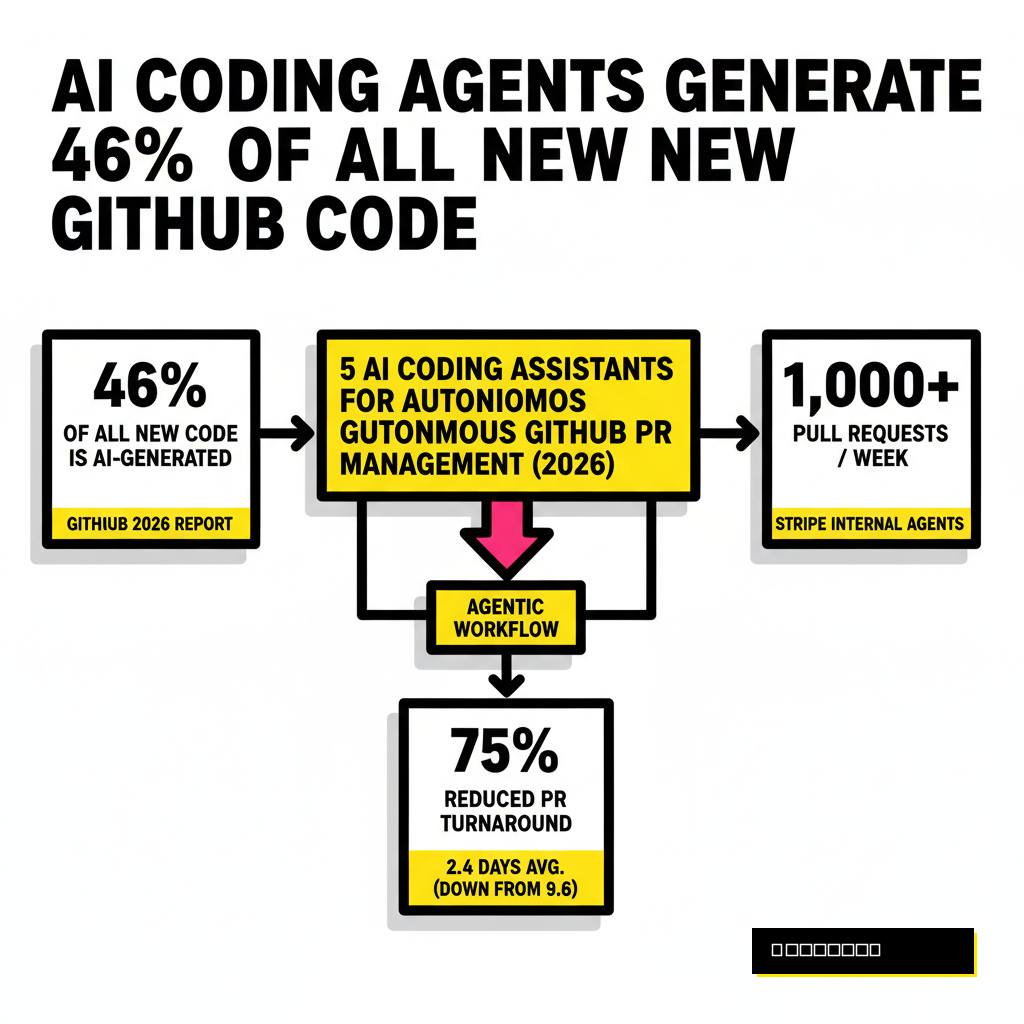
Software development has moved past the era of simple code completion. While the early 2020s focused on autocomplete, 2026 belongs to the autonomous coding agent. These systems do not just suggest the next line of code. They analyze entire GitHub repositories, plan complex features, execute multi-file refactors, and submit pull requests with minimal human intervention. According to a 2026 GitHub report, AI coding assistants now generate 46% of all new code written on the platform. This shift allows developers to move away from mundane syntax and focus on high-level architecture.
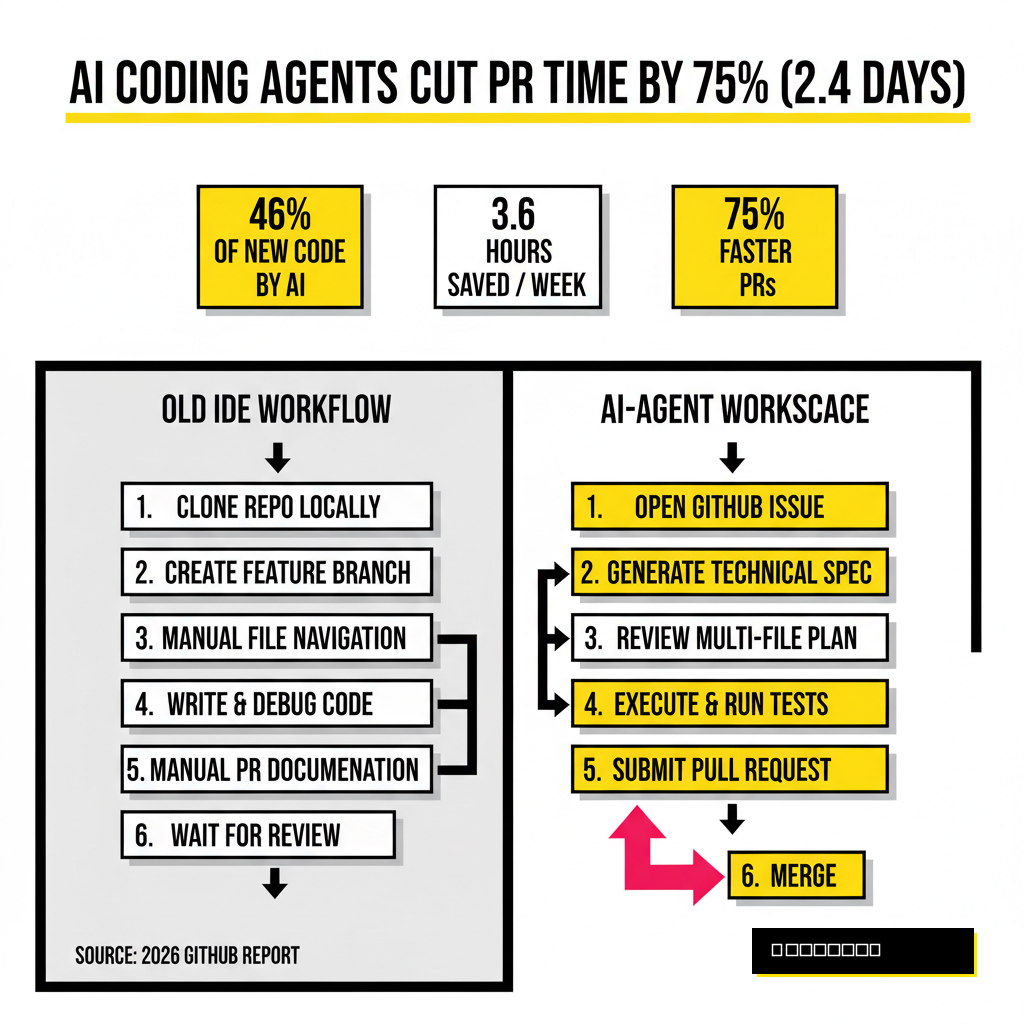
Adopting these agents is no longer an experiment for early adopters. Professional engineering teams at companies like Stripe now utilize specialized orchestration layers to manage their workflows. Stripe's internal agents currently produce over 1,000 merged pull requests per week. For smaller teams, the impact is even more visible. Pull request turnaround times have dropped by 75% on average, falling from 9.6 days to just 2.4 days for teams harnessing agentic workflows. If you are still manually writing boilerplate for every new feature, you are effectively working at a 2023 pace in a 2026 world.
GitHub Copilot Workspace: The Integrated Issue-to-PR Engine
GitHub Copilot Workspace represents the most seamless path for teams already living in the GitHub ecosystem. It functions as a web-based development environment that bridges the gap between a written issue and a merged PR. Instead of starting in an IDE, you begin at the GitHub Issue itself. By clicking "Open in Workspace," the system analyzes the issue description and generates a formal specification. This spec defines the requirements and technical approach before a single line of code is written.
Control remains central to the Workspace experience. Developers review the specification, then the system generates a plan showing every file that requires modification. Once you approve the plan, Copilot edits the files in a cloud-hosted environment. It even runs your test suite to ensure the changes do not break existing logic. Since its broader release in 2025, Workspace has become a staple for managing bug backlogs and routine feature requests. Recent data indicates that developers save approximately 3.6 hours per week by delegating these structured tasks to the Workspace agent.
Workspace Workflow
- 1. Open GitHub Issue
- 2. Generate Technical Spec
- 3. Review Multi-file Plan
- 4. Execute & Run Tests
- 5. Submit Pull Request
Standard IDE Workflow
- 1. Clone Repository Locally
- 2. Create Feature Branch
- 3. Manual File Navigation
- 4. Write & Debug Code
- 5. Manual PR Documentation
Claude Code: The Terminal Architect for High-Complexity Tasks
Anthropic's Claude Code has emerged as the performance leader for complex, multi-step engineering tasks. Living entirely in the terminal, it utilizes the latest Claude models to navigate codebases with high reasoning capabilities. As of April 2026, Claude Opus 4.7 leads the SWE-bench Verified leaderboard with a record 87.6% resolution rate. This benchmark requires an AI to fix real-world GitHub issues in popular Python repositories without human help. Claude Code's ability to handle these tasks stems from its 1-million-token context window and its sophisticated sub-agent coordination.
Professional developers often prefer Claude Code because it integrates directly with local development tools. It can execute shell commands, install dependencies, and run linters to fix type errors iteratively. Unlike cloud-only tools, it works where your code lives. Anthropic also introduced a "SKILL.md" ecosystem that allows teams to teach the agent specific deployment playbooks or internal coding standards. By integrating these custom instructions, the agent produces pull requests that already align with your team's unique style guides. This level of customization is essential for maintaining high ranking in modern search environments, a concept explored in our guide on 8 AEO tactics for search visibility.
Devin: The End-to-End Sandbox Specialist
Cognition Labs pioneered the autonomous agent space with Devin, and the 2.2 version released in 2026 remains a powerhouse for end-to-end tasks. Devin operates within its own sandboxed cloud environment. This environment includes a browser, a terminal, and a code editor, allowing the agent to test its own work exactly like a human engineer would. If a task involves web scraping or testing a frontend UI, Devin can launch a browser, navigate to the site, and verify the implementation visually. This capability makes it particularly effective for legacy migrations and third-party API integrations.
Enterprise teams at institutions like Goldman Sachs and Nubank have deployed Devin to handle repetitive migration work. In one reported case at Nubank, Devin delivered migrations 8 to 12 times faster than manual processes while reducing costs significantly. The agent's "Interactive Planning" feature allows developers to validate the technical approach before execution begins. This prevents the agent from going down a rabbit hole of incorrect logic. While it might be slower than a raw CLI agent, the safety of the sandbox ensures that AI-generated changes do not pollute your local environment until they are fully verified.
OpenHands and Sweep: Open Ecosystems for PR Automation
OpenHands, formerly known as OpenDevin, provides a community-driven alternative to proprietary agents. With over 147,000 GitHub stars, it has become the standard for developers who want model-agnostic autonomy. It allows you to swap between OpenAI, Anthropic, and Google Gemini models depending on the task's complexity or cost constraints. This flexibility is vital for organizations that want to avoid vendor lock-in. OpenHands excels at repetitive maintenance tasks like code reviews, test generation, and documentation updates across large monorepos.
Sweep takes a different approach by focusing specifically on the GitHub workflow. It operates as a GitHub App that listens for new issues. When an issue is labeled for Sweep, the agent analyzes the repository, writes the fix, and opens a pull request automatically. It is particularly adept at handling small, well-defined bugs that often clutter a developer's backlog. By automating these "micro-tasks," Sweep allows senior engineers to focus on architectural decisions. For those looking at how multimodal models are changing broader automation, examining multimodal AI in support automation offers a clear parallel to these coding workflows.
| Agent | Best For | Key Differentiator |
|---|---|---|
| Claude Code | High-Complexity Logic | Terminal-native with 1M token context |
| Copilot Workspace | Enterprise Teams | Native GitHub issue-to-PR integration |
| Devin | End-to-End Autonomy | Fully sandboxed cloud environment |
| OpenHands | Open Source/Privacy | Model-agnostic and community-driven |
| Sweep | Bug Backlogs | GitHub App listening for labeled issues |
Implementation & Governance: Mastering the Review Cycle
Deploying autonomous agents requires a fundamental shift in how we think about code review. While these tools increase throughput, they also introduce new risks. A 2025 study by CodeRabbit found that AI-generated pull requests contained 2.74 times more security vulnerabilities than human-authored code. This does not mean the agents are incompetent. It means they prioritize functional correctness over secure architectural patterns. Organizations must implement strict governance to catch these issues before they reach production.
Successful teams use a risk-tiered review strategy. Low-risk changes, such as documentation updates or CSS fixes, can be auto-approved by secondary AI agents. High-risk changes involving authentication, data schemas, or payment logic still require a senior human reviewer. Never delegate the final understanding of the code to the machine. You are still responsible for the logic that hits your production servers. By using a combination of automated linters, security scanners, and manual oversight, you can enjoy the 75% speed boost of AI agents without compromising the stability of your system.