The Great Un-Screening
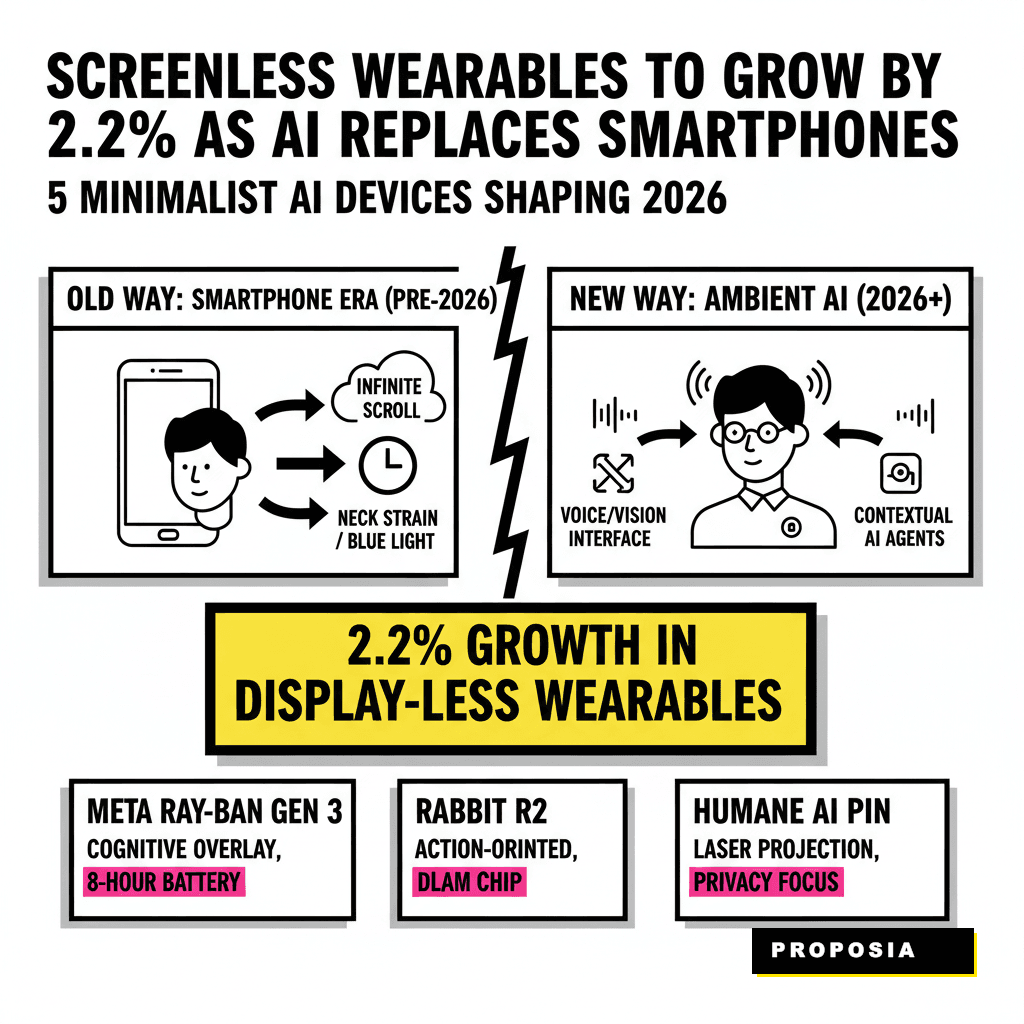
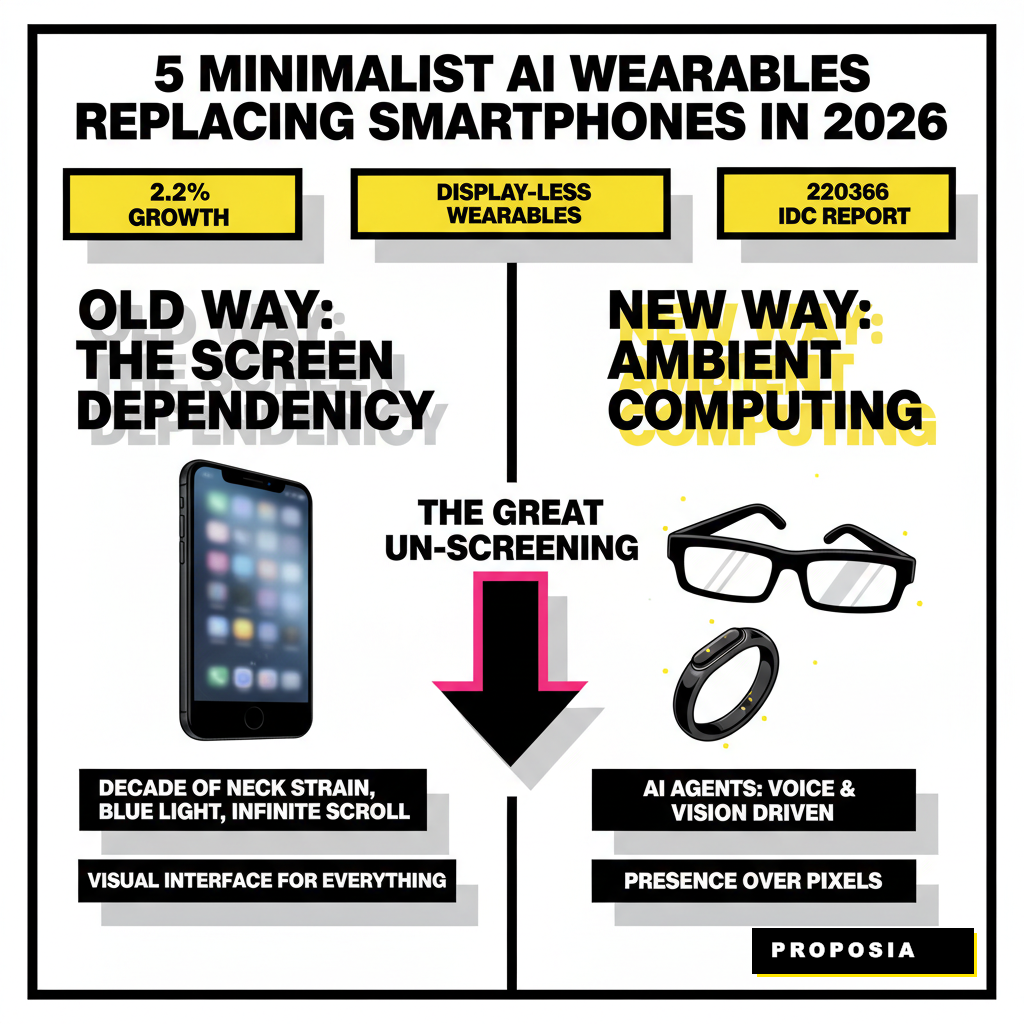
The slab of glass in your pocket is finally losing its grip. For over a decade, we accepted the smartphone as the unavoidable center of our digital lives. We tolerated the neck strain, the blue light, and the constant pull of the infinite scroll because there was no other way to access the internet. That changed over the last eighteen months. As AI agents became more capable of handling complex tasks through voice and vision, the need for a visual interface began to evaporate.
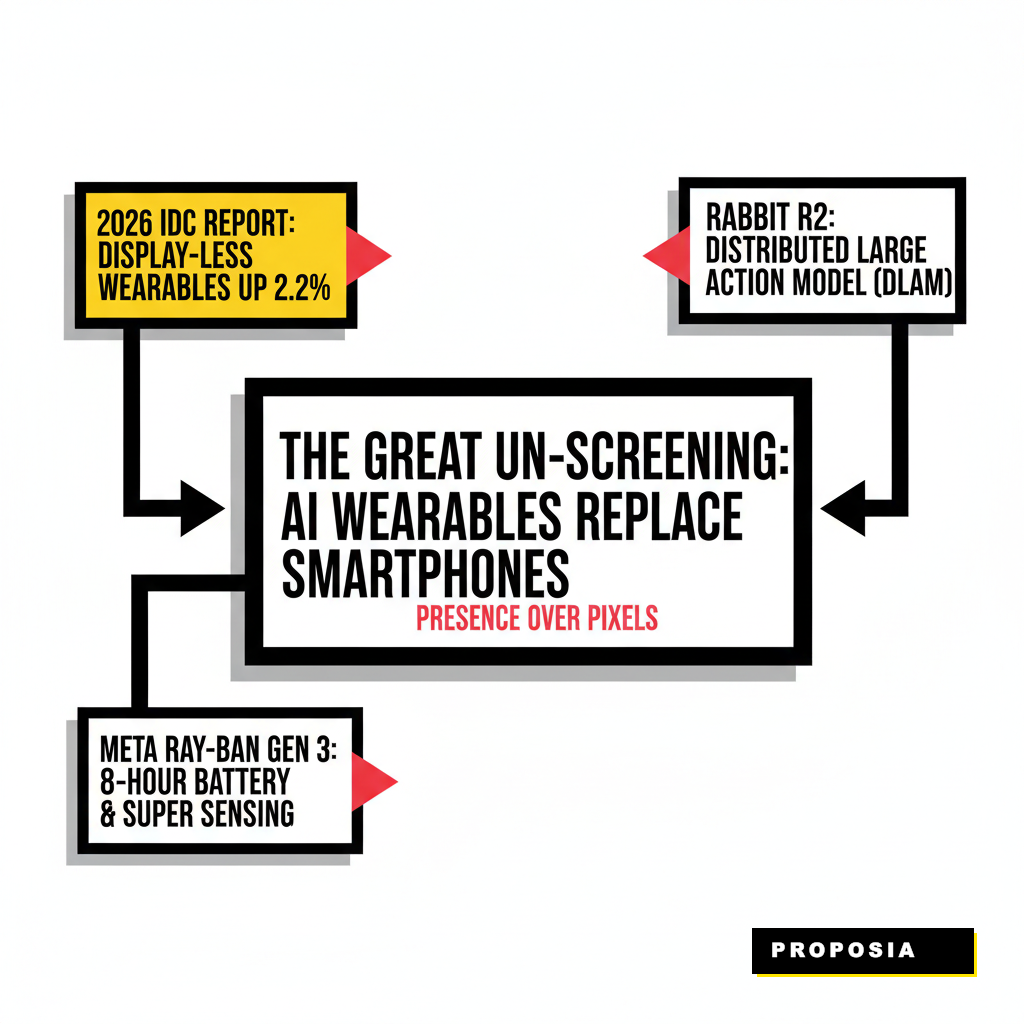
We are now in the era of ambient computing. This shift is not about adding more gadgets to your life, but about thinning the layer between you and the information you need. According to a 2026 IDC report, shipments of display-less wearables are projected to grow by 2.2 percent this year as consumers prioritize presence over pixels. People are realizing that an AI agent living in their glasses or on their lapel is often more efficient than an app on a screen. Here are the five devices leading this charge.
Meta Ray-Ban Gen 3: The Eyes and Ears of Your Agent
Meta officially moved the needle with the release of the third-generation Ray-Ban smart glasses in March 2026. While the previous versions were essentially cameras with speakers, the Gen 3 model functions as a full-scale cognitive overlay. The hardware features a new Qualcomm Snapdragon AR1 Plus chipset, which enables what Meta calls "Super Sensing." This allows the glasses to maintain a continuous, low-power awareness of your surroundings without draining the battery in an hour.
I have used these to navigate unfamiliar cities and manage grocery lists in real time. Instead of looking down at a map, you simply walk, and the audio cues guide you based on the actual storefronts you see. The device also handles live translation with near-zero latency, making it a viable tool for international business. The most significant update is the "Apparel" variant, which offers a thicker frame to house a battery capable of 8 hours of mixed use. This is the first time a pair of smart glasses has truly felt like an all-day replacement for the quick-glance functions of a phone.
Meta Gen 2 (2024)
- 12MP Camera
- Look and Ask AI
- 4-hour battery life
- Basic audio quality
Meta Gen 3 (2026)
- Advanced 4K Spatial Sensor
- Super Sensing (Continuous AI)
- 8-hour battery (Apparel model)
- Wind-resistant 5-mic array
Rabbit R2: The Action-Oriented Companion
Rabbit had a polarizing start, but the R2 has matured into a powerful execution tool. The core of its success lies in the Distributed Large Action Model (DLAM). Unlike standard language models that just talk, the DLAM can actually navigate the web and apps to perform tasks. If you tell the R2 to book a flight and a car for a conference, it does not just show you options; it navigates the checkout pages and presents you with a final confirmation. This reflects the shift toward agentic workflows that we have documented in our previous technical breakdowns.
The R2 hardware is more rugged than the R1, featuring a tactile scroll wheel and a rotating camera that feels more intentional. It functions as a dedicated "doer" that sits in your palm or clips to a bag. While it still has a small screen, the interface is designed for confirmation rather than consumption. You spend seconds looking at it, not minutes. For anyone trying to reclaim their attention span while staying productive, the R2 provides a necessary buffer against the notification-heavy ecosystem of iOS and Android.
Limitless Pendant: The External Hard Drive for Your Brain
The Limitless Pendant has become the gold standard for knowledge workers in 2026. It is a tiny, magnetic clip that records and transcribes every conversation you have, provided you have consent. It solves the problem of the "lost thought." When you are in a meeting or a casual brainstorming session, the Pendant is constantly indexing the dialogue. Later, you can ask it, "What was the specific feedback John gave about the pricing model?" and it will play back the exact audio and provide a summary.
With a 100-hour battery life, it is the only wearable that effectively eliminates charging anxiety. It integrates directly with Slack and Google Meet, ensuring that your physical world conversations are as searchable as your digital ones. This level of passive utility is what makes it a phone killer. You no longer need to pull out your phone to take a note or record a voice memo. The Pendant is already doing it, and it is doing it better than a general-purpose device ever could. Such efficiency comes at a cost, however, as the 2026 compute crunch has pushed the subscription price for unlimited AI processing to roughly thirty dollars a month.
Humane AI Pin 2: The Refined Projection
After a difficult launch in 2024, Humane returned in April 2026 with a hardware refresh that fixed almost every major complaint. The Pin 2 features a significantly more efficient laser ink display that remains visible even in direct sunlight. They also solved the thermal issues that plagued the first generation by moving the heavy processing to the cloud and optimizing the on-device NPU for ambient tasks. It feels like a piece of high-end jewelry rather than a gadget.
The AI Pin 2 is particularly effective for real-time health and nutrition tracking. You can hold a piece of fruit in front of the camera and ask for its nutritional profile, and the laser will project the data directly onto your palm. It is a futuristic experience that makes the smartphone feel clunky and outdated. While it has not fully replaced the phone for everyone, it has captured a significant segment of the market that values a screen-free lifestyle. For these users, the Pin 2 is the primary gateway to the internet, handling everything from messaging to complex queries with simple gestures and voice commands.
| Device | Primary Interface | Best For |
|---|---|---|
| Meta Ray-Ban Gen 3 | Audio/Vision | Navigation & Translation |
| Rabbit R2 | Voice/Tactile | Automating Digital Tasks |
| Limitless Pendant | Ambient Audio | Meeting Memory |
| Humane AI Pin 2 | Laser Projection | Nutrition & Contextual Info |
Oura Ring Gen 4: The Silent Health Guardian
The Oura Ring Gen 4 is the most minimalist of all. It does not have a camera, a screen, or a projector. Instead, it focuses on the internal data that a smartphone usually ignores. By 2026, the Oura app has evolved from a simple data dashboard into a proactive health coach. It uses generative AI to analyze your biometric trends and offer specific advice. If your heart rate variability is low, it might suggest a specific breathing exercise or tell you to skip your morning coffee.
Independent validation studies have shown the Oura Ring 4 to be 99.9 percent reliable for resting heart rate when compared to medical-grade ECG devices. This level of accuracy has made it a staple for anyone who wants to monitor their longevity without the distraction of a screen on their wrist. It is the ultimate passive wearable. You put it on and forget about it for a week. While the other devices on this list handle your external world, the Oura Ring 4 is the master of your internal state. It proves that the most impactful technology is often the kind you cannot see.
Choosing Your Ambient Stack
You do not need all five of these devices to replace your phone. Most early adopters are building a "stack" that fits their specific lifestyle. A common combination is the Meta Ray-Bans for outdoor use and the Limitless Pendant for work. This pairing covers vision, audio, and memory, leaving the smartphone as nothing more than a high-powered router that stays in a bag or a drawer. The goal is to move away from the constant distraction of the screen and back toward the physical world.
As AI continues to advance, the hardware will only get smaller and more discreet. The real victory of 2026 is not the technology itself, but the freedom it has provided. We are finally learning to use the internet without letting it consume our attention. Whether you prefer a ring, a pair of glasses, or a clip-on pin, the future of computing is clearly no longer found in your pocket. It is all around you, waiting for your command.