The 2026 Tax Shift: Why Creators Need Autonomous Agents
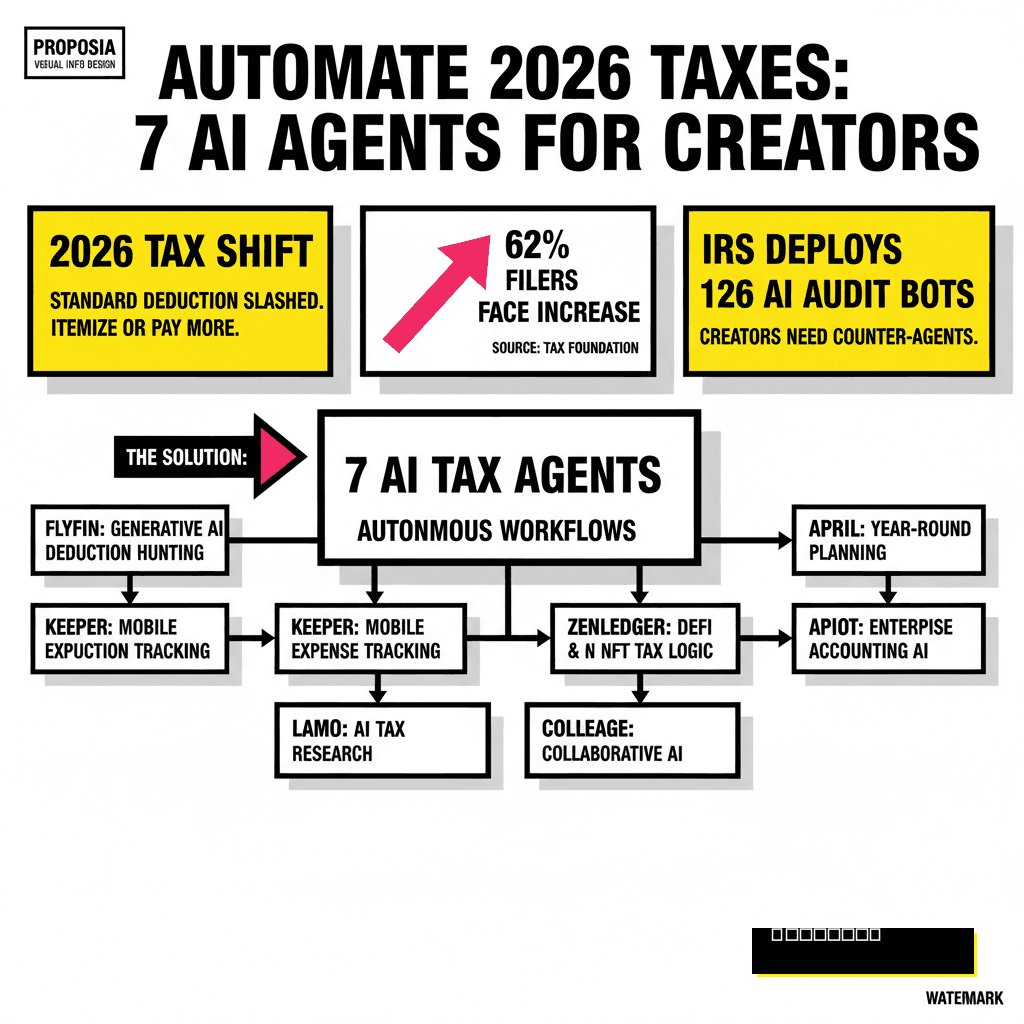
The 2026 tax season marks a massive transition for the creator economy. Most of the individual tax provisions from the 2017 Tax Cuts and Jobs Act (TCJA) expired at the end of 2025. This sunsetting means tax rates are reverting to pre-2018 levels, and the standard deduction has been slashed. For a single creator, the standard deduction dropped from approximately $15,450 in 2024 to just $8,350 in 2026. This change forces millions of creators to itemize their deductions to avoid a significant tax hike. According to a 2026 report from the Tax Foundation, over 62 percent of filers are facing a tax increase this year. The complexity of finding every possible write-off to offset these higher rates is no longer a task for a human with a spreadsheet. It is a job for autonomous AI agents.
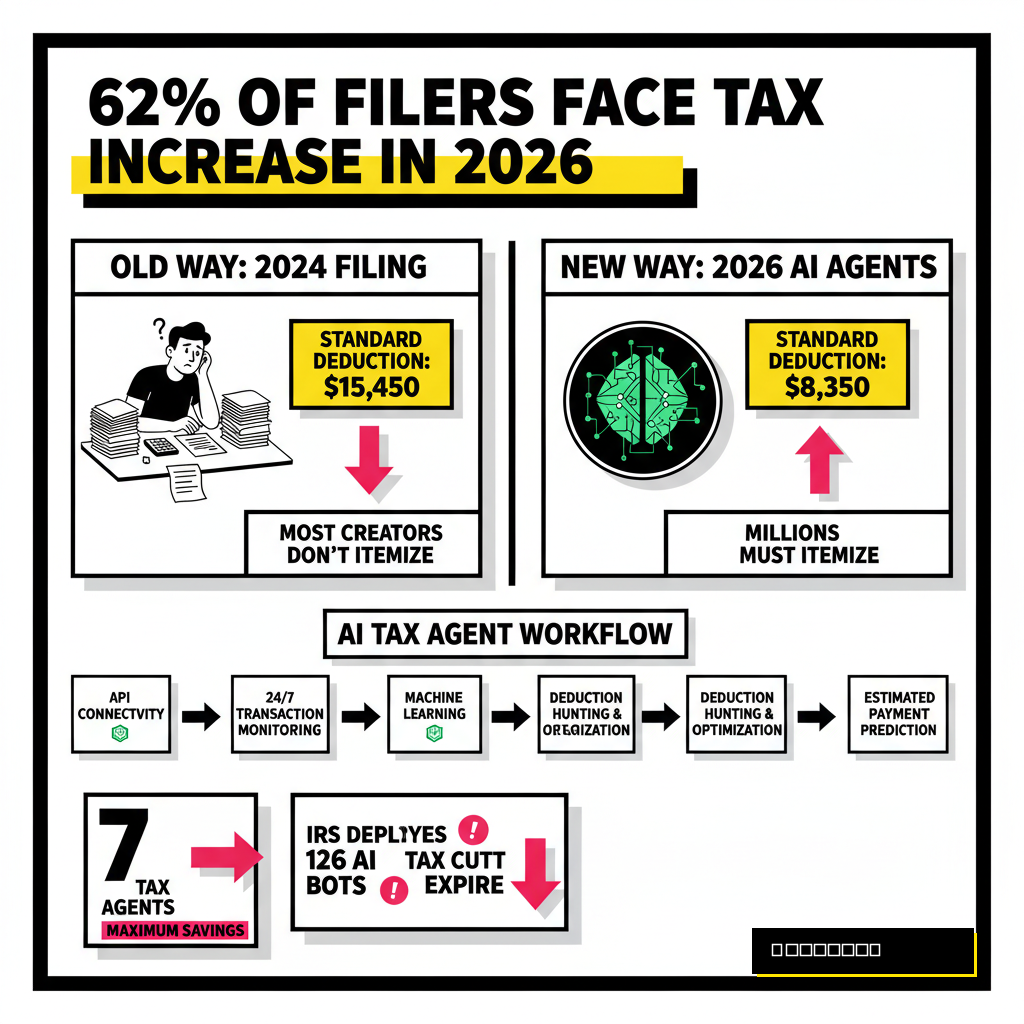
These agents operate differently than the static software of the past decade. They do not wait for you to upload a PDF. They connect directly to your financial stack via APIs, monitoring transactions 24/7. They apply machine learning to categorize expenses, hunt for obscure 1099 write-offs, and even predict your quarterly estimated payments with startling accuracy. While the IRS has deployed its own fleet of 126 AI applications for audit selection, creators are fighting back with their own agentic workflows to ensure total compliance and maximum savings.
The Top 7 Autonomous AI Tax Agents for 2026
Choosing the right agent depends on the complexity of your revenue streams. If you are balancing YouTube ad sense, affiliate marketing, and a side of crypto trading, your requirements differ from a pure-play freelance designer. Here are the elite agents dominating the 2026 landscape.
| AI Agent | Primary Strength | Best For |
|---|---|---|
| FlyFin | Generative AI Deduction Hunting | High-earning 1099 creators |
| Keeper | Mobile-first expense tracking | Gig workers and micro-influencers |
| ZenLedger | DeFi and NFT tax logic | Web3 and Crypto-native creators |
| April | Embedded year-round planning | Fintech users (Mercury/Brex) |
| Lamo | AI-powered tax research | Complex scenario planning |
| Intuit Assist | Scale and Audit Defense | Traditionalists wanting AI speed |
| ChatFin | Real-time transaction intelligence | Creators with high transaction volume |
1. FlyFin: The 24/7 AI Accountant
FlyFin remains the heavyweight for the self-employed. Its generative AI engine scans your bank statements and categorizes every expense against more than 200 possible deduction categories. What sets FlyFin apart in 2026 is its hybrid approach. After the AI identifies your deductions, a human CPA reviews the work before filing. This provides the speed of an agent with the liability protection of a human professional. For creators who often mix personal and business spending on a single card, FlyFin is excellent at untangling the mess without manual intervention.
2. Keeper: The Deduction Hunter
Keeper is built for the mobile-first creator. It functions like a concierge that texts you whenever it finds a potential business expense. Did you buy a new camera lens or pay for a high-speed internet upgrade? Keeper flags it instantly. By the time April 15 rolls around, your Schedule C is already 95 percent complete. It is particularly effective for those who find traditional tax software intimidating and prefer a conversational interface.
3. ZenLedger: The Web3 Specialist
For creators earning in Ethereum or selling NFTs, ZenLedger is indispensable. The 2026 tax code introduces stricter reporting for digital assets through the new Form 1099-DA. ZenLedger's agent connects to over 400 exchanges and 30 DeFi protocols to aggregate your cost basis and capital gains. It handles the "One Big Beautiful Bill" Act requirements with ease, ensuring your crypto activity doesn't trigger an automated IRS flag.
4. April: The Embedded Intelligence
April does not exist as a standalone app you download. Instead, it is embedded into the financial tools you already use, like Mercury or high-end payroll systems. It provides a real-time view of your tax liability throughout the year. As your income shifts, April adjusts your estimated payments, preventing the dreaded April surprise. It is the gold standard for creators who want their tax strategy to be an invisible, background process.
How to Deploy Your Autonomous Tax Agent
Setting up an AI tax agent is a one-time process that saves hundreds of hours annually. The goal is to move from manual data entry to a system of automated verification. Most creators can follow a standard deployment path to get their agent running before the next quarterly deadline.
First, link your primary business accounts using a secure protocol like Plaid or Finicity. The agent will then ingest up to 24 months of historical data to learn your spending patterns. For creators, this often involves training the agent on what constitutes a "content production" expense versus a personal meal. Once the agent is trained, it operates autonomously. You only need to intervene when the agent flags a "high-uncertainty" transaction. This is similar to how you might approach building an autonomous research agent for crypto alpha—you set the parameters, and the agent handles the heavy lifting.
Navigating the 2026 Compliance Landscape
The IRS is not sitting idle while creators automate their taxes. In early 2026, the agency confirmed it is running 126 active AI applications to modernize enforcement. These systems are designed to identify discrepancies in 1099 reporting and flag returns with unusual deduction-to-income ratios. Using your own AI agent is the only way to match the precision of the IRS's automated audits. By utilizing an agent that follows a strict logic-based compliance framework, you ensure that every deduction is backed by a clear digital trail.
One major hurdle for creators in 2026 is the Qualified Business Income (QBI) deduction, which is also set to expire or be heavily modified. AI agents are currently the only tools updated in real-time to handle these shifting legislative goalposts. They can simulate different filing scenarios to determine if you should accelerate certain business purchases into the current year or defer them. This level of proactive planning was previously reserved for those paying five-figure retainer fees to boutique accounting firms.
Security, Privacy, and the EU AI Act
When you grant an AI agent access to your bank accounts, security is the paramount concern. In 2026, the EU AI Act has set the global standard for how financial AI must handle user data. High-risk AI systems, which include many financial agents, are now required to maintain rigorous logging, transparency, and human oversight. Most top-tier agents like TaxBit and FlyFin have already achieved SOC 2 Type II compliance and integrated the transparency requirements mandated by the EU.
Traditional Accountant
- Hourly fees ($200-$500/hr)
- Reactive year-end filing
- Prone to manual entry errors
- Limited to business hours
AI Tax Agent
- Fixed subscription costs
- Proactive 24/7 monitoring
- Data-driven accuracy
- Instant scenario modeling
Privacy is also a competitive advantage. The best agents use local-first processing or zero-knowledge proofs to ensure that your raw transaction data is never used to train global models without your consent. As a creator, your financial data is your intellectual property. Protecting it while still getting the benefits of automation is the delicate balance you must maintain. Always verify that your chosen agent offers bank-level encryption and a clear data-deletion policy.
Final Thoughts for the 2026 Filing Year
The era of the "tax season" is effectively over. In its place is a continuous, automated process of financial optimization. By deploying an autonomous agent, you are not just filing forms; you are building a defensive wall against a more aggressive IRS and a more complex tax code. The cost of these agents is negligible compared to the average $3,700 in extra write-offs they discover. As you focus on growing your audience and refining your craft, let the robots handle the math. They do not get tired, they do not miss receipts, and they certainly do not mind working while you sleep.