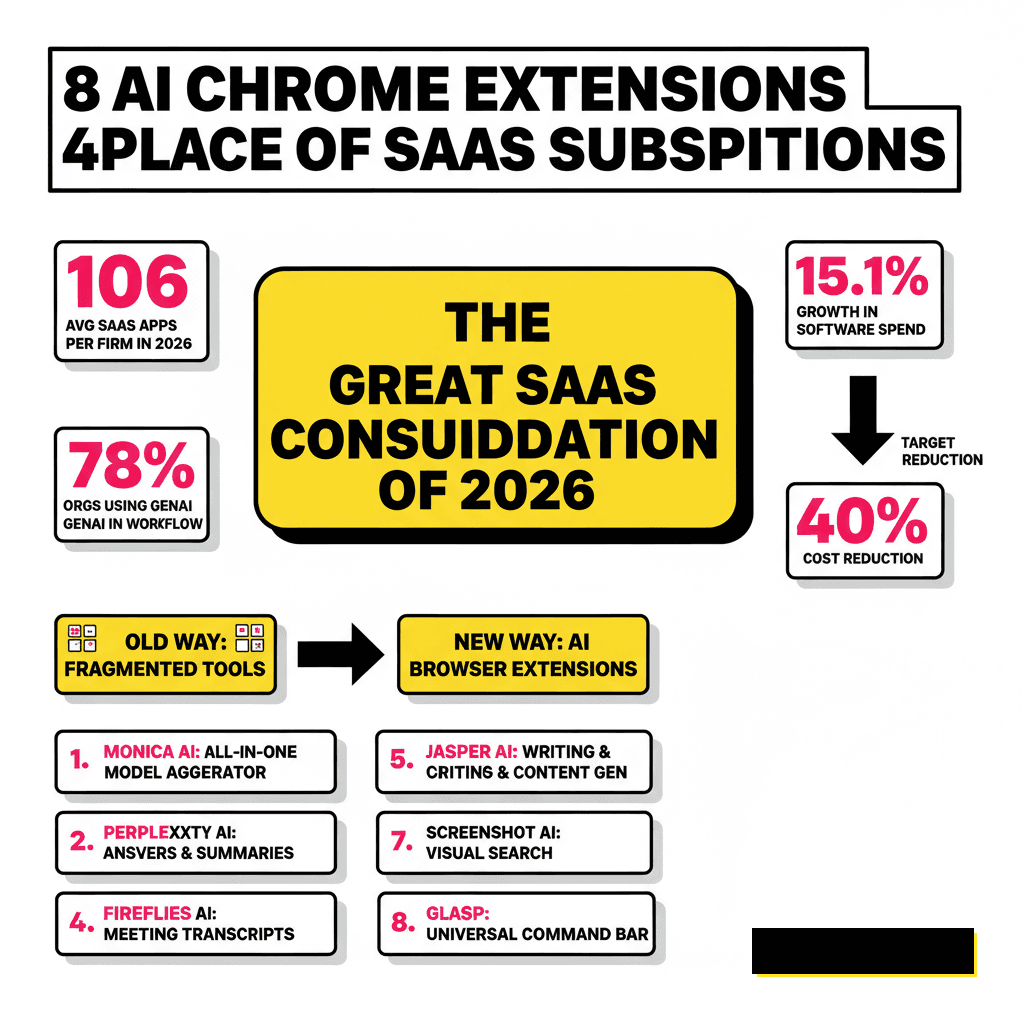
The Great SaaS Consolidation of 2026
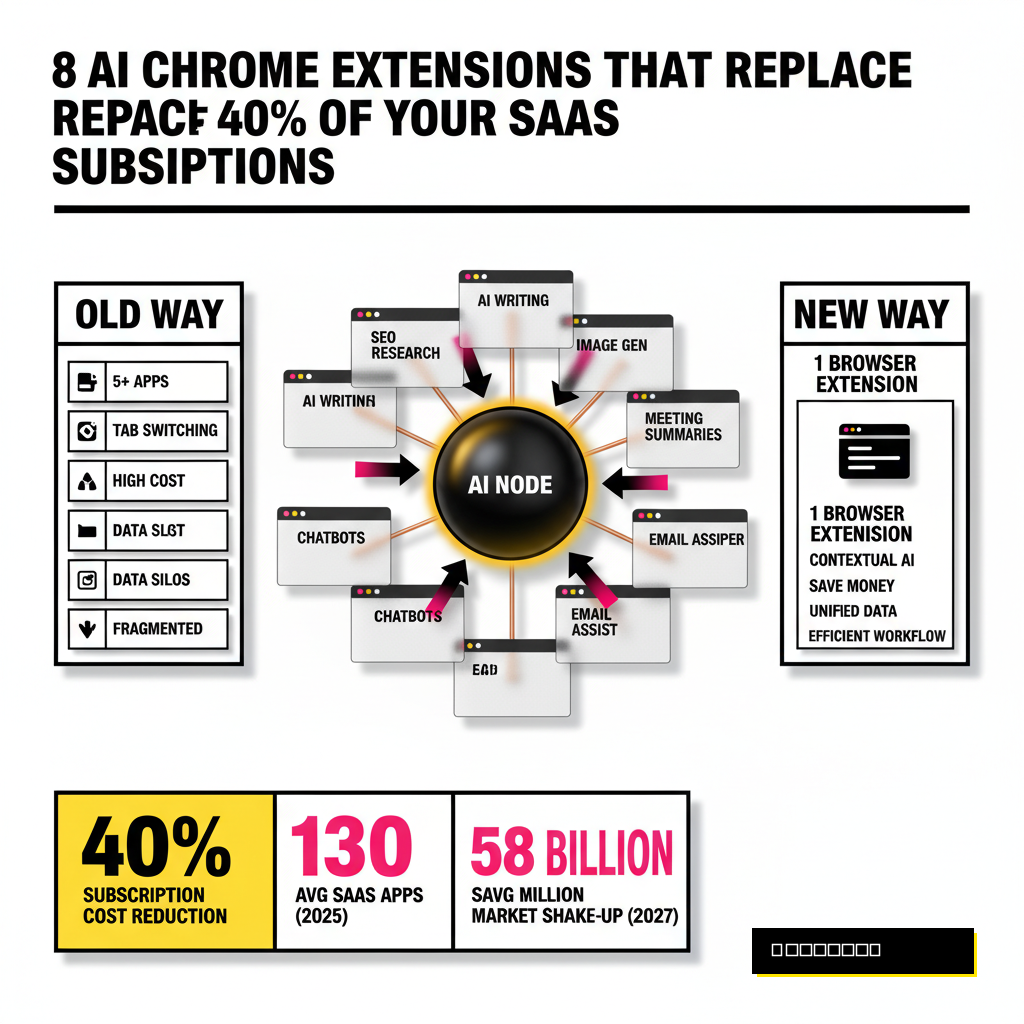
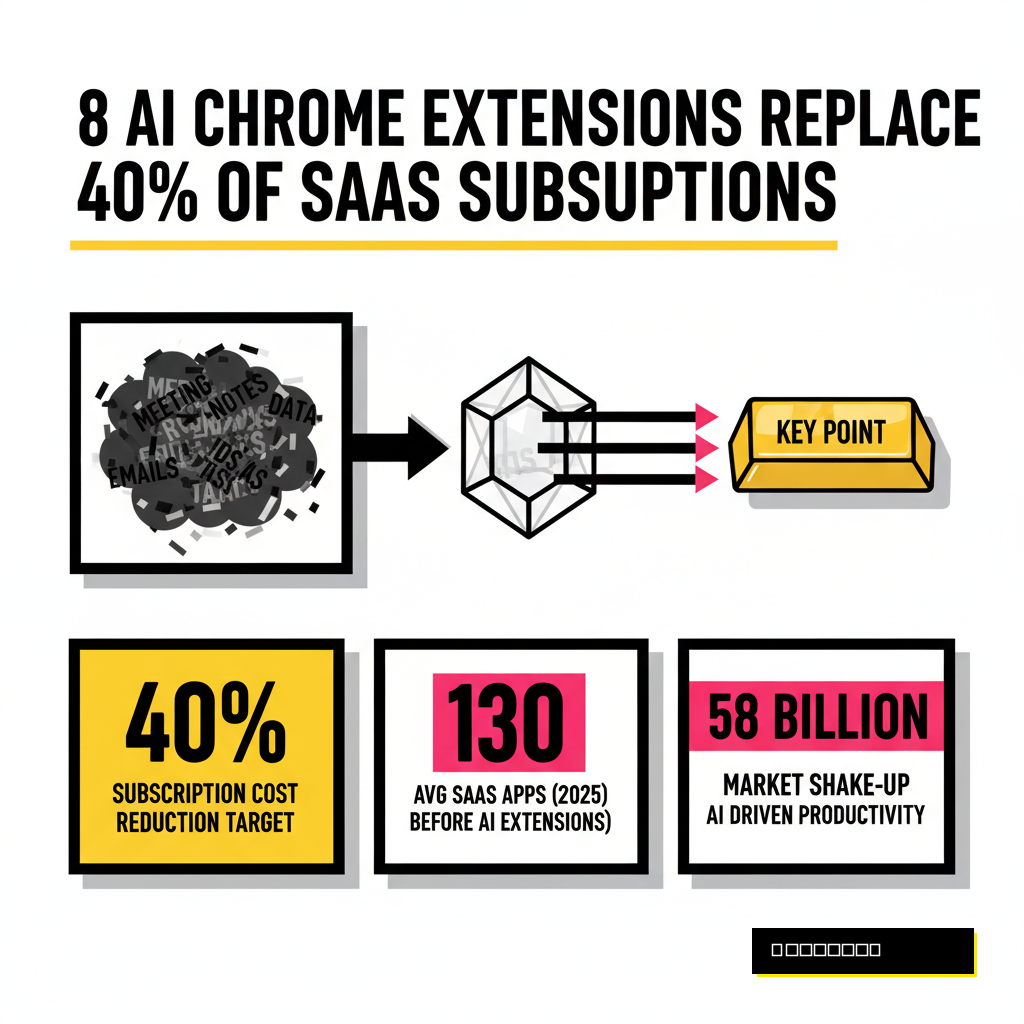
Managing a creator business in 2026 often feels like death by a thousand $19 monthly bills. You start with a subscription for SEO research, add another for AI writing, and eventually realize your credit card statement looks like a graveyard of apps you barely touch. According to a 2025 BetterCloud report, the average organization was juggling 130 different SaaS tools. By early 2026, that number began to drop as creators realized that their browser could do the heavy lifting for them. The era of the fragmented point solution is ending. Gartner recently predicted a $58 billion market shake-up in productivity tools through 2027, driven by the rise of AI agents that live directly inside your browser.
Browser extensions have transformed from simple ad-blockers into full-scale operating systems. Instead of paying for five different AI models, you can now access GPT-5, Claude 4, and Gemini 2 through a single sidebar. This shift allows you to reclaim your focus and your budget. We are seeing a move away from tab-switching and toward contextual intelligence. When your AI knows what you are looking at, it becomes infinitely more useful than a standalone chat window. Here are the eight power-user extensions that will help you slash your software spend by 40% this year.
1. Monica AI: The All-in-One Model Aggregator
Monica AI stands as the heavy hitter for anyone tired of paying for multiple LLM subscriptions. Most creators maintain a ChatGPT Plus account and a Claude Pro account for different tasks. Monica collapses these into one interface. It provides a sidebar that works on any website, allowing you to switch between GPT-5, Claude 4.5, and even DeepSeek with a single click. This eliminates the need for separate $20 per month bills for each model. The extension also handles image generation and PDF analysis, replacing tools like ChatPDF or Midjourney for basic creative needs.
| Feature | Monica AI | Sider | Merlin |
|---|---|---|---|
| Model Variety | Highest (10+ models) | High (6+ models) | Moderate (4+ models) |
| Best Use Case | Power Users | Clean Interface | Summarization |
| Free Tier | Credits Based | 30 Queries/Day | Limited |
Sider and Merlin offer similar functionality, but Monica currently leads in model depth. For those worried about data sovereignty while using these cloud-based sidebars, our local LLM guide covers how to run models on your own hardware for maximum privacy. Integrating a sidebar into your workflow saves roughly 30 minutes of copy-pasting per day. You can summarize a long-form article, draft a response, and generate a supporting image without ever leaving the original tab. This contextual awareness is exactly why point solutions are losing their grip on the market.
2. Harpa AI: Replacing Your Automation Stack
Harpa AI is not just a chatbot. It is a web automation agent that can replace your Zapier or Make.com subscriptions for browser-based tasks. It monitors web pages for changes, scrapes data into spreadsheets, and triggers webhooks based on specific conditions. If you currently pay for a tool to track competitor pricing or to alert you when a new job post appears, Harpa can do that for free. It runs locally on your machine, which means your data does not sit on a third-party server. This makes it a formidable choice for creators who handle sensitive competitive intelligence.
Productivity experts often overlook the cost of small automation tasks. A $30 per month Zapier bill adds up quickly when you are only syncing a few rows of data. Harpa allows you to build custom commands that combine AI logic with browser actions. You could set it to visit a list of URLs, summarize the latest news from each, and send that summary to your Slack channel. This level of autonomy was previously reserved for expensive enterprise platforms. Now, it lives in a 15-megabyte extension.
3. Wiseone: The Research Assistant for Deep Work
Reading complex reports or academic papers usually requires a separate subscription to a tool like Genei or lateral.ai. Wiseone replaces these by living inside your browser and providing instant cross-referencing. When you encounter a difficult concept, you can hover over it for a simplified explanation. The cross-check feature is particularly vital in 2026. It pulls data from multiple reliable sources to verify the claims in the article you are reading. This helps you maintain the high standards required for verified human content, ensuring your work remains factually sound.
Efficiency in research is the silent killer of creator profit margins. If you spend four hours researching a topic that should take one, you are effectively cutting your hourly rate by 75%. Wiseone shortens the synthesis phase by providing a "Focus" mode that highlights the most important sentences in any long-form text. It also offers an "Ask Anything" box that only uses the current page as its knowledge base. This prevents the AI from hallucinating external information, which is a common frustration with general-purpose chatbots.
4. Compose AI: Writing Without the Jasper Price Tag
Specialized AI writing platforms like Jasper or Copy.ai often cost between $40 and $100 per month. For many creators, this is an unnecessary expense when Compose AI provides similar autocomplete and rewriting features for free. It integrates directly into your email, Google Docs, and social media platforms. Instead of moving your draft to a separate app, you type naturally and let the AI finish your sentences. It learns your specific tone over time, which reduces the need for heavy editing. This extension is perfect for handling the high volume of low-stakes writing that clutters a creator's day.
The Old Way (SaaS)
- Open separate writing app
- Copy-paste context into tool
- Generate draft and edit
- Copy-paste back to email/CMS
- Cost: $49/month+
The Extension Way
- Type directly in the browser
- Autocomplete handles the bulk
- Rewrite in-line with shortcuts
- No context-switching required
- Cost: Free / $10/month
Speed is the primary benefit here. When you can draft a professional outreach email in 20 seconds without leaving your inbox, your throughput increases significantly. Compose AI also includes a "Shorten" and "Expand" feature that helps you fit your content into specific formats like tweets or LinkedIn posts. It replaces the need for dedicated social media caption generators. By keeping your writing environment unified, you avoid the cognitive load of switching between different user interfaces.
5. Glasp: Your Social PDF and Web Highlighter
Glasp is a unique tool that replaces paid research organizers like Readwise for some users. It allows you to highlight text on any webpage or PDF and instantly save it to a public or private profile. The real power comes from its YouTube summary feature. When you open a video, Glasp provides a full transcript and an AI-generated summary in the sidebar. This replaces the need for separate YouTube-to-text services. It creates a digital trail of your learning that you can export directly to Notion or Obsidian, acting as a bridge between your browser and your long-term knowledge base.
Collaboration is another area where Glasp shines. You can see what other experts in your field are highlighting, which provides a curated feed of information that is far more valuable than a generic algorithm. For researchers, this social element replaces the need for expensive industry newsletters or community-based research groups. It turns the act of browsing into an act of collective intelligence building. You are no longer just consuming content; you are archiving and connecting ideas for future projects.
6. Fireflies & Perplexity: The Intelligence Duo
The final pieces of the subscription-killing puzzle are Fireflies and the Perplexity extension. Fireflies replaces the need for an expensive meeting recorder like Otter.ai for Google Meet or Zoom calls. It transcribes your conversations in real-time and provides a searchable database of action items. This ensures that no detail is lost in the noise of a busy schedule. Meanwhile, the Perplexity extension replaces your need for a traditional search engine or a subscription to high-end market research reports. It provides cited, verified answers to complex questions, acting as a replacement for both Google and specialized research desks.
Using these eight tools in combination allows a solo creator to operate with the efficiency of a small team. You are effectively replacing a copywriter, a research assistant, an automation engineer, and a transcriptionist with a set of browser plugins. The cumulative savings often exceed $200 per month, which can be reinvested into higher-leverage areas of your business. As we move deeper into 2026, the competitive advantage will go to those who can do more with less. Your browser is no longer just a window to the web. It is the only office you need.