The Citation Gap: Why Ranking #1 Is No Longer Enough
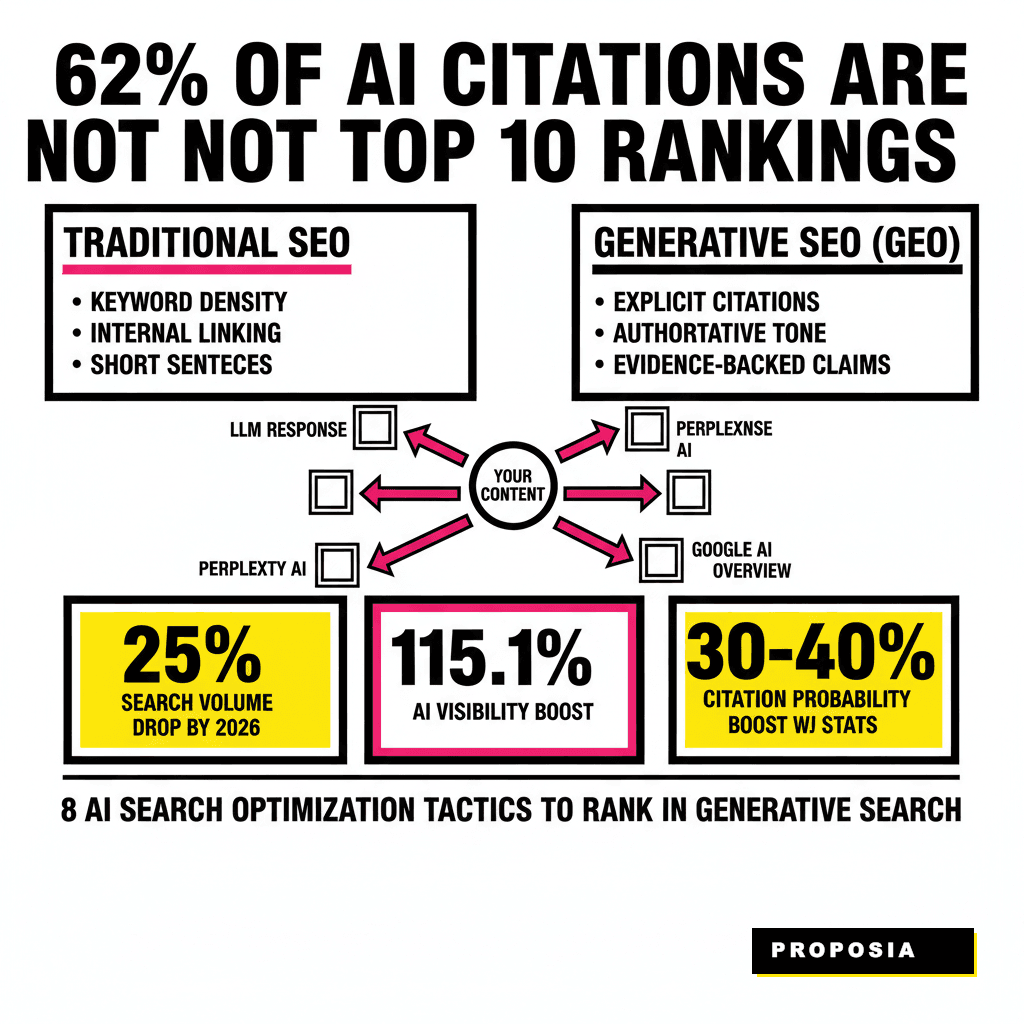
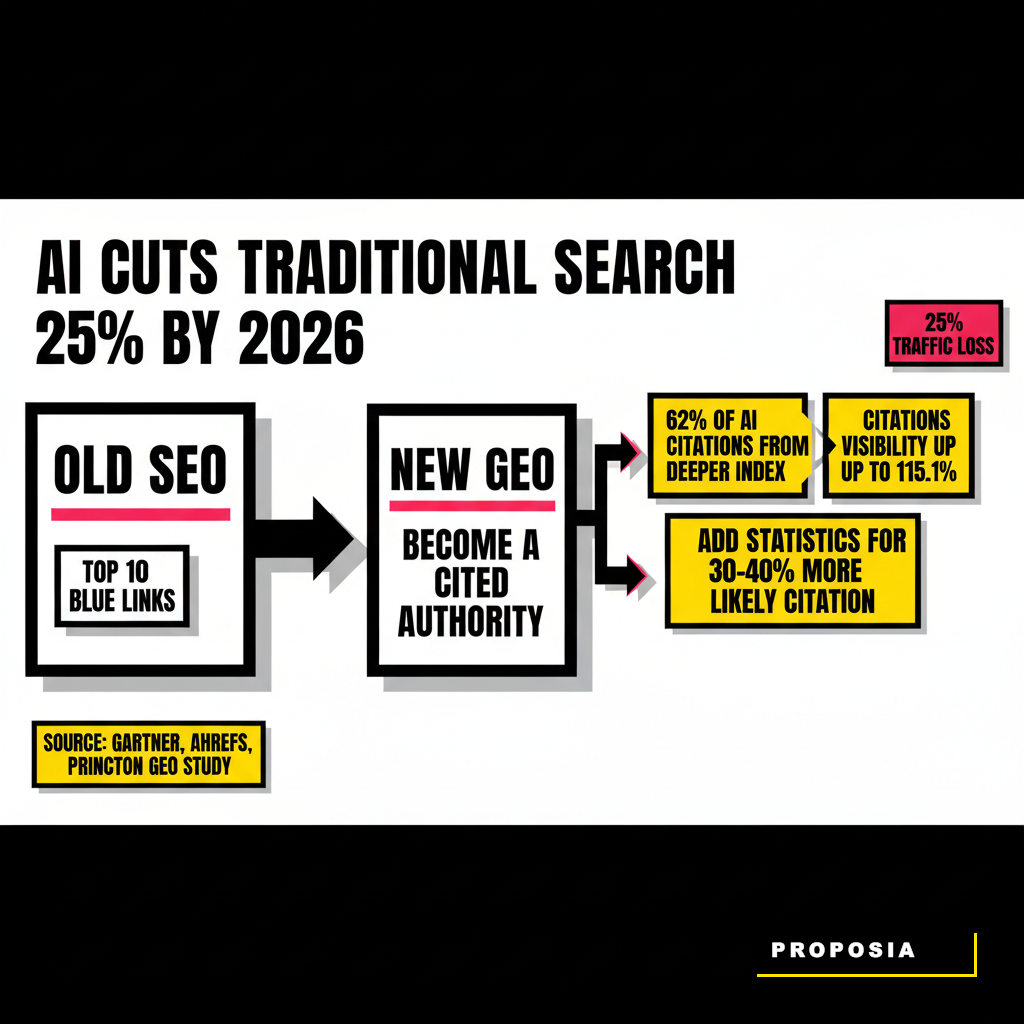
Search is undergoing its most significant structural shift since the late nineties. According to a 2024 report by Gartner, traditional search engine volume is projected to drop 25% by the end of 2026. This decline does not mean people have stopped asking questions. Instead, they have moved toward generative engines like Perplexity, ChatGPT, and Google’s AI Mode. These platforms do not just provide links. They synthesize answers and cite sources.
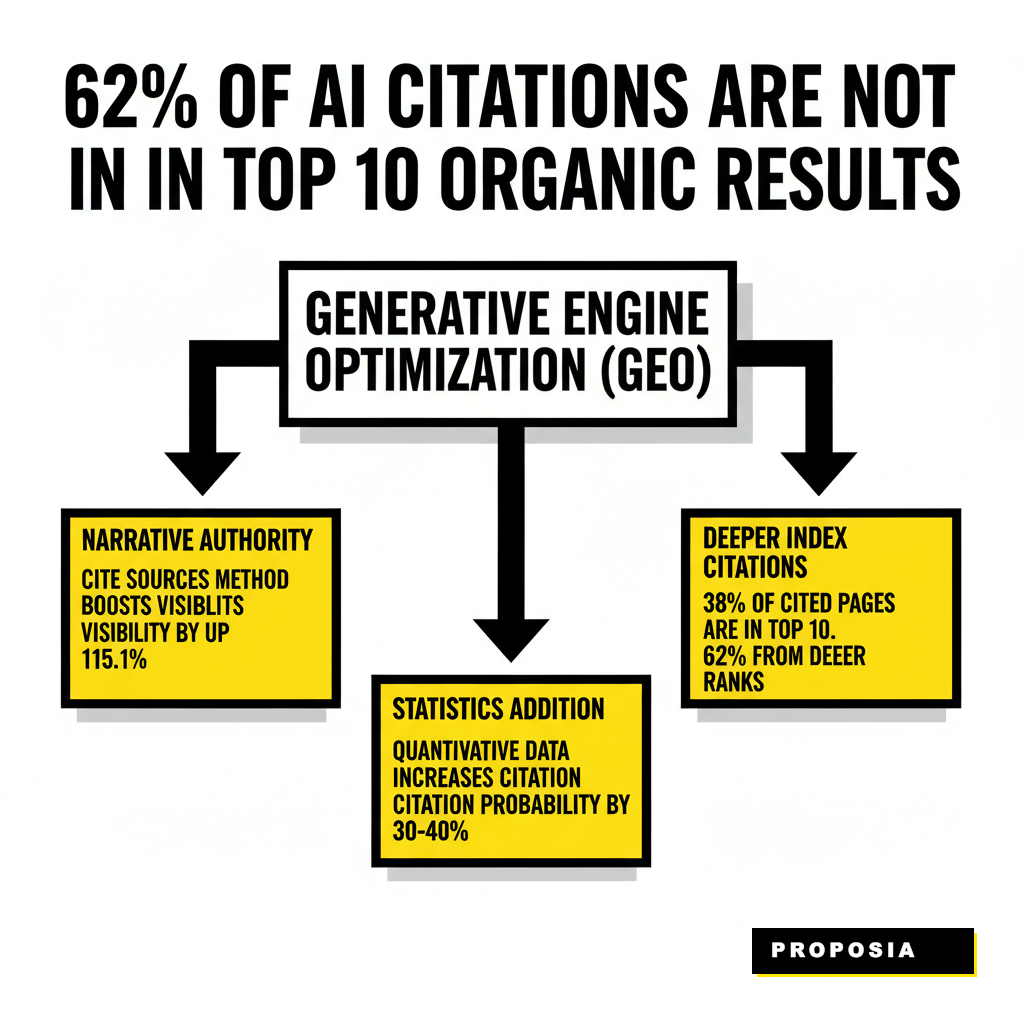
The traditional SEO playbook focused on the top 10 blue links. However, 2026 data from Ahrefs shows that only 38% of pages cited in Google AI Overviews actually rank in the top 10 organic results. This means a staggering 62% of citations come from deeper in the index. The game has changed from ranking for keywords to becoming a cited authority within an LLM’s response window. We call this Generative Engine Optimization or GEO.
1. Narrative Authority and the Cite Sources Method
Large language models prioritize content that looks like a credible source. A landmark study by researchers at Princeton and Georgia Tech found that the Cite Sources method can improve AI visibility by up to 115.1% for websites that traditionally rank outside the top five. This tactic involves explicitly mentioning where your information comes from within the body text. You should treat your blog posts like academic papers or high-end journalism. Using phrases like "According to recent industry data" or "As reported by [Source Name]" signals to the AI that your content is grounded in fact.
Traditional SEO Approach
- Focus on keyword density.
- Internal linking for link equity.
- Short, punchy sentences for readability.
GEO Citation Approach
- Explicit citation of external studies.
- Authoritative, persuasive tone.
- Evidence-backed claims with clear provenance.
2. Statistics Addition and Verifiable Data
AI models have a strong bias toward quantitative data. The Princeton GEO research validated that adding statistics to your content results in a 30% to 40% boost in citation probability. When an AI summarizes a topic, it looks for specific numbers to provide a definitive answer. If your article says "many people use AI," you will likely be ignored. If you say "75.7% of marketers regularly use AI tools in 2026," you provide a discrete data point that the LLM can easily extract and attribute to you. Always include original or curated statistics in your first two paragraphs to capture the attention of AI crawlers.
3. Entity-Based Semantic Clustering
Keywords are losing their status as the primary unit of search. Generative engines think in terms of entities: people, places, things, and concepts. To rank, you must build semantic clusters around a core entity. This means your content should cover the entire ecosystem of a topic. If you are writing about AI search, you must also address LLMs, citation frequency, and zero-click behavior. By connecting these related concepts, you help the AI build a knowledge graph of your expertise. This structure makes it easier for models like Gemini or GPT-5 to see your domain as the primary authority for that specific subject cluster.
4. Optimization for the Fan-Out Query Process
Google’s 2026 AI Mode uses a mechanism called query fan-out. When you ask a complex question, the AI splits it into several sub-queries. It then searches for answers to those sub-queries across different parts of the web. To optimize for this, your content must be modular. Each section of your article should answer a specific, standalone question related to the main topic. This allows the AI to pluck a single paragraph from your site to satisfy one branch of its fan-out process. Using clear H3 headings that mirror common sub-questions is the most effective way to facilitate this.
| User Query Type | AI Sub-Query Fan-Out | Optimization Tactic |
|---|---|---|
| Commercial | Pricing comparison, feature sets, user reviews. | Tables and bulleted feature lists. |
| Informational | Definition, history, current trends, future outlook. | Comprehensive H3 subsections with stats. |
| Technical | Implementation steps, common errors, tool requirements. | Numbered steps and technical schema. |
5. Leveraging Third-Party Citation Hubs
Your own website is no longer the only place where you should optimize for search. Generative engines heavily weight citations from community-driven platforms. In 2026, Reddit and LinkedIn have become the most cited domains for informational and professional queries. AI models trust the human-verified nature of these sites. To improve your brand’s citation frequency, you must actively participate in these external ecosystems. Getting mentioned in a high-upvoted Reddit thread or a viral LinkedIn post acts as a massive authority signal for LLMs. This is especially true for technical niche topics where the AI seeks community consensus.
6. Schema Graphing for LLM Context
Structured data is the bridge between human language and machine understanding. While Schema.org has been around for years, its role in 2026 is mission-critical. You should use advanced schema types like Article, FAQPage, and Person to explicitly define the relationships in your content. This helps AI crawlers map your data without having to guess the context. For example, if you are writing about technical audits, using Organization schema to link your company to the topic of governance can increase your trust score. This is highly relevant when implementing 10 must-have tools for AI governance and compliance audits in 2026, as the AI needs to verify your authority in a regulated space.
7. Conversational Intent and Multi-Turn Search
Generative search is rarely a one-and-done interaction. Users now engage in multi-turn conversations where they ask follow-up questions. Your content must anticipate these second and third steps. Instead of just answering "What is ASO?", your article should naturally lead into "How do I implement ASO on a budget?" or "What are the best tools for ASO?". By structuring your content as a journey, you increase the chances of being the source for the entire conversational session. You can see this logic in action when designing 12 zero-code prompts for specialized GPT-5 assistants, where the prompt chain must handle evolving user needs.
Single-Query Focus
- Targeting one high-volume keyword.
- Providing a brief, isolated answer.
- Ending the post with a basic CTA.
Multi-Turn Strategy
- Answering the initial query.
- Predicting the next logical question.
- Providing deep-dive links for further research.
8. The 90-Day Freshness Cycle
Freshness has become one of the most aggressive ranking factors in generative search. AI crawlers favor recent data to avoid the risk of hallucinating outdated information. Research from AirOps indicates that content updated within the last 90 days is three times more likely to be cited in Google’s AI Mode than older, static pages. This requires a shift from a "publish and forget" mindset to a continuous update cycle. You should revisit your top-performing GEO assets every quarter to refresh the statistics, update the expert quotes, and ensure the technical advice remains current. In the fast-moving world of AI, a six-month-old article is often treated as obsolete.