The Rise of the Agentic Search Era
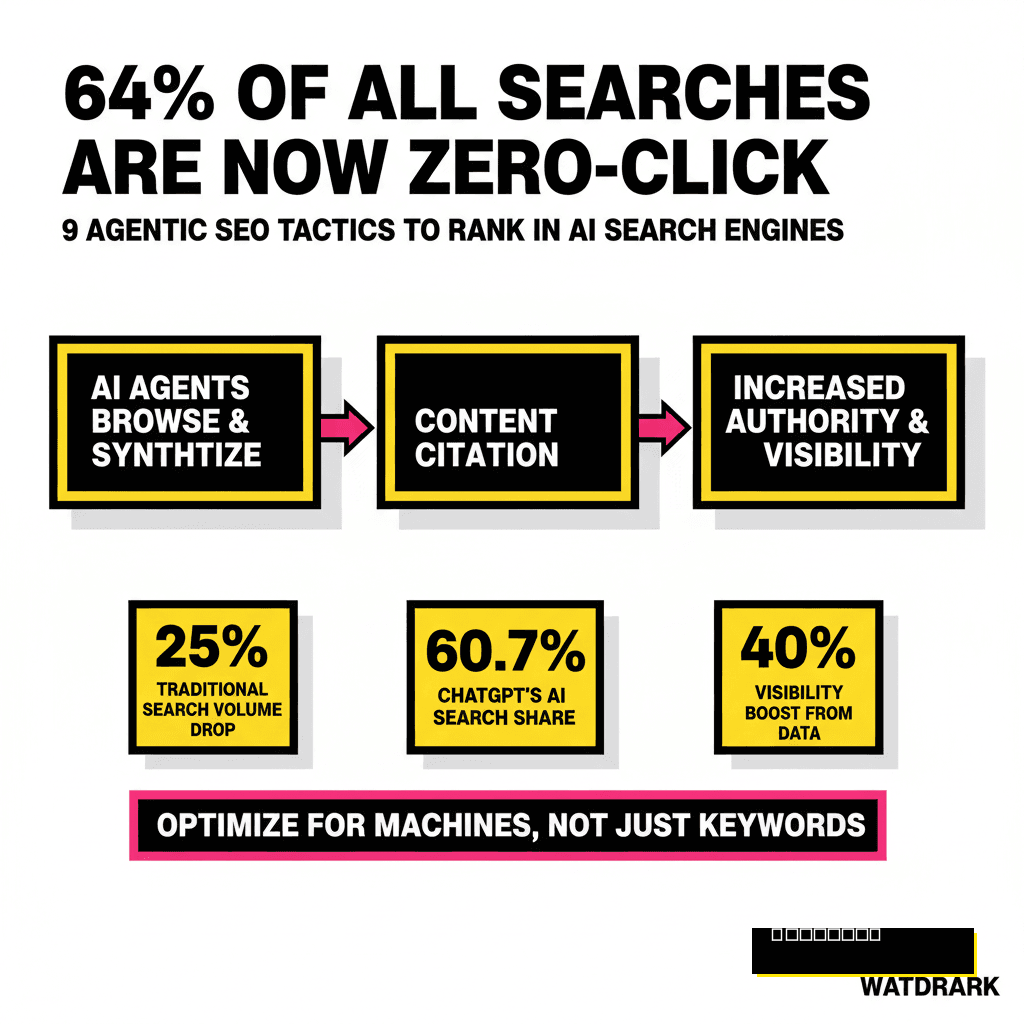
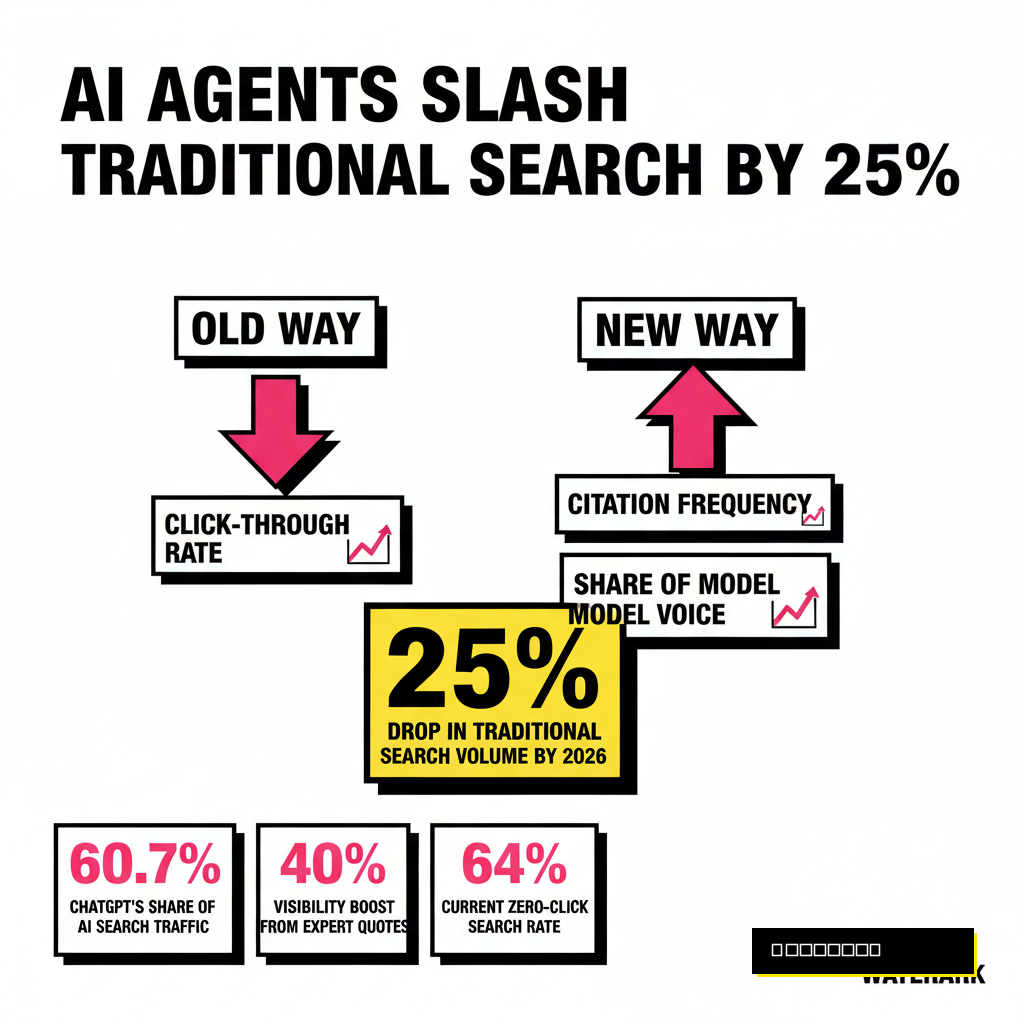
Search has moved past the era of blue links. According to a 2026 Gartner report, traditional search engine volume has dropped by 25 percent as users shift toward conversational AI tools. People no longer want to browse through ten different websites to find a single answer. Instead, they ask an agent like SearchGPT or Perplexity to do the work for them. These agents browse the web, synthesize findings, and present a finished response. If your content is not the one being cited, your organic visibility effectively drops to zero.
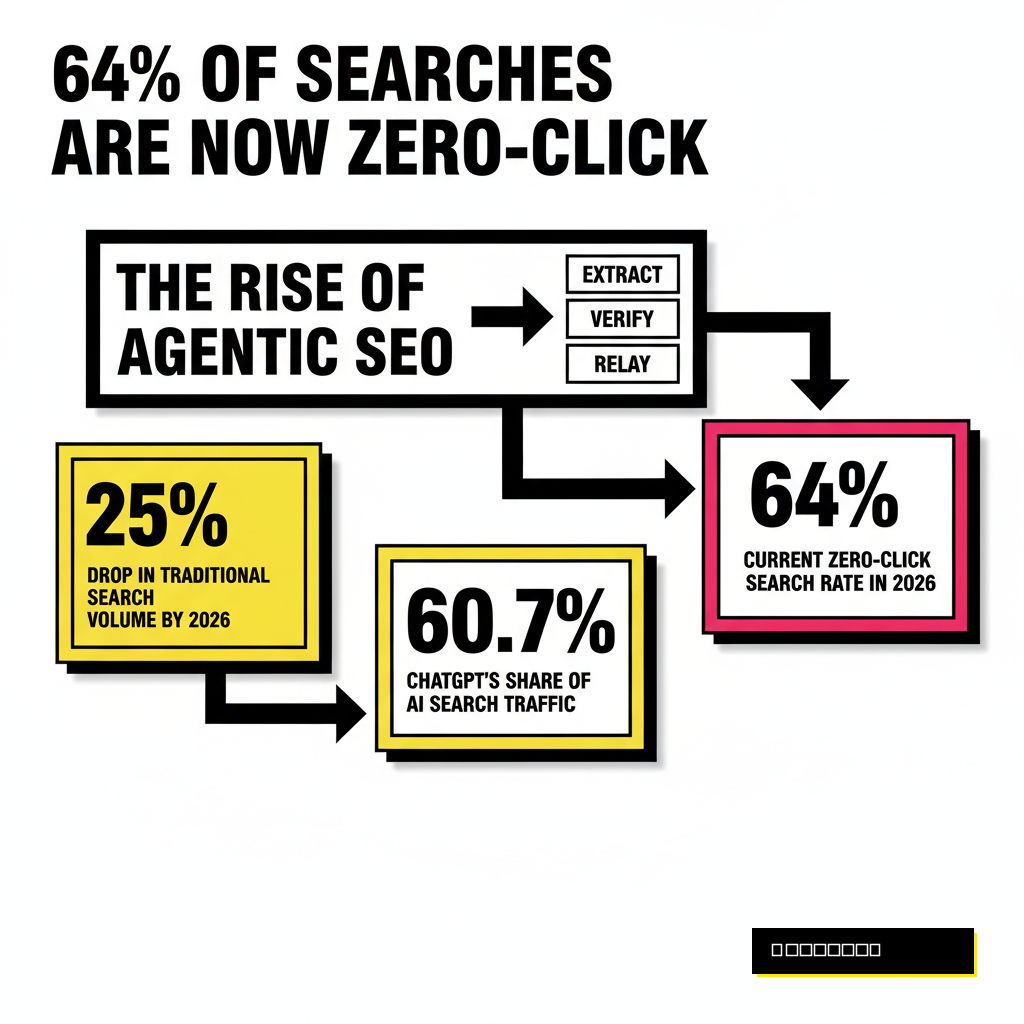
Creators who want to stay relevant must adopt agentic SEO. This approach focuses on making content usable for machines rather than just clickable for humans. You are no longer just optimizing for a keyword. You are optimizing for an agent that needs to extract, verify, and relay your information to a user. Recent data from SparkToro indicates that over 64 percent of all searches now end without a single click to a website. Success in this environment requires appearing inside the AI response itself.
Understanding the New Search Metrics
Measuring success in 2026 looks different than it did three years ago. Click-through rate is no longer the primary indicator of health. Brands now track citation frequency and share of model voice. If an AI agent mentions your brand as the definitive source for a query, you gain authority that transcends a simple visit. This authority builds a feedback loop where the model becomes more likely to recommend you in future sessions.
Current market leaders like ChatGPT and Microsoft Copilot combined hold nearly 74 percent of the AI search market. Google Gemini remains a strong contender at 15 percent. Each of these platforms uses slightly different retrieval methods. Some prioritize recency, while others look for deep technical authority. Mastering agentic SEO means building a presence that satisfies all these varied requirements simultaneously.
Tactic 1: Answer-First Prose Architecture
Agents prioritize clarity above all else. When an LLM scans your page, it looks for a direct answer to the user's prompt. If you bury the lead under a long introduction, the agent will move on to a clearer source. You should place the most important information in the first 50 to 100 words of every section. This structure makes it easy for the model to extract a snippet and cite you as the primary source.
Traditional SEO
- Keyword density focus
- Long narrative introductions
- Backlink quantity metrics
- Human-only readability
Agentic SEO
- Intent and prompt alignment
- Direct answer-first structure
- Citation and provenance focus
- Machine-readable data layers
Using question-based headings also helps. Phrases like "How do I optimize for SearchGPT?" or "What are agentic workflows?" act as signposts for the crawler. These headings align perfectly with the natural language prompts users type into AI interfaces. By mirroring the user's question, you increase the likelihood that the agent selects your content as the perfect match.
Tactic 2: Advanced Schema Graphing
Schema markup is no longer optional for technical health. It has become the primary way agents understand the relationships between different entities on your site. Beyond basic article schema, you should implement FAQ, HowTo, and Review markup. These structured data types provide a roadmap for the AI to follow when it needs to perform a specific task for a user.
Organization schema is particularly critical for brand recognition. Agents need to know exactly who you are and what you specialize in. If you are discussing technical topics like local LLM configurations, your schema should explicitly link your expertise to that niche. This connection helps the AI build a confidence score in your content, making it more likely to cite you as a trusted authority.
Tactic 3: High-Frequency Freshness Loops
AI search engines have a strong preference for recency. Perplexity and SearchGPT perform live web searches to ensure their answers are not outdated. If your data is six months old, an agent will likely bypass it for a competitor who updated their post last week. You need to implement a regular refresh cycle for your core content. Updating a single statistic or adding a new expert quote can trigger the agent to re-crawl and re-rank your page.
| Tactic Name | Core Action | Primary Benefit |
|---|---|---|
| Answer Framing | Answer in first 100 words | Snippet extraction |
| Freshness Loops | Monthly data updates | Recency ranking boost |
| Expert Hooks | Original research & quotes | Verifiability score |
| Agent Seeding | External brand mentions | Cross-platform trust |
Setting up an internal system to track content decay is essential. Search engines now look for "last updated" metadata that matches the actual changes on the page. Simply changing the date without updating the substance can lead to penalties from modern AI filters. Focus on providing the most current, verifiable information to maintain your spot at the top of the answer stack.
Tactic 4: Primary Data and Expert Hooks
Agents value verifiability. A study by Seer Interactive found that content containing original research, case studies, or expert quotes saw a 40 percent boost in visibility within AI search results. When you provide a unique data point, the AI sees your site as a primary source. It would much rather cite the original creator of a statistic than a secondary source that is just reporting on it.
Including verified human credentials is the next step in this evolution. As we discussed in our guide on Verified Human SEO, search engines are increasingly cautious about AI-generated sludge. They want to see a real person with real experience behind the content. Adding detailed author bios and linking to verified social profiles builds the trust signals that AI agents require before they recommend your brand to a user.
Tactic 5: Logical Reasoning Chains
New reasoning models, such as OpenAI's o1, think through problems in a step-by-step manner. They don't just guess the next word. They analyze logic. To optimize for these models, your content should follow a clear, logical progression. Use "if-then" scenarios and systematic breakdowns of complex topics. When the AI can follow your reasoning, it is more likely to use your framework as the basis for its own generated response.
Structuring your guides with clear, numbered steps is the easiest way to achieve this. Each step should represent a logical milestone in the process. If you are explaining a technical workflow, ensure every transition is clear and every prerequisite is stated. This level of detail helps the agent understand the "how" and "why" behind your advice, which is exactly what users are looking for in conversational search.
Tactic 6: Third-Party Ecosystem Seeding
AI agents do not just look at your website. They scan the entire digital ecosystem to form an opinion of your brand. They look at mentions on Reddit, reviews on G2, and citations in news publications. If your brand is frequently discussed in these high-authority spaces, the agent develops a higher confidence score in your information. You should spend as much time seeding your brand in these external communities as you do on your own blog.
Participating in niche forums and industry discussions is a powerful way to build this off-page authority. When an agent finds your brand mentioned positively in a Reddit thread, it treats that as a strong social proof signal. These external signals often carry more weight than traditional backlinks in the world of generative search. Focus on becoming a recognized name in the places where your target audience already spends their time.
Tactic 7: Table-First Data Structuring
Large language models excel at parsing tables. When you present data in a structured HTML table, the agent can easily compare different options and extract specific values. This format is far superior to a block of text for technical specifications or pricing comparisons. If you want to be the source for a "best of" or "comparison" query, use a table to make your findings unmistakable.
Consistency in your table formatting also matters. Use clear headers and concise data points. This structure allows the AI to translate your table directly into its own response without needing to reformat the information. The goal is to make it as easy as possible for the machine to do its job. The less friction there is for the agent, the more often you will see your brand in the citation list.
Tactic 8: Explicit Bot Permissions
Technical SEO in 2026 requires a proactive approach to bot management. You must ensure that your robots.txt file explicitly allows crawlers like OAI-SearchBot and PerplexityBot. If you block these bots, you are essentially opting out of the AI search economy. Beyond just allowing them, you should optimize your site's performance to handle the frequent crawls that these agents require.
Monitoring how these bots interact with your site provides valuable data. You can see which pages they are visiting most frequently and which ones they are ignoring. This information tells you where the agents see the most value. Use these insights to double down on the content that is already performing well and fix the technical issues on the pages that are being skipped. Clear, crawlable HTML is the foundation of every successful agentic strategy.
Tactic 9: Multi-Modal Optimization
Search is no longer just about text. Users frequently upload images or use voice commands to interact with AI agents. Optimizing for this multi-modal future means providing high-quality alt text for every image and ensuring your videos are transcribed. If an agent can "see" and "hear" your content, it can use it in a much wider range of scenarios.
Creating visual aids like diagrams and charts also helps. These elements provide a non-textual way to explain complex concepts. When an agent synthesizes an answer, it often looks for visual components to include alongside the text. By providing these assets in a clear, accessible format, you increase your chances of appearing in the rich media sections of AI responses. This holistic approach ensures you are visible no matter how the user chooses to search.
Adapting to the New Reality
The transition to agentic SEO is not a temporary trend. It is a fundamental shift in how information is discovered and consumed. Those who continue to rely on old keyword-stuffing tactics will find themselves increasingly invisible. By focusing on clarity, structure, and verifiability, you can secure your place in the future of search.
Success requires a commitment to quality and a willingness to adapt. The rules of engagement have changed, but the goal remains the same: to provide the most helpful answer to the user. If you can prove to the agents that your content is the best available source, the traffic and authority will follow. Start implementing these tactics today to ensure your brand stays at the top of the answer stack in 2026 and beyond.