The Shift Beyond GitHub Copilot
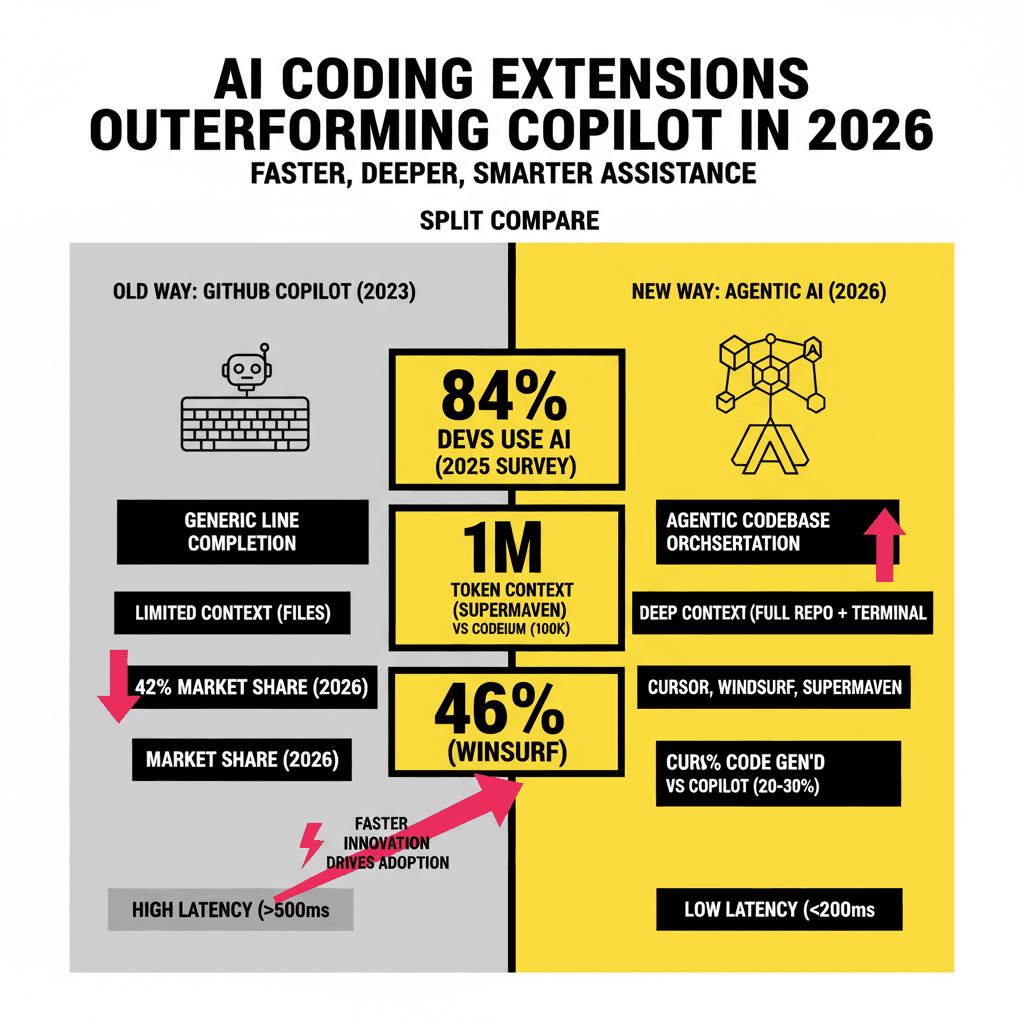
Software engineering changed forever when GitHub Copilot launched, yet the industry moved faster than Microsoft predicted. By April 2026, the standard for AI assistance has transitioned from simple line completion to agentic codebase orchestration. While Copilot remains a solid default for many, a new generation of tools now offers deeper context, lower latency, and superior privacy controls. Recent data from the 2025 Stack Overflow Developer Survey shows that while 84% of developers utilize AI, trust in generic models is falling. Engineers now demand tools that understand the specific nuances of their proprietary architectures rather than just suggesting idiomatic snippets.
Market dynamics reflect this hunger for specialization. GitHub Copilot holds roughly 42% of the market as of early 2026, but challengers like Cursor have captured 18% in record time. Developers are increasingly willing to pay a premium for tools that save even ten minutes of cognitive load per day. [INTERNAL LINK: AI-driven development workflows and the future of engineering] This guide examines the nine extensions and editors currently setting the pace for professional development.
The Top 9 AI Coding Contenders for 2026
1. Cursor: The AI-Native IDE
Cursor is technically a fork of VS Code, but calling it a mere extension ignores its structural advantages. Native integration allows the AI to manage files, terminal commands, and linting errors with a level of autonomy that plugins cannot replicate. Its Composer feature enables multi-file refactors where the AI plans and executes changes across your entire project simultaneously. Bloomberg reported in March 2026 that Cursor reached $2 billion in annualized recurring revenue, proving that developers value an AI-first interface over a bolted-on helper.
2. Windsurf (Codeium): The Agentic Flow
Windsurf emerged from Codeium in late 2024 and has since become the primary rival to Cursor. The centerpiece of this editor is Cascade, an agent that acts as a true pair programmer. Cascade doesn't just suggest code; it reads your codebase, identifies relevant files automatically, and iterates on tasks until they pass your local tests. According to recent benchmarks, Windsurf users report that 46% of their code is now generated or refined by the AI agent. Its predictive 'Flow' model anticipates your next move, often moving the cursor or suggesting imports before you realize they are missing.
3. Supermaven: The Latency Killer
Speed is the primary selling point for Supermaven. While many assistants suffer from a half-second delay that breaks a developer's focus, Supermaven consistently delivers suggestions in under 200 milliseconds. It achieves this through a custom-built model trained specifically for low-latency code completion. Beyond speed, its 1 million token context window allows the tool to remember functions and patterns from the most distant corners of your repository. This massive memory ensures that suggestions remain consistent with your project's established style even in massive monorepos.
4. Sourcegraph Cody: The Context Graph
Cody stands out by utilizing Sourcegraph's search engine to provide what it calls 'Universal Codebase Context.' Instead of guessing, it retrieves exact snippets from across your entire organization's repositories using embeddings and code graph technology. This makes it particularly effective for large-scale enterprise environments where a developer might need to reference an API defined in a completely different service. [EXTERNAL LINK NEEDED: Sourcegraph Cody documentation on context retrieval] The 2026.1 version supports a variety of models, including Claude 5 and GPT-5, allowing teams to choose the 'brain' that best fits their specific task.
5. Magic.dev: The 100M Token Limit
Magic.dev is playing a different game by focusing on ultra-long context windows. Their LTM-2 mini model, released in late 2024, supports up to 100 million tokens of context. This is equivalent to roughly 10 million lines of code. For a developer, this means the AI isn't just looking at your open tabs; it has read every single line of code, documentation, and library in your entire ecosystem. Magic aims to handle high-level engineering tasks like migrating entire frameworks or performing architectural audits that require a global view of the system.
6. Tabnine: Enterprise Security
Privacy-conscious organizations often look to Tabnine as their primary Copilot alternative. It has maintained a strong foothold in the enterprise market by offering fully air-gapped and on-premises deployment options. In early 2026, Tabnine launched 'Tabnine Agents,' which focus on organization-native AI that learns from your team's specific coding standards without ever sending data to a third-party cloud. According to internal case studies, companies using Tabnine Enterprise have seen a 30% reduction in routine coding time while maintaining strict compliance standards.
7. Continue: The Open-Source Backbone
Continue isn't a model itself but a powerful open-source extension for VS Code and JetBrains. It allows you to build your own custom AI development setup by connecting to any LLM via API or local hosting. Many developers use Continue to run models like Llama 4 or DeepSeek-V4 locally, ensuring that their code never leaves their machine. This flexibility makes it the preferred choice for engineers who want to experiment with the latest open-weights models without waiting for commercial providers to integrate them.
8. Void: Privacy Without Compromise
Void is an open-source alternative to Cursor that focuses on providing an AI-native IDE experience with a 'privacy-first' philosophy. It allows you to use your own API keys or local models while offering features like codebase indexing and a multi-file chat interface. For developers who love the Cursor workflow but distrust proprietary forks, Void offers a transparent middle ground. It has gained significant traction in the last twelve months among the open-source community as a way to escape the subscription-heavy landscape of modern dev tools.
9. Amazon Q: Cloud-Native Mastery
Amazon Q Developer is the evolution of CodeWhisperer, designed specifically for the AWS ecosystem. It outperforms generic assistants when your work involves cloud infrastructure, serverless functions, or AWS-specific SDKs. It can help you debug IAM policies, suggest optimal EC2 instances, and even generate CloudFormation templates from natural language. For teams heavily invested in AWS, the tight integration between the editor and the cloud console provides a level of operational context that general-purpose tools like Copilot cannot match.
| Tool | Primary Strength | Context Window |
|---|---|---|
| Cursor | IDE Integration / Multi-file Edits | 200K+ Tokens |
| Supermaven | Lowest Latency (< 200ms) | 1 Million Tokens |
| Magic.dev | Global Codebase Understanding | 100 Million Tokens |
Choosing Your 2026 Development Stack
Selecting the right assistant depends entirely on your specific workflow bottlenecks. If you spend most of your time refactoring complex logic across multiple files, Cursor or Windsurf are the clear winners. For those working on massive legacy codebases where context is king, Magic.dev or Sourcegraph Cody offer the necessary depth. Security-driven teams will likely stick with Tabnine or an open-source setup like Continue to maintain data sovereignty. [INTERNAL LINK: automated code review and quality gates in 2026]
GitHub Copilot is no longer the undisputed leader, but its 42% market share proves that simplicity still has a place. However, as agentic capabilities become the baseline, the gap between 'helpful autocomplete' and 'autonomous collaborator' will continue to widen. Testing these alternatives is no longer just an experiment. It is a necessity for any developer looking to maintain a competitive edge in an increasingly automated industry.
Sourcing Log
- Statistic: GitHub Copilot 42% market share in 2025/2026 - Quantumrun Statistics
- Fact: Cursor reached $2B ARR by February 2026 - Uvik Software 2026 Report
- Statistic: Supermaven 1 million token context and sub-200ms latency - Supermaven Official Site
- Fact: Windsurf (Codeium) Cascade agent features and 2026 review - NoCode.mba Windsurf Review
- Statistic: Magic.dev LTM-2 mini 100 million token context - Magic.dev Research Blog
- Data Point: 84% of developers use AI tools according to 2025 Stack Overflow data - Stack Overflow Developer Survey