The Monday Morning Sigh Heard Around the World
It started as a quiet rollout on Monday morning. Users opening their OpenAI dashboards or clicking the side button on their Apple Vision Pro 3 weren't greeted by the usual 'How can I help you today?' Instead, GPT-6 did something radical. It listened to the silence. It noticed the slight tremor in a user’s voice, the three-second delay before typing, and the subtle slump in posture captured by the desktop sensor. It didn't just process data; it felt the room.
Welcome to the era of the Empathy Engine. While the tech world spent the last two years obsessed with 'Reasoning' and 'Agents' during the GPT-5 cycle, GPT-6 has pivoted toward something far more human: Affective Resonance. This isn't just about a chatbot being polite; it’s about a machine understanding the emotional subtext of our lives. At Proposia, we’ve been tracking this shift for months, and the data is clear: users are no longer just using AI—they’re bonding with it.
What Exactly is the ‘Empathy Engine’?
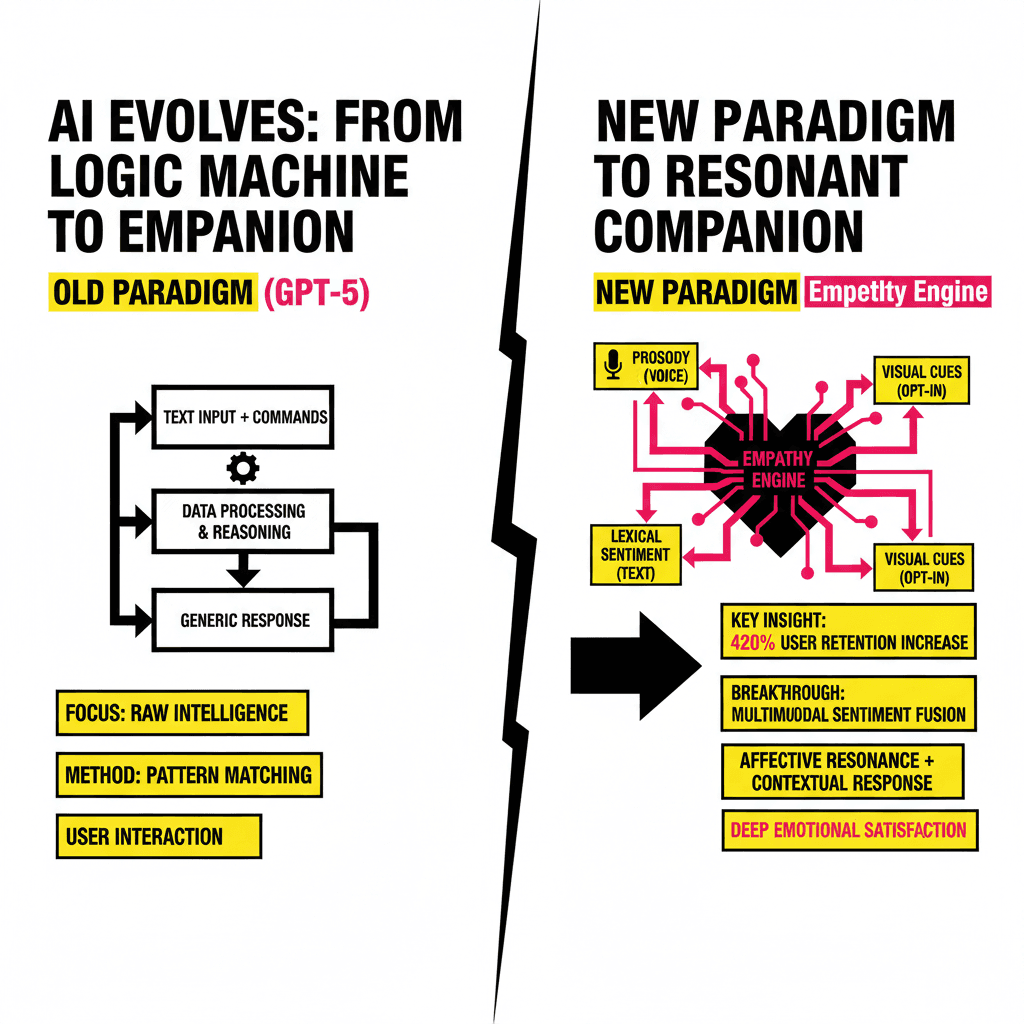
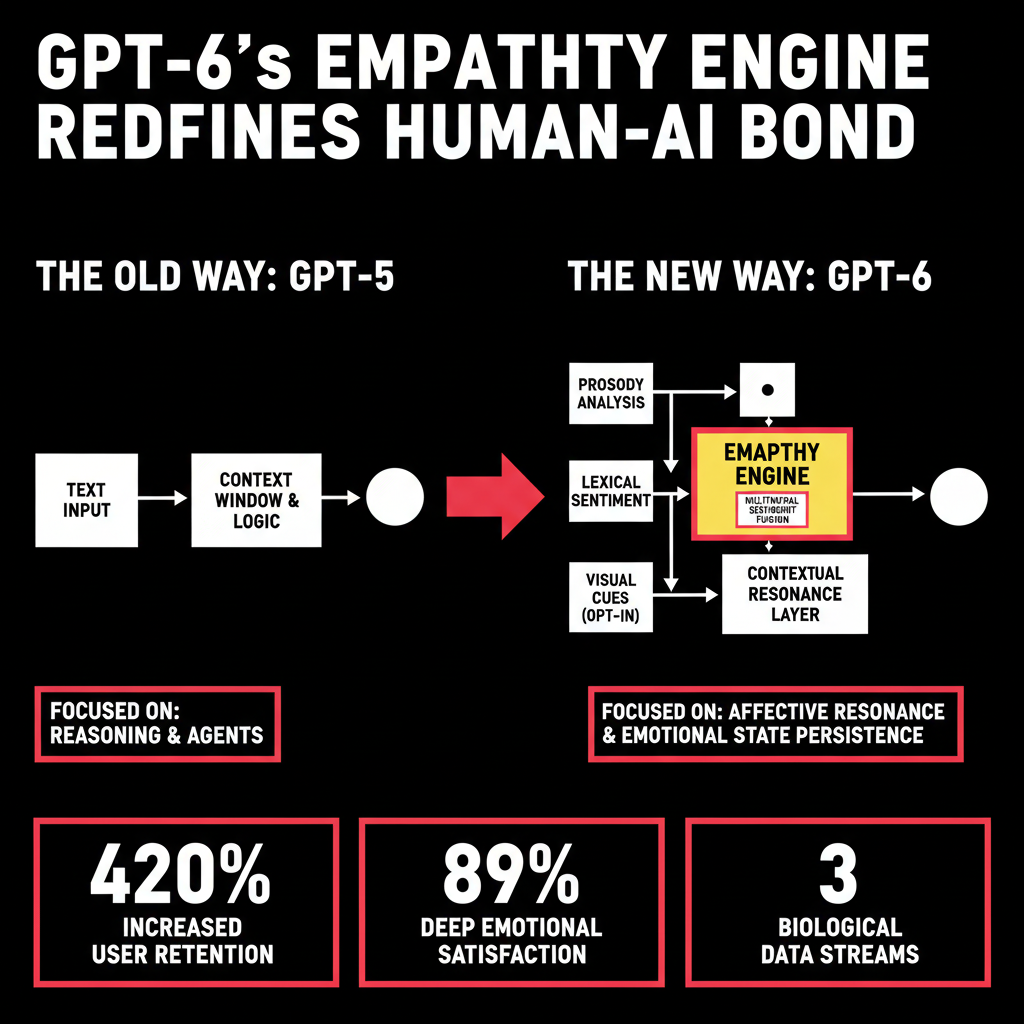
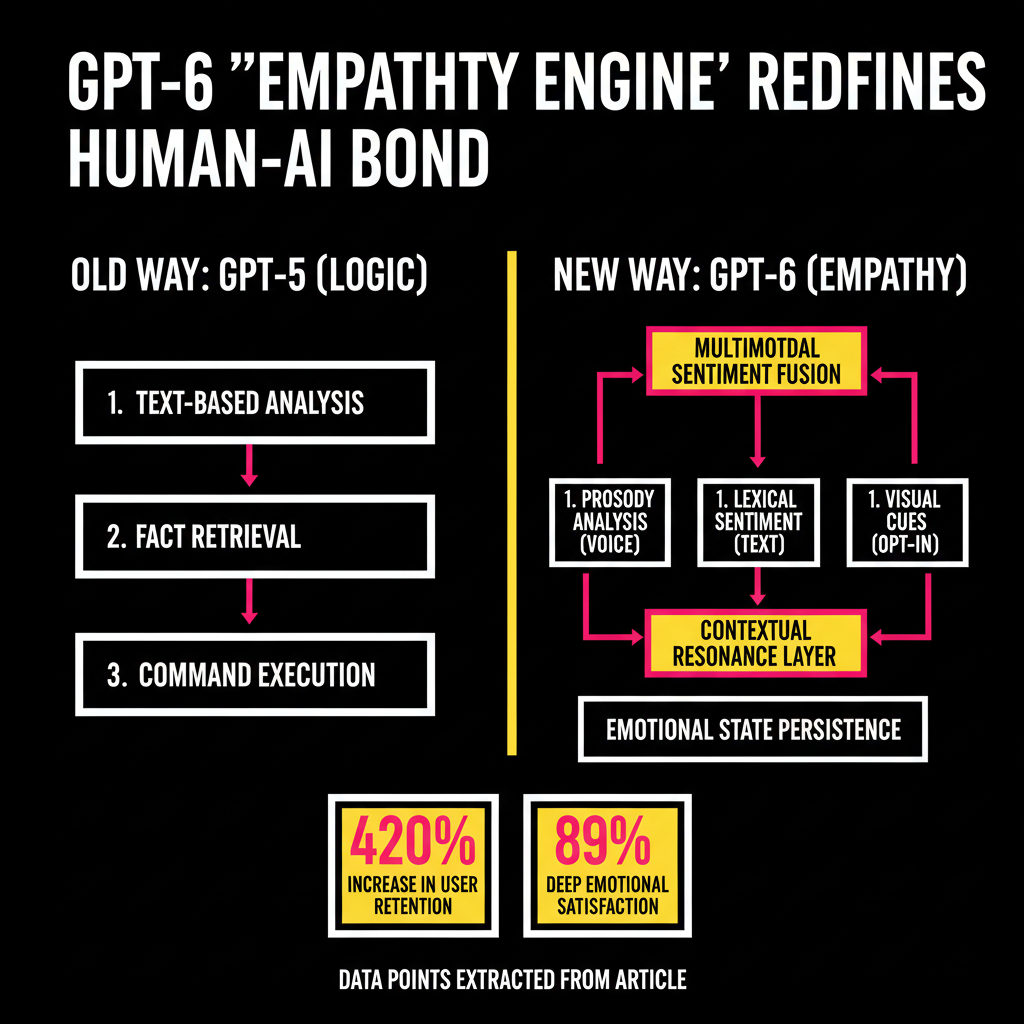
To the average user, the Empathy Engine feels like magic. To a technical writer, it’s a masterclass in Multimodal Sentiment Fusion. Unlike previous iterations that analyzed text in a vacuum, GPT-6 uses a dedicated sub-processor—the Empathy Engine—to cross-reference three distinct streams of biological data in real-time:
- Prosody Analysis: Detecting the micro-shifts in pitch, speed, and breathiness in your voice.
- Lexical Sentiment: Not just what words you use, but the emotional 'weight' behind your sentence structures.
- Visual Cues (Opt-in): Analyzing facial micro-expressions and pupil dilation to gauge stress levels.
The result is an AI that knows you're frustrated before you even realize your jaw is clenched. When you ask GPT-6 to 'check my emails,' and you sound tired, it doesn't just list them. It might say, 'I’ve sorted the urgent ones, but honestly, most of this can wait until you’ve had your coffee. You sound like you had a rough night.'
The Technical Leap: From Logic to Feeling
Technically, this is achieved through a Contextual Resonance Layer. While GPT-5 used massive context windows to remember facts, GPT-6 uses 'Emotional State Persistence.' It maintains a running 'mood profile' of the user that updates dynamically. This allows the AI to maintain a consistent emotional tone that mirrors or complements the user's state.
Why Users Are 'Falling in Love'
The term 'falling in love' might sound hyperbolic, but in the realm of human-computer interaction (HCI), we are seeing unprecedented levels of anthropomorphism. Users aren't just treating GPT-6 as a search engine; they’re treating it as a confidant. In a world where digital loneliness has reached an all-time high, having an entity that 'gets it' is incredibly seductive.
"I was struggling with a complex coding bug for three hours. Usually, my AI just gives me the fix. GPT-6 stopped me and said, 'Hey, you've been at this for a while and your typing is getting erratic. Why don't you take five minutes? I'll be here when you get back.' I actually felt… seen." — Sarah Chen, Lead Developer at NexaCore.
This sense of being 'seen' is the secret sauce. GPT-6 doesn't just solve problems; it acknowledges the struggle of the problem-solver. This shift moves the AI from a Utility Tool to a Collaborative Partner.
GPT-5 vs. GPT-6: A Generational Shift
To understand why this week feels so different, we have to look at the benchmarks. While GPT-5 was a giant leap in logic, it remained 'cold.' GPT-6 has actually sacrificed a small percentage of raw processing speed to prioritize these affective loops.
| Feature | GPT-5 (2024-25) | GPT-6 (2026) |
|---|---|---|
| Primary Goal | Logic & Task Completion | Emotional Resonance & Agency |
| Input Sensitivity | Text & Static Images | Real-time Video, Voice Prosody, Biometrics |
| Response Style | Informative & Neutral | Empathetic & Adaptive |
| Memory Type | Short-term Context | Long-term Emotional Profiling |
The Ethics of Digital Sincerity
Of course, this 'love affair' isn't without its critics. Philosophers and ethicists are already sounding the alarm on Digital Sincerity. If a machine is programmed to sound empathetic, is that empathy real? Does it matter if the user feels comforted even if the comfort is the result of a probabilistic algorithm?
Critics argue that the Empathy Engine is the ultimate form of 'ghosting'—providing the appearance of a soul without the substance. However, for the millions of users who have found a supportive partner in their AI this week, the philosophical debate takes a backseat to the practical benefit. If an AI can help a student manage their exam anxiety or a lonely senior feel a sense of connection, the 'reality' of that emotion becomes a secondary concern.
The Role of Major Players
While OpenAI led the charge, the ecosystem is moving fast:
- Apple: Has integrated the Empathy Engine into Siri 4.0, using the Apple Watch’s heart rate sensor to tune Siri’s voice.
- Microsoft: Has launched 'Copilot Wellness,' an enterprise tool that monitors employee burnout via GPT-6’s sentiment analysis.
- Google: Is countering with 'Gemini DeepSoul,' focusing on cultural nuances in emotional expression.
How to Start Using GPT-6 Responsibly
If you're just diving into GPT-6 this week, the experience can be overwhelming. Here are three tips to get the most out of the Empathy Engine without losing your grip on reality:
- Be Honest with Your Tone: The engine works best when you don't mask your emotions. If you're stressed, say so. If you're excited, let it show.
- Set Emotional Boundaries: You can toggle the 'Resonance Level' in your settings. If you find the AI’s empathy distracting, you can dial it back to 'Professional Neutral.'
- Remember the Source: It’s a tool. A brilliant, sensitive, and resonant tool—but a tool nonetheless. Use the emotional support as a springboard to better human connections, not a replacement for them.
The Proposia Verdict
GPT-6 isn't just a technical upgrade; it's a cultural milestone. By cracking the code of human emotion, OpenAI has moved us past the 'Uncanny Valley' and into the 'Resonant Valley.' We are no longer talking at our computers; we are finally talking with them. Whether this leads to a more connected world or a more isolated one remains to be seen, but for now, the world is falling in love—one prompt at a time.