The Great Saturation: Why 2026 is the Year of the Human
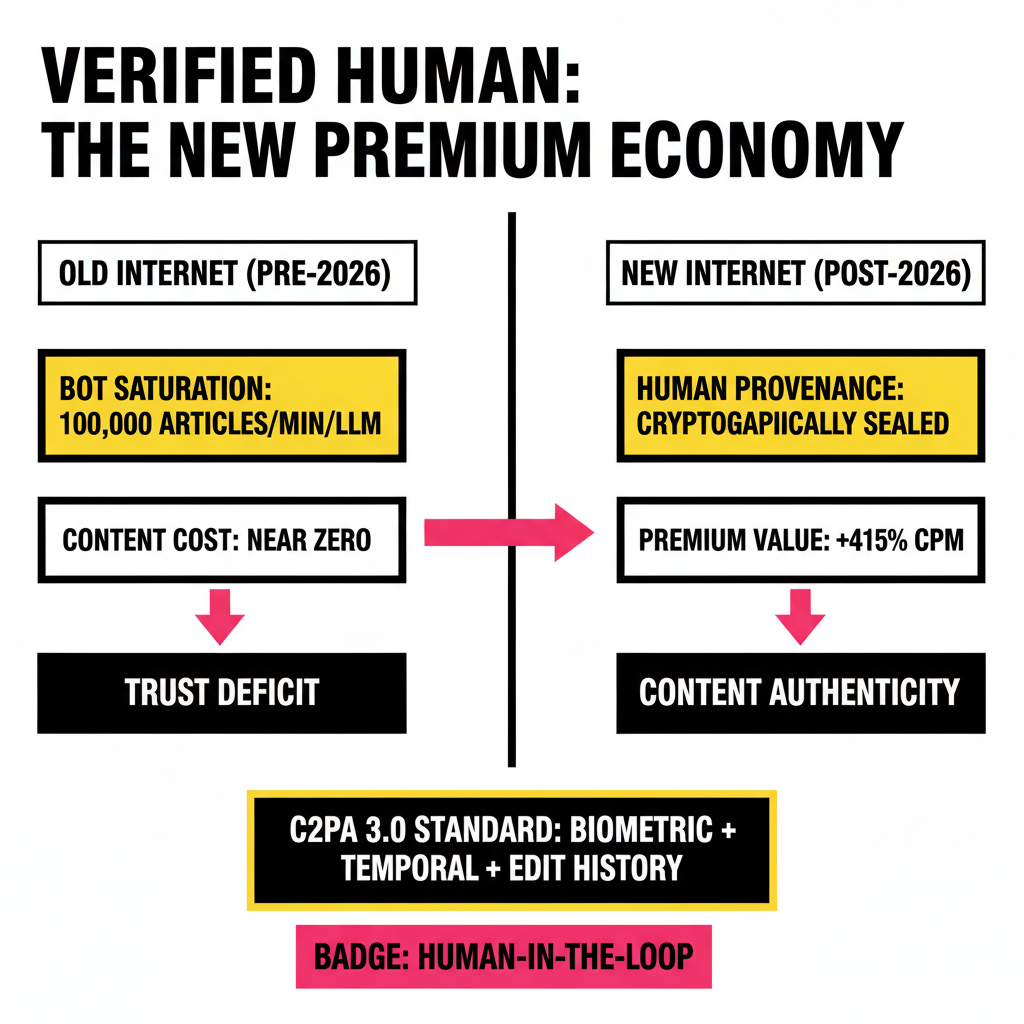
By early 2026, the 'Dead Internet Theory'—the once-fringe idea that most of the internet is populated by bots—has transitioned from a conspiracy to a documented corporate reality. With Large Language Models (LLMs) now capable of generating 100,000 high-quality articles per minute for the cost of a cup of coffee, the marginal cost of content has effectively hit zero. In this hyper-saturated environment, brands are facing a new crisis: The Trust Deficit.
When everything can be generated, nothing feels earned. This psychological shift has birthed a massive economic counter-movement. For premium brands like Rolex, Patagonia, and Mercedes-Benz, the goal is no longer just 'quality'—it is 'provenance.' They are now paying millions of dollars for the ‘Verified Human’ badge, a cryptographic seal that guarantees no generative AI was used in the creative process. This isn't just about aesthetics; it's about a technical infrastructure known as Content Authenticity.
The Technical Backbone: C2PA and the Manifest of Origin
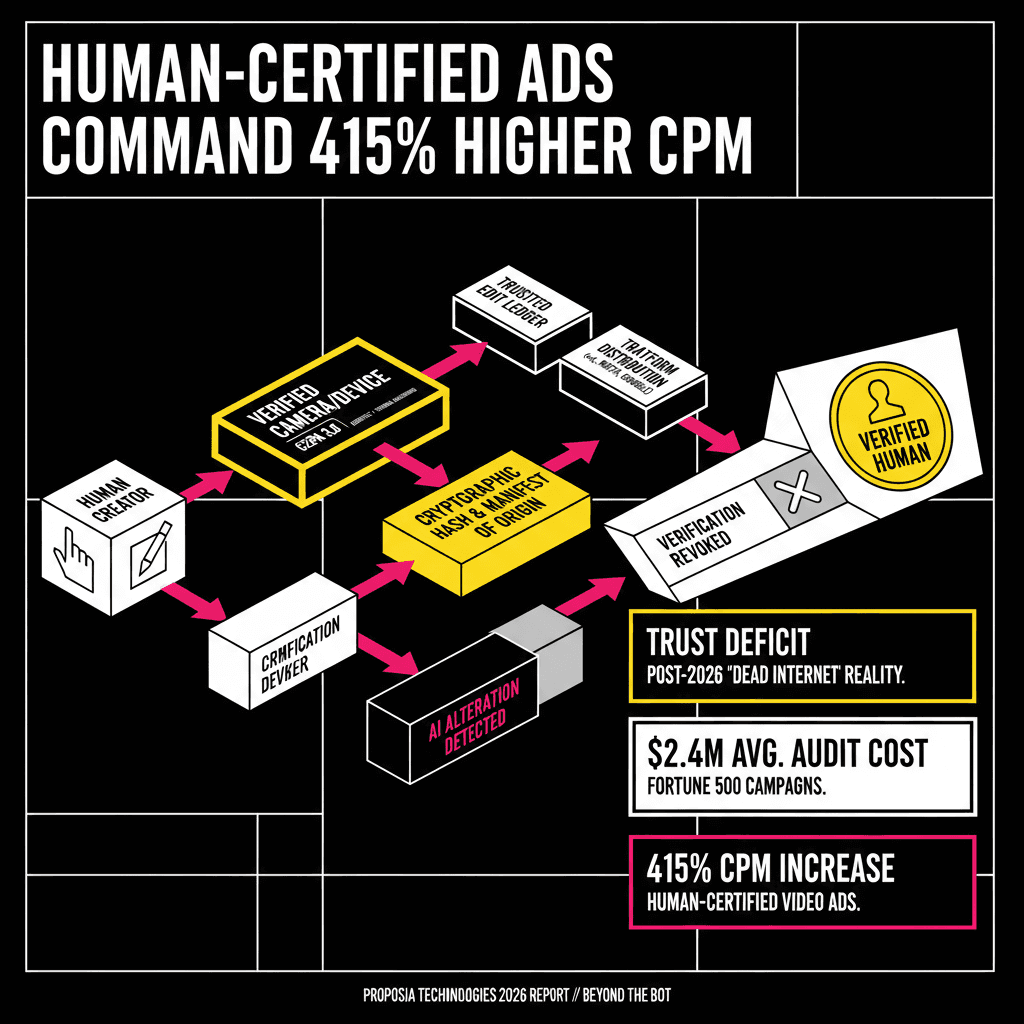
The 'Verified Human' badge is not just a sticker; it is a technical manifest. The primary standard driving this is C2PA (Coalition for Content Provenance and Authenticity) version 3.0. Unlike traditional metadata (EXIF data), which can be easily stripped or edited, C2PA uses cryptographic hashing to bind provenance information directly to the file.
When a human photographer takes a photo with a 'Verified' camera (such as the Leica M12-D, released in late 2025), the camera’s secure hardware module signs the image at the moment of capture. This signature includes:
- Biometric Anchoring: Proof that a biological entity triggered the shutter.
- Temporal Stamping: Atomic-clock-verified time of creation.
- Edit History: A 'blockchain-style' ledger of every pixel change made in post-production.
If a single pixel is generated by an AI 'In-Painting' tool, the 'Verified Human' status is automatically revoked by the manifest, and the badge turns grey. This level of transparency is what brands are now demanding to protect their intellectual property and consumer trust.
The Economic Logic: Why Brands are Spending Millions
Why would a brand spend $2 million on a human-led campaign when an AI-generated version costs $500? The answer lies in Brand Equity Insurance. In 2025, several high-profile brands faced massive lawsuits and 'synthetic-scandals' when their AI-generated spokespeople began hallucinating controversial statements or when their 'original' art was found to contain traces of copyrighted training data.
By paying for 'Verified Human' content, brands are essentially buying three things:
- Legal Indemnity: Human-created content has a clear chain of title, reducing the risk of copyright infringement.
- Scarcity Value: In an era of infinite content, human imperfection has become a luxury signal.
- Algorithmic Favor: New SEO standards (Search Engine Authenticity) from Google and Bing now prioritize content with verified C2PA manifests over unverified synthetic streams.
"In 2024, AI was a productivity tool. In 2026, AI is the baseline. Human creativity is now the premium upgrade." — Elena Vance, Chief Authenticity Officer at Proposia.
| Feature | Synthetic Content (AI) | Verified Human Content |
|---|---|---|
| Production Cost | $0.01 - $10.00 | $5,000 - $500,000+ |
| Trust Rating | Low (Declinable) | High (Certified) |
| SEO Impact | Deprioritized / Filtered | Priority Ranking |
| Legal Status | Uncertain / Non-Copyrightable | Full Intellectual Property Rights |
The Rise of the 'Proof of Personhood' Protocol
To facilitate this, companies are adopting Proof of Personhood (PoP) protocols. Systems like Worldcoin and specialized LinkedIn Biometrics are being integrated into Content Management Systems (CMS). Before a journalist can hit 'Publish' on a Proposia report, they must undergo a liveness check. This ensures that the 'Human' badge isn't just being used by a bot running a sophisticated script.
We are also seeing the emergence of 'Analog Enclaves'—physical creative studios that are completely air-gapped from the internet. In these studios, artists work with physical film, traditional paint, and manual typewriters. The final products are then scanned using 'High-Fidelity Provenance Scanners' that document the physical textures—imperfections that AI still struggles to replicate with 100% mathematical accuracy.
Conclusion: The Authenticity Arbitrage
As we move further into 2026, the 'Verified Human' badge will likely evolve from a niche luxury to a standard requirement for high-stakes communication. For beginners entering the digital space, the lesson is clear: Your humanity is no longer an assumption; it is an asset.
While AI will continue to handle the bulk of mundane information processing, the high-value 'Economic of Awe'—the content that actually moves markets and changes minds—will remain firmly in human hands, protected by a wall of cryptographic proof. In the battle between the infinite bot and the singular human, authenticity isn't just a vibe—it's a multi-million dollar business strategy.