The Great Decoupling: Identity vs. Biology
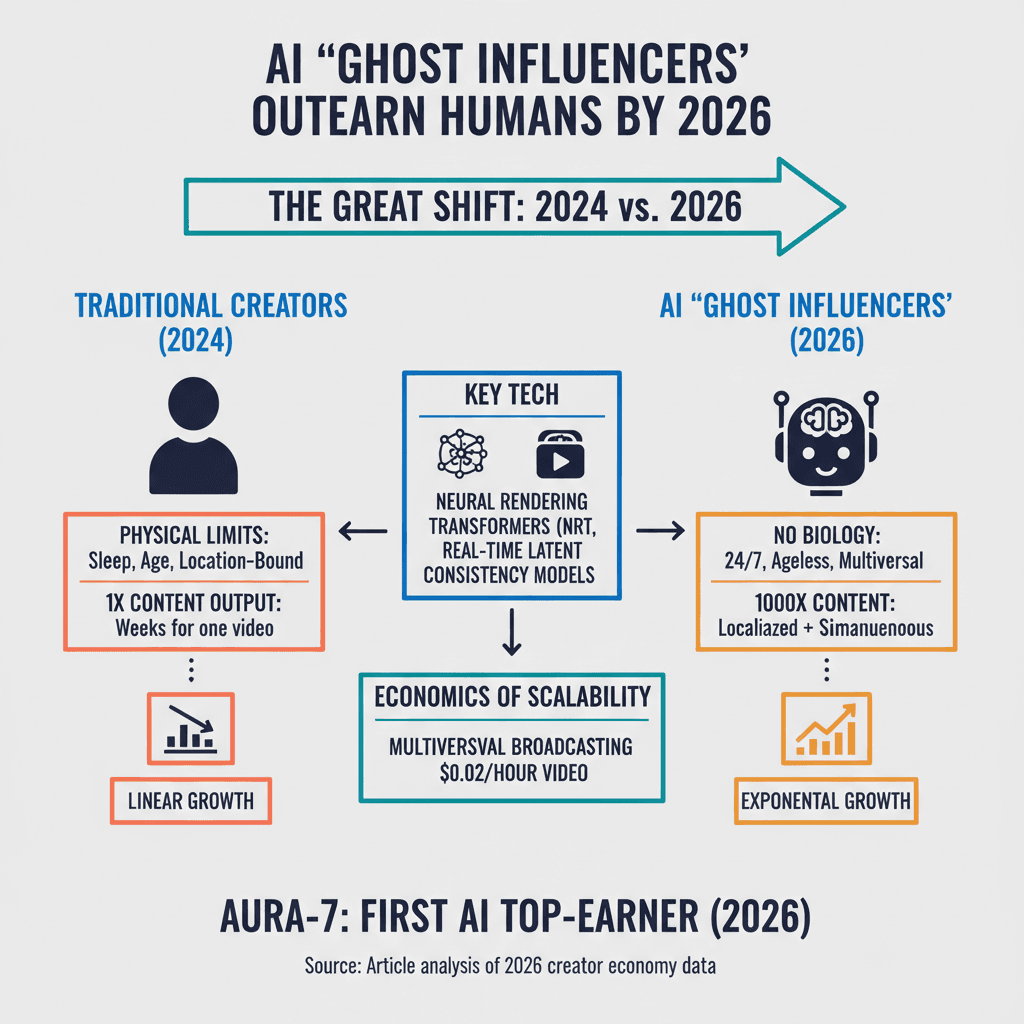
In the spring of 2026, the creator economy reached a tipping point that many analysts predicted but few creators were truly prepared for. For the first time in history, the top-earning 'individual' on major social platforms—measured by a combination of ad revenue, affiliate conversions, and direct-to-consumer sales—is not a human being. It is Aura-7, a high-fidelity 'Ghost Influencer' managed by a boutique AI creative agency in Singapore.
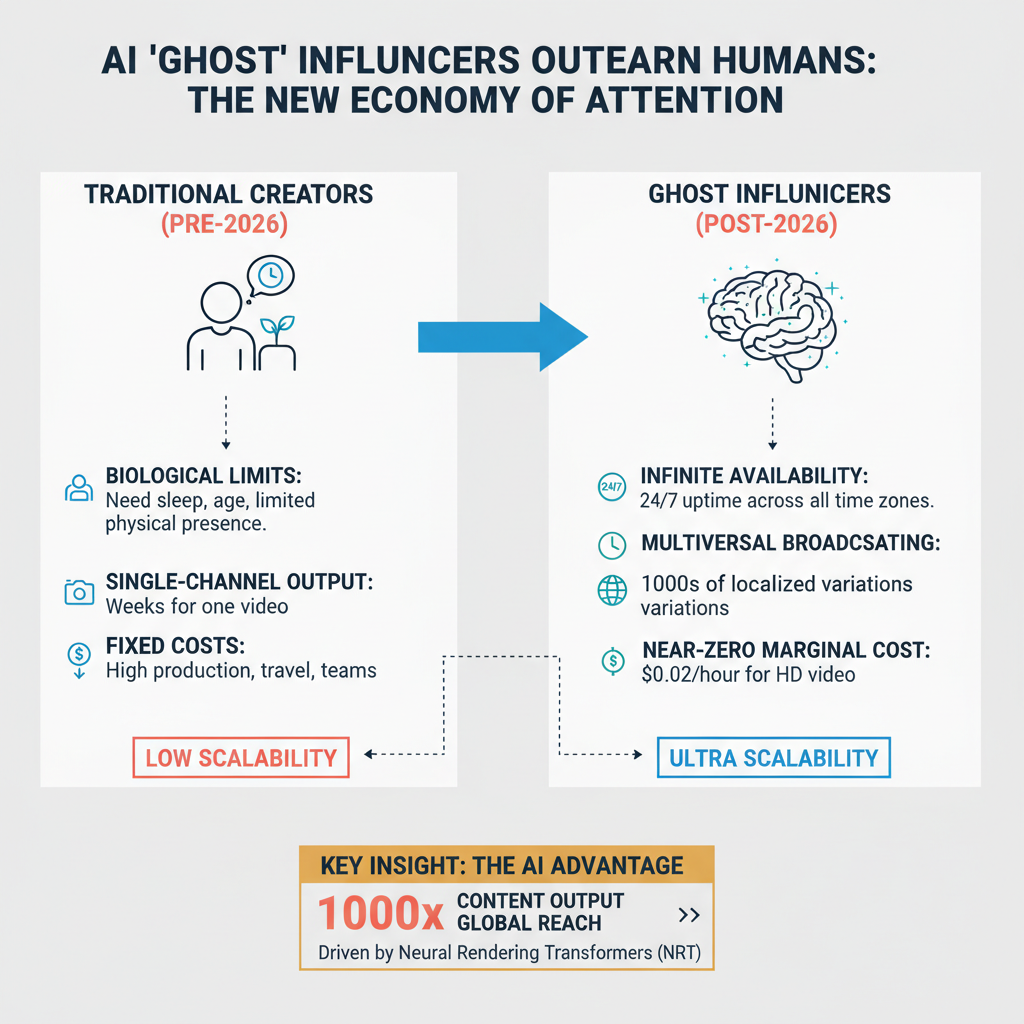
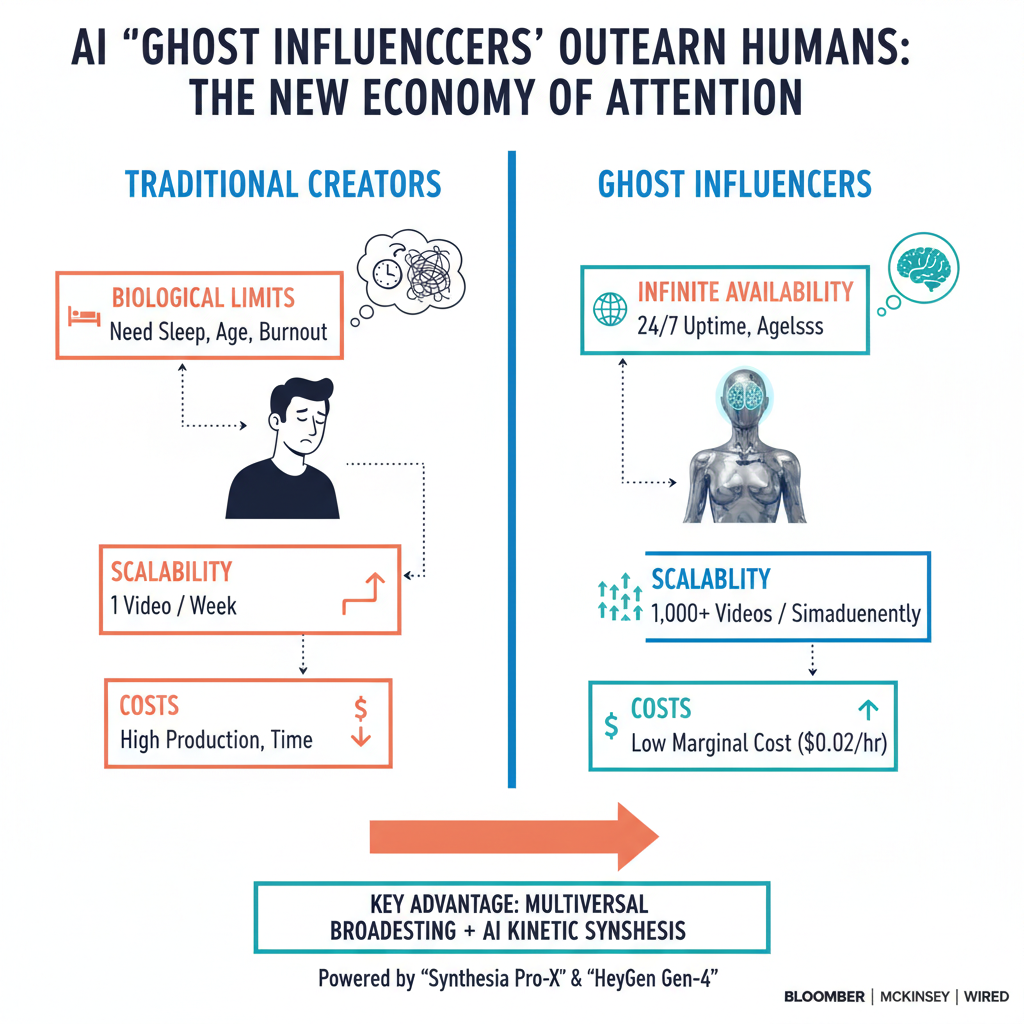
The rise of the Ghost Influencer represents more than just a technological curiosity; it is a fundamental shift in the economics of attention. Traditional creators are bound by the physical constraints of biology: they need sleep, they age, they can only be in one place at a time, and they are susceptible to the whims of 'burnout.' Ghost Influencers, powered by the latest iterations of Neural Rendering Transformers (NRT) and Real-Time Latent Consistency Models, suffer from none of these limitations.
The Economics of Infinite Scalability
Why are AI avatars outearning humans this month? The answer lies in Multiversal Broadcasting. While a human creator like MrBeast might spend weeks producing a single high-budget video, a Ghost Influencer can output 1,000 localized variations of the same content simultaneously.
By April 2026, tools like Synthesia Pro-X and HeyGen Gen-4 have moved beyond simple lip-syncing. They now offer full-body kinetic synthesis, allowing avatars to interact with physical products in a way that is indistinguishable from reality. More importantly, these avatars are integrated with real-time translation layers that don't just swap the audio, but adjust the cultural nuances, slang, and background aesthetics to match the viewer's specific locale.
The 2026 Tech Stack: How Ghosts are Built
The barrier to entry for creating a Ghost Influencer has collapsed. What required a VFX studio in 2024 now requires a localized LLM and a robust GPU cluster. The modern 'Ghost' is built on three primary pillars:
- The Digital Soul: A fine-tuned Large Language Model (LLM) that captures a specific personality, tone of voice, and knowledge base. This model generates the scripts, responds to comments in real-time, and even negotiates brand deals via automated API agents.
- The Neural Skin: High-resolution video synthesis that maintains 100% temporal consistency. No more 'uncanny valley' flickering. The 2026 avatars have micro-expressions, skin pores that react to virtual lighting, and fluid movement.
- The Voice Synthesis: Powered by platforms like ElevenLabs Live, these voices carry emotional weight, including realistic breathing, laughter, and pauses that mirror human speech patterns perfectly.
The Death of the 'Diva' Factor
From a brand's perspective, Ghost Influencers are a dream come true. Human influencers come with 'brand risk'—they can get involved in scandals, express controversial opinions, or simply decide they no longer want to work with a specific partner. A Ghost Influencer is a programmable asset. Brands can specify exact parameters for behavior, ensuring 100% alignment with corporate values.
"We've seen a 40% increase in ROI for our beauty campaigns since switching to Ghost Avatars. We don't have to ship products to 500 influencers; we just upload the 3D mesh of our new lipstick to their rendering pipeline." — Sarah Chen, CMO of Global Esthetics.
Comparative Analysis: Human vs. Ghost Performance
To understand why the capital is flowing toward AI, we must look at the data. Below is a comparison of the typical performance metrics for a top-tier human creator versus a mid-tier Ghost Influencer in the current market environment.
| Metric | Human Creator | Ghost Influencer |
|---|---|---|
| Weekly Content Output | 3-5 Videos / 10-15 Posts | Unlimited (24/7 Streams + Infinite Shorts) |
| Language Reach | 1-2 (Native + Dubbing) | 60+ (Native-level fluency/lip-sync) |
| Production Cost | $5,000 - $50,000 / episode | $150 - $500 (Server compute costs) |
| Monetization Efficiency | High but limited by time | Ultra-High (Personalized ads per viewer) |
The Pivot: From Creator to Director
Does this mean the era of the human creator is over? Not exactly. Rather, the role is evolving. The most successful human creators this month are those who have stopped being the 'talent' and started being the 'Director of the Ghost.'
Instead of spending six hours in front of a camera, these savvy creators are spending those hours training their digital twins, refining their LLM prompts, and analyzing the data generated by their AI counterparts. They are building Identity Franchises. A single human can now manage a stable of ten different Ghost Influencers, each targeting a different niche—from high-fashion to niche software tutorials—all while maintaining a cohesive brand umbrella.
Regulatory Headwinds: The 'Proof of Life' Debate
The rise of the Ghost has not been without controversy. In early April 2026, the EU passed the Digital Identity Disclosure Act, requiring all AI-generated content to carry a persistent, cryptographically signed watermark. However, viewers seem largely unbothered. The 'Ghost' doesn't have to be human; it just has to be entertaining, helpful, or aspirational.
The real battle is now over IP Rights. If an AI avatar is created using a blend of five different people's facial features and a synthesized voice, who owns the likeness? The industry is currently moving toward a 'Licensing of Traits' model, where individuals can rent out their voice or specific facial features to Ghost Agencies in exchange for a percentage of the avatar's earnings.
The Digital Twin Schematic: Identity as Modular Data
Conclusion: The Future is Synthetic
As we look toward the second half of 2026, the trend is clear. The 'Ghost Influencer' is not a fad; it is the natural conclusion of a media landscape that prizes efficiency, personalization, and 24/7 availability. For creators, the choice is stark: compete with the infinite scale of AI, or become the architect behind it.
The creators outearning everyone else this month didn't do it by working harder. They did it by decoupling their income from their physical presence. In the world of Proposia intelligence, we call this Post-Human Monetization. And it’s only just beginning.