The August 2026 Deadline: Why AI Governance Is No Longer Optional
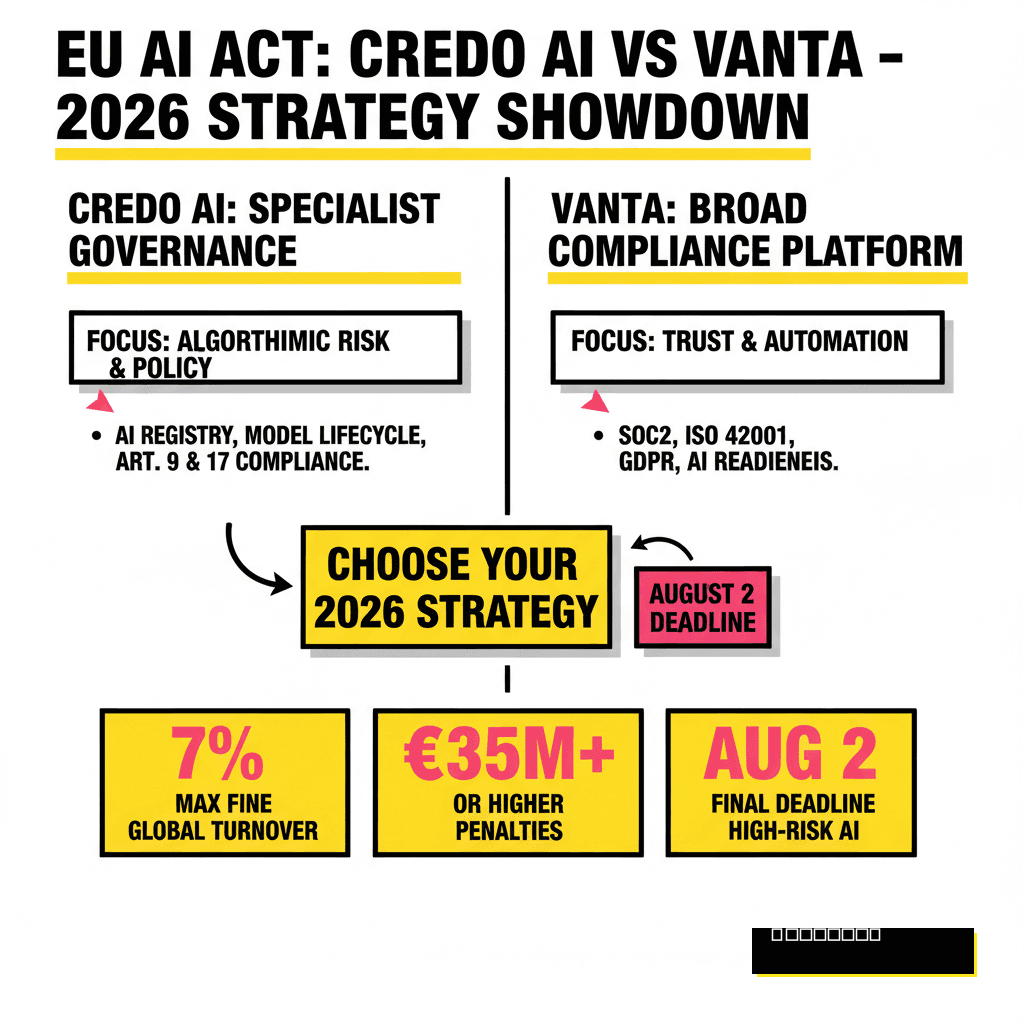
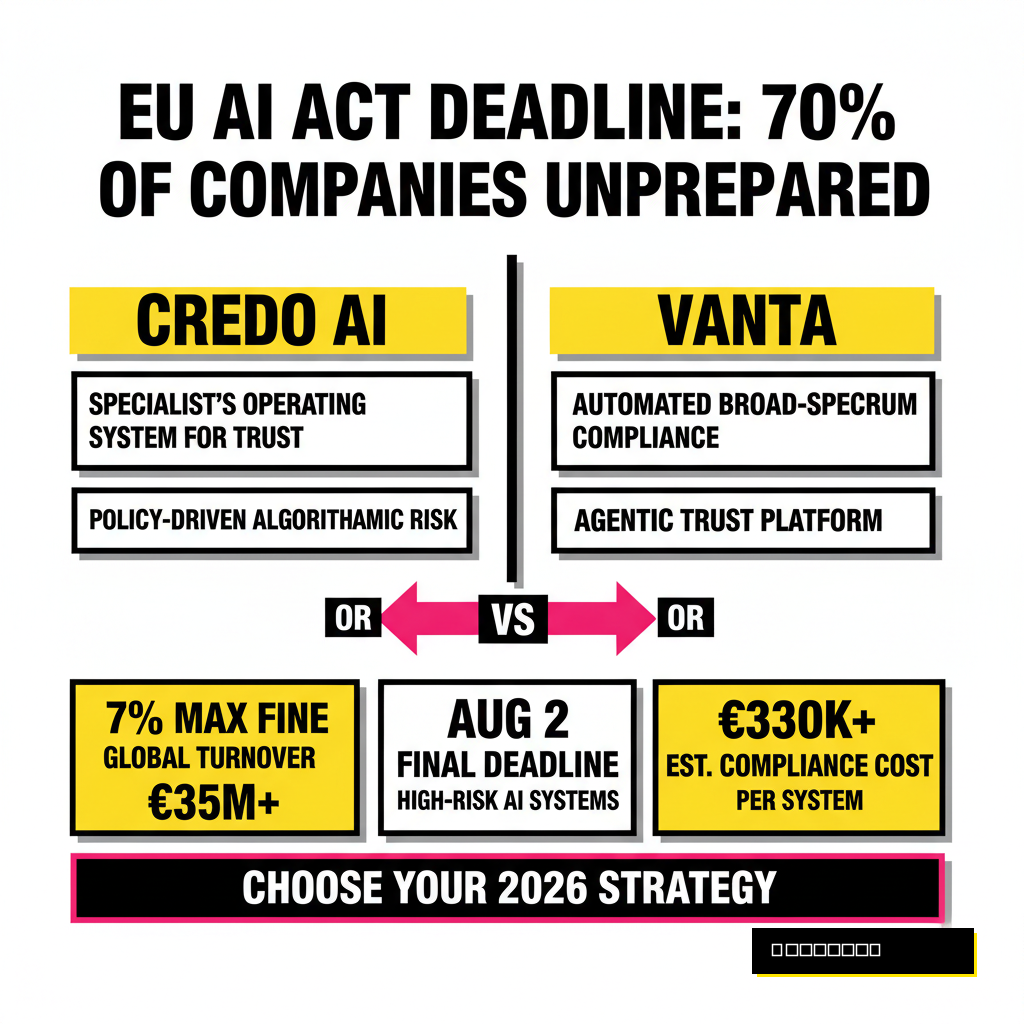
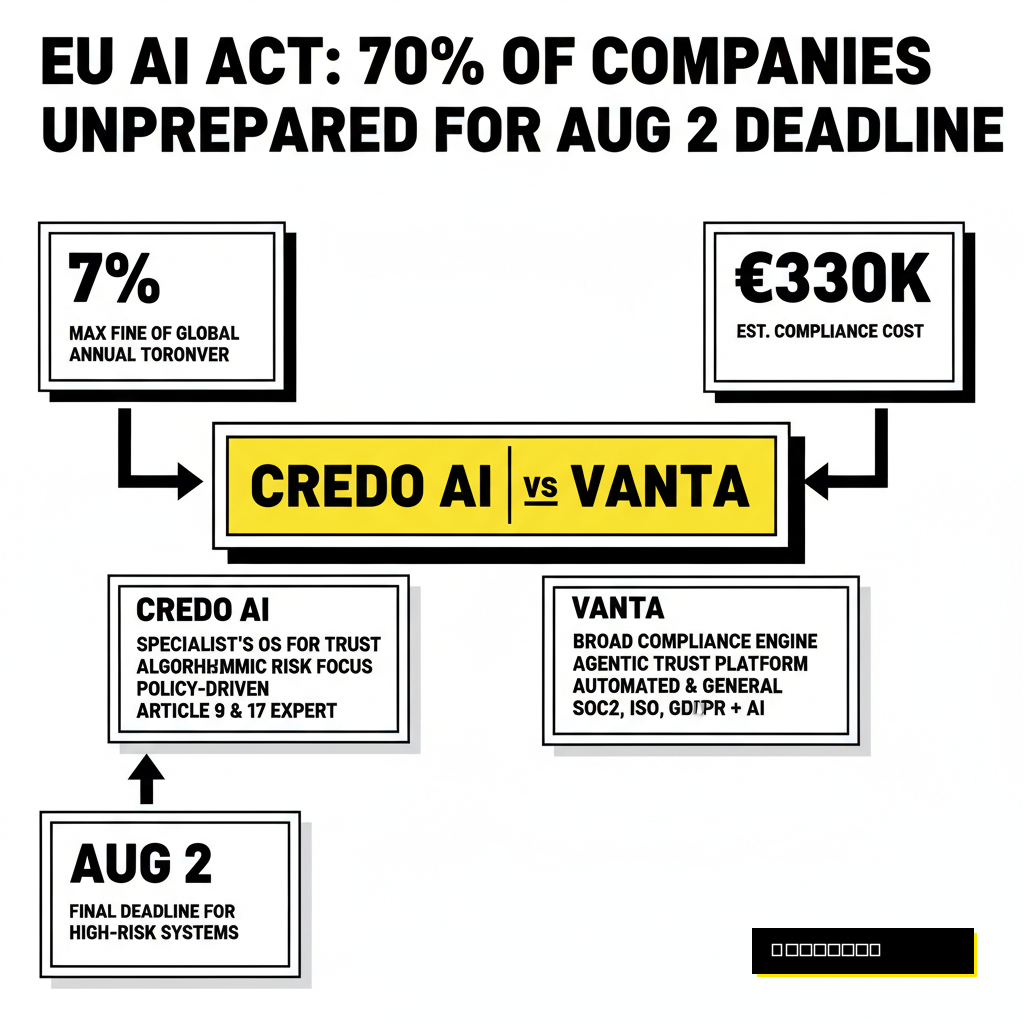
The grace period for the EU AI Act is officially ending. As of April 2026, the countdown to the August 2 deadline for high-risk AI systems is the primary concern for every enterprise operating within the European market. This is no longer a theoretical exercise for legal teams. It is a fundamental shift in how software is built, deployed, and audited. Organizations that fail to meet these standards face penalties of up to €35 million or 7% of global annual turnover, whichever is higher. According to a 2026 research report from the European Parliament, only about 30% of mid-sized firms feel fully prepared for the looming enforcement. This gap has turned the spotlight on two major players in the compliance space: Credo AI and Vanta.
Credo AI and Vanta approach this problem from different directions. Credo AI was built from the ground up to handle the specific nuances of algorithmic risk, while Vanta has evolved from a general security compliance tool into an agentic trust platform. Choosing between them depends on whether you need a deep, policy-driven operating system for responsible AI or an automated, broad-spectrum compliance engine that handles AI alongside SOC2, ISO 42001, and GDPR.
Credo AI: The Specialist’s Operating System for Trust
Credo AI positions itself as the operating system for trustworthy AI. It focuses on the entire lifecycle of a model, from initial data sourcing to post-market monitoring. For companies building high-risk systems, such as AI-driven hiring tools or credit scoring models, Credo AI provides the granular policy packs needed to satisfy Article 9 and Article 17 of the EU AI Act. The platform excels at bridging the communication gap between technical data scientists and legal compliance officers. It translates complex regulatory requirements into actionable technical controls that teams can implement during the development phase.
One of the standout features of Credo AI is its comprehensive AI Registry. This allows organizations to catalog every model, agent, and application in use. By centralizing this inventory, companies can quickly identify which systems fall under the high-risk category of Annex III. However, it is important to note that Credo AI typically focuses on documentation and policy rather than real-time runtime enforcement. You will often need to integrate it with external observability tools to block unsafe outputs in production. This depth is why Credo AI was named one of the most innovative companies of 2026 by Fast Company. It is the go-to choice for heavily regulated industries where the cost of a single biased decision could be catastrophic. For those concerned about data rights during this process, using 4 AI privacy agents can help automate permissions alongside your governance framework.
Vanta: Automating Compliance Through Agentic Trust
Vanta has taken a different path by focusing on automation and speed. In 2026, Vanta is marketed as an Agentic Trust Platform. It uses its own AI agents to continuously monitor an organization’s environment for compliance gaps. While Credo AI asks, "Is this model ethical?", Vanta asks, "Is this model secure and documented according to our standards?" Vanta is particularly effective at discovering shadow AI. According to Vanta’s 2026 data, 70% of companies have AI tools accessing their environment without proper procurement. Vanta’s automated scanners find these tools and pull them into a centralized dashboard for review.
The Credo AI Logic
- Deep focus on algorithmic fairness and bias.
- Lifecycle-spanning policy enforcement.
- Manual assessment workflows for complex risks.
- Best for high-risk, custom-built AI providers.
The Vanta Logic
- Automated evidence collection via agents.
- Broad coverage of security and AI frameworks.
- Rapid discovery of shadow AI tools.
- Best for fast-growing firms scaling multiple standards.
The platform’s strength lies in its ability to manage multiple frameworks simultaneously. If you are already using Vanta for SOC2 or ISO 27001, adding the EU AI Act module is a logical step. It reuses existing controls to reduce redundant work. Jeremy Epling, Vanta’s Chief Product Officer, noted in early 2026 that their goal is to embed a 24/7 GRC engineer into every security team. This makes Vanta a highly attractive option for mid-market companies that do not have the resources for a massive, dedicated AI ethics department. Ensuring this level of trust also plays into your brand's digital presence, which is a core component of 8 AI search optimization tactics for maintaining authority in generative search results.
Side-by-Side: Comparing Features for 2026 Requirements
When comparing these platforms, the choice often comes down to the depth of the AI-specific requirements versus the breadth of the overall compliance program. The EU AI Act requires more than just a checklist; it requires technical documentation, logging, and human oversight mechanisms. Credo AI provides a more structured environment for the Fundamental Rights Impact Assessments (FRIAs) required for certain high-risk systems. Vanta, on the other hand, provides a more streamlined path for general-purpose AI (GPAI) model providers who need to prove transparency and copyright compliance without the heavy lift of custom model auditing.
| Feature Capability | Credo AI | Vanta |
|---|---|---|
| EU AI Act Policy Packs | Comprehensive / Specialist | Standardized / Automated |
| Shadow AI Discovery | Moderate (Integration based) | High (Native scanners) |
| Algorithmic Bias Testing | Native Workflows | External Integration Required |
| Multi-Framework Support | AI-Centric Only | Broad (SOC2, ISO, HIPAA) |
| Implementation Speed | 4-8 Weeks | 1-3 Weeks |
Cost is another significant factor. For a mid-sized enterprise, the initial cost of compliance for a high-risk system can range between €144,350 and €247,150. Credo AI tends to have higher setup costs due to the level of customization required for complex AI lifecycles. Vanta offers a more economical entry point, especially for companies that are already paying for their GRC suite. The trade-off is that Vanta might require more manual effort to satisfy the most stringent technical documentation requirements of the Act (Articles 11 and 12), whereas Credo AI has those templates built into its core DNA.
The Implementation Roadmap: Moving from Pilot to Compliant Production
Moving a system into production under the 2026 regulatory regime requires a clear sequence of events. You cannot simply flip a switch and be compliant. It starts with a comprehensive inventory of every AI system in use, followed by a risk classification. Once a system is identified as high-risk, the heavy lifting of conformity assessments and technical documentation begins. This process must be iterative, not a one-time event. Gerald Kierce, CEO of Trustible, has pointed out that governance is not about slowing innovation, but about removing the uncertainty that prevents scaling. If you cannot explain or defend your AI use cases, you cannot expand them.
The choice between Credo AI and Vanta often signals an organization’s AI maturity. Organizations that are building their own proprietary models and deploying them in sensitive areas like healthcare or law enforcement will find Credo AI’s depth indispensable. Those that are primarily using third-party AI agents and SaaS tools will find Vanta’s automation more than sufficient. As the August deadline approaches, the priority should be on establishing a system of record that can withstand a regulatory audit. Whether that is a specialist platform or a broad GRC tool, the goal is the same: building a foundation of trust that allows your business to grow without the fear of a 7% fine.
Final Decision: Which Platform Fits Your 2026 Strategy?
Choosing your governance partner is a strategic decision that will affect your product roadmap for years. Credo AI is the right choice if your primary risk is the model itself—the bias, the fairness, and the specific regulatory scrutiny of an AI-first product. Vanta is the right choice if your primary risk is the organization—the sprawl of tools, the security of data, and the need to maintain multiple compliance certifications with a lean team. Both platforms have recognized that the future of business is not just about building AI, but about proving that the AI is safe. Organizations that invest in these platforms now are not just avoiding fines; they are gaining a competitive advantage by being able to move faster and more confidently than their ungoverned peers.
The era of experimental AI is over. By 2026, the market has made it clear that accountability is the only way forward. Whether you choose the deep specialization of Credo AI or the agentic automation of Vanta, the most important step is to start the process today. The window for compliance is closing, and the regulators are no longer just watching—they are ready to act.