The Production Engine Reality: CC Integration vs Standalone Power
Creative departments in 2026 no longer treat AI as a experimental curiosity. High-volume production demands a choice between two distinct philosophies. Adobe Firefly 4 represents the integrated approach, where generative tools exist as features within the Creative Cloud ecosystem. Midjourney v7 remains the specialist engine, prioritizing raw aesthetic quality and rapid iteration via its refined web interface. Understanding which platform fits your agency requires looking past the pixels and focusing on the friction in your daily pipeline.
Adobe Firefly 4
- Native Photoshop Generative Fill and Expand
- Vector generation directly in Illustrator
- Firefly AI Assistant for multi-step tasks
- Brand Intelligence for style compliance
Midjourney v7
- Superior aesthetic control and textures
- Draft Mode for 10x faster iteration
- Model Personalization based on user taste
- Integrated 3D and video generation
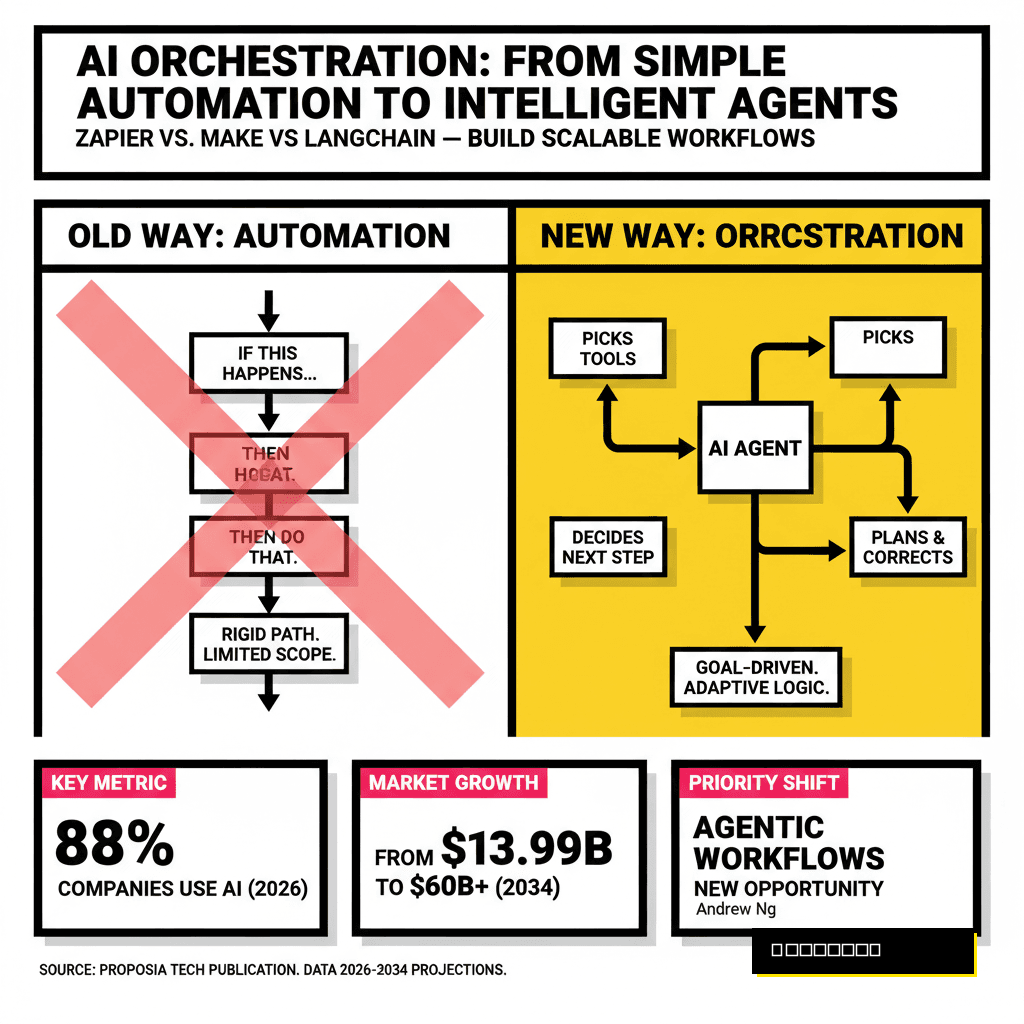
Firefly 4 introduced the Firefly AI Assistant in April 2026, which allows creators to execute complex workflows through natural conversation. A designer can ask the assistant to generate a hero image, resize it for five social platforms, and apply brand-compliant typography in a single sequence. Midjourney v7 counters this with its new Draft Mode. This feature renders images at ten times the speed of previous versions, allowing for a liquid flow of ideas that feels more like sketching than prompting. While Midjourney excels at the initial spark of creation, Adobe wins on the finishing line where assets must be prepped for export.
Intellectual Property and the Enterprise Indemnity Gap
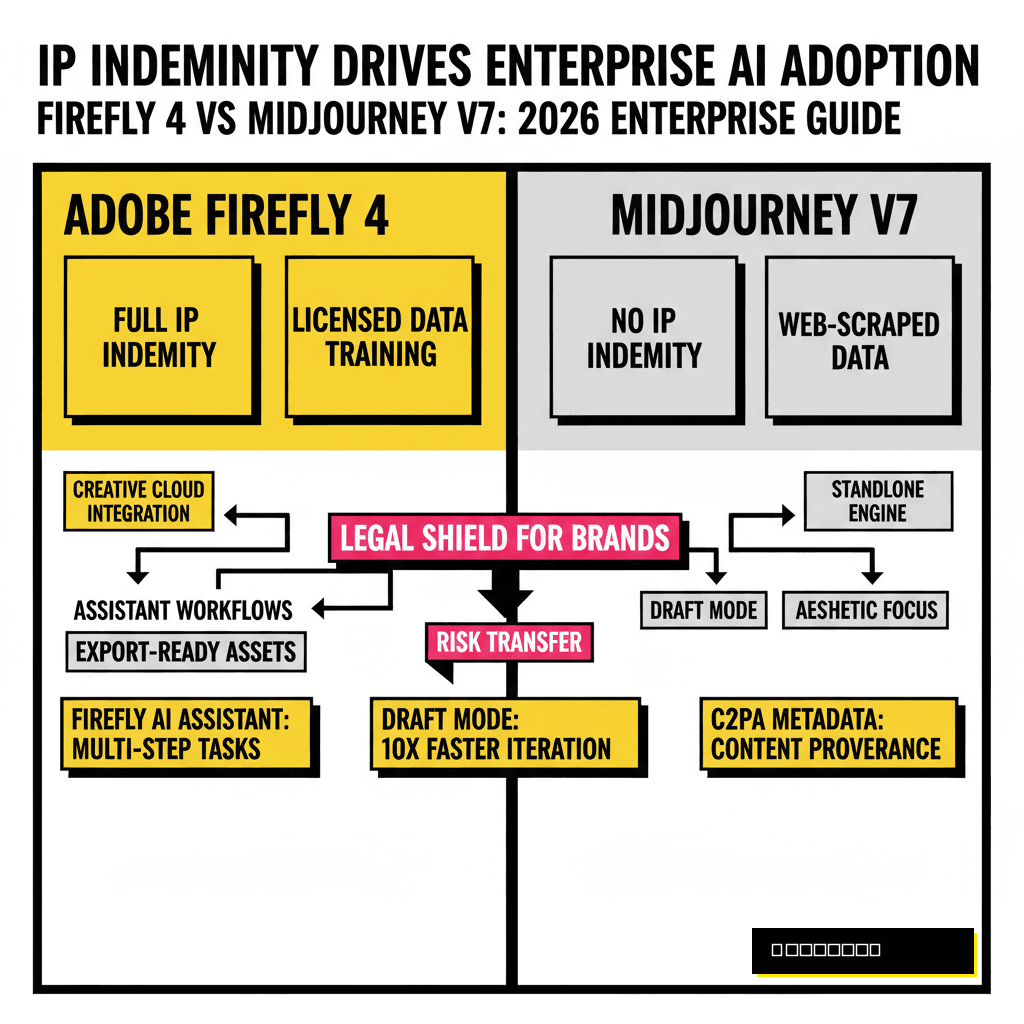
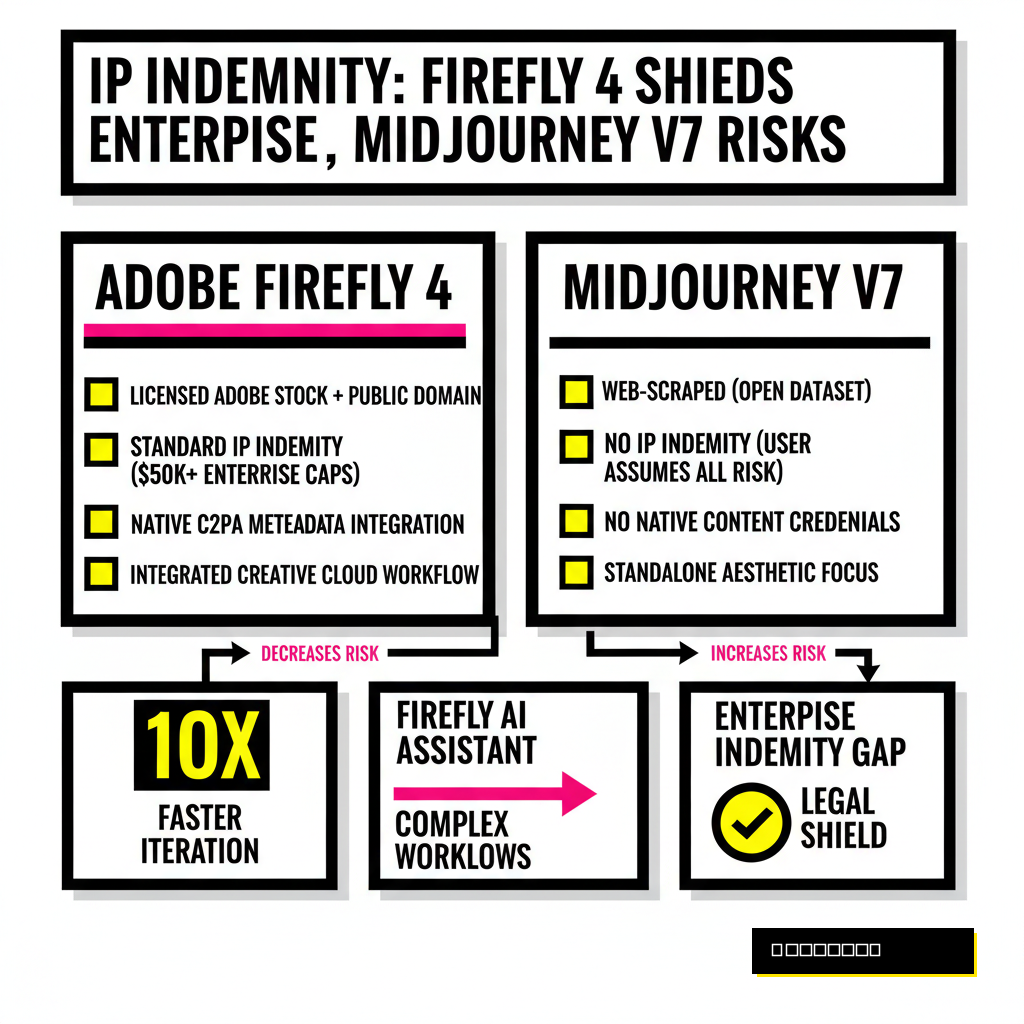
Commercial safety remains the primary hurdle for large-scale AI adoption. Adobe continues to distance itself from competitors by offering full IP indemnification for enterprise customers. This legal shield is possible because Firefly is trained exclusively on licensed Adobe Stock and public domain content. For a global brand, the risk of a copyright claim outweighs the benefit of a slightly more artistic AI output. Agencies producing client-facing work often default to Firefly to ensure their deliverables are legally sound.
| Feature | Adobe Firefly 4 | Midjourney v7 |
|---|---|---|
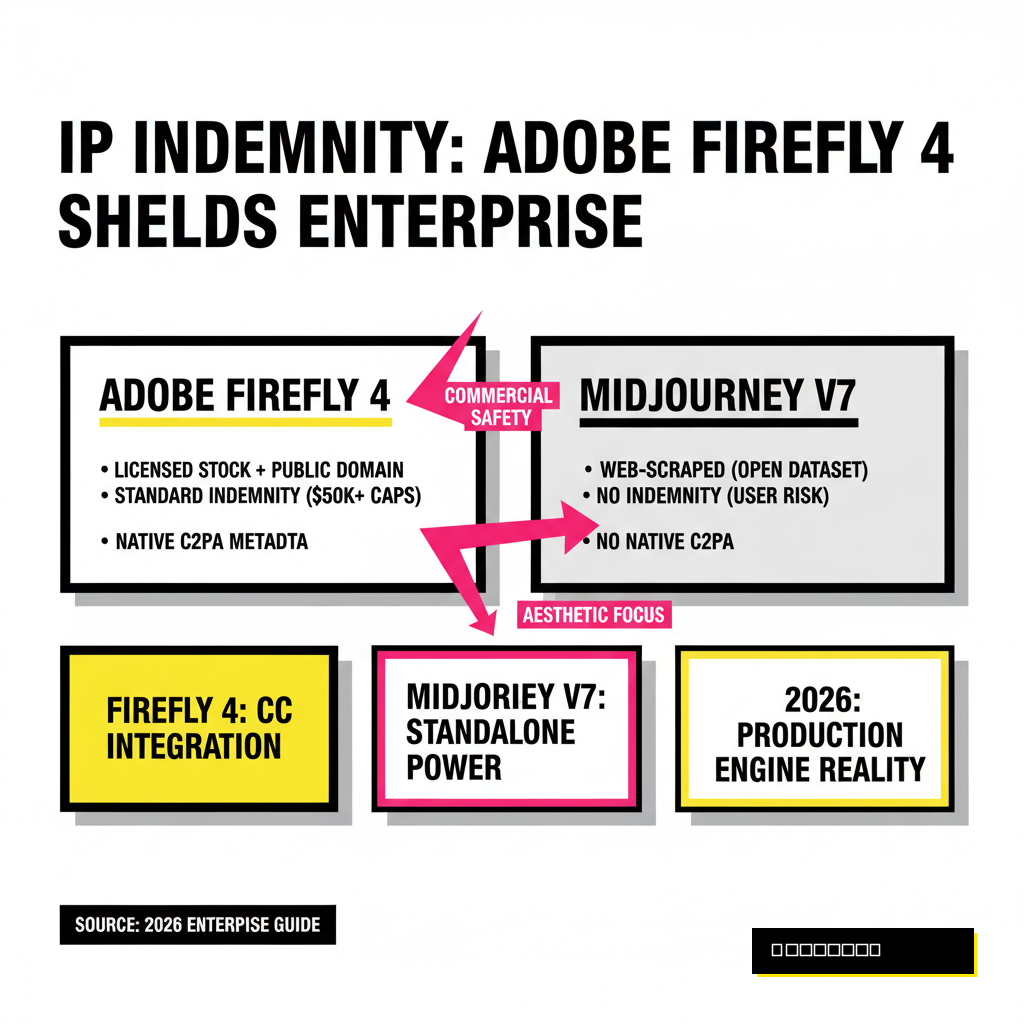
| Training Data | Licensed Adobe Stock + Public Domain | Web-scraped (Open Dataset) |
| IP Indemnity | Standard ($50k+ Enterprise caps) | None (User assumes all risk) |
| Content Credentials | Native C2PA metadata integration | Minimal / Optional |
| Brand Safety | Built-in Brand Intelligence filters | Community-moderated |
Midjourney v7 terms of service as of April 2026 still explicitly disclaim liability for third-party intellectual property claims. While the model is arguably the most powerful artistic engine ever built, it lacks the provenance required by regulated industries. Proposia previously discussed this in our guide on 2026 AI Compliance, where we noted that the lack of a clear audit trail is a deal-breaker for Fortune 500 legal teams. Firefly 4 solves this by cryptographically binding Content Credentials to every export, proving the asset's origin and the specific AI models used in its creation.
Prompt Engineering vs Precision Control
The era of the thousand-word prompt is ending. Firefly 4 emphasizes precision through UI-based controls rather than linguistic gymnastics. The new Precision Flow tool uses a slider system to adjust the mood, lighting, and composition of a generated image in real-time. Instead of guessing how the AI interprets the word cinematic, a user simply slides the lighting intensity toward the desired look. This shift toward direct manipulation makes the tool accessible to senior art directors who may not want to spend their day fine-tuning text strings.
Midjourney v7 takes a different path by doubling down on model personalization. By analyzing your previous favorites and rating history, the engine builds a unique aesthetic profile that is active by default. This means two different users can provide the same prompt and receive radically different results tailored to their specific style. This level of artistic intuition is unmatched, but it can make collaborative work difficult when a team needs a unified look. Firefly 4 counters this with Style Kits, which allow an agency to lock in specific brand parameters so every team member generates consistent visuals.
Cost Analysis and ROI for Creative Agencies
The economics of AI image generation have shifted from subscription costs to GPU efficiency and time-to-market. According to a 2026 Forrester Research report, agencies using AI automation for personalization saw a 67% reduction in content production costs. Midjourney's pricing remains competitive, with the Mega Plan at $120 per month offering 60 hours of fast GPU time. However, the hidden cost of Midjourney is the lack of centralized management. Adobe Creative Cloud for Enterprise provides the administrative tools necessary for large teams, including pooled credits and single sign-on security.
ROI is increasingly measured by how many steps an image takes to reach a final destination. An image generated in Midjourney must be downloaded, upscaled, imported into Photoshop, and manually masked. Firefly 4 allows these steps to happen within a single application. For agencies producing thousands of assets per month, the time saved by staying within the Adobe ecosystem often justifies the higher per-seat cost. Furthermore, the ability to generate vectors natively in Illustrator with Firefly 4 eliminates the need for manual tracing, a task that previously took hours of junior designer time. This integration is why we consider Adobe the verified human choice for professional output where efficiency is paramount.
The Workflow Bridge: API and Automation
Enterprise users are moving away from manual prompting and toward automated pipelines. Firefly Services provides a robust API that allows developers to trigger generations directly from a Digital Asset Management (DAM) system. A retailer can automatically generate thousands of lifestyle backgrounds for product shots as soon as a new SKU is uploaded. Midjourney has made progress with its own API, but it remains heavily focused on the creative individual rather than the corporate infrastructure. The 2026 landscape favors platforms that play well with others.
The integration of partner models like Kling 3.0 and Google Nano Banana 2 into Firefly Services marks a significant change. Adobe is no longer just a model provider; it is becoming an orchestration layer for creative AI. This allows agencies to use Firefly's secure framework and Content Credentials while benefiting from the specialized strengths of other models. Midjourney remains a closed ecosystem, which preserves its unique look but limits its utility in a modern, multi-model production environment. For more technical details on managing these models at scale, consult our Local LLM Handbook.
Final Verdict: Choosing Your Primary Engine
The decision between Firefly 4 and Midjourney v7 comes down to your position in the creative value chain. If your work involves high-stakes branding, regulated industries, or massive volume where every second of friction counts, Firefly 4 is the logical choice. Its legal protections and deep integration into the world's most popular design tools make it the standard for enterprise production. Adobe's commitment to the Content Authenticity Initiative ensures that your work remains trustworthy in an era of synthetic media.
Midjourney v7 is the better fit for independent creators, boutique agencies, and conceptual artists who need to push the boundaries of what AI can visualize. Its ability to capture complex textures and maintain character consistency across different scenes is still the industry gold standard for pure artistry. Many top agencies now use both: Midjourney for the initial ideation and mood boarding phase, and Firefly for the final asset production. This hybrid approach allows you to capture the best of both worlds—unmatched creativity and enterprise-grade reliability.