The Great Decoupling of Human Seats and Digital Labor
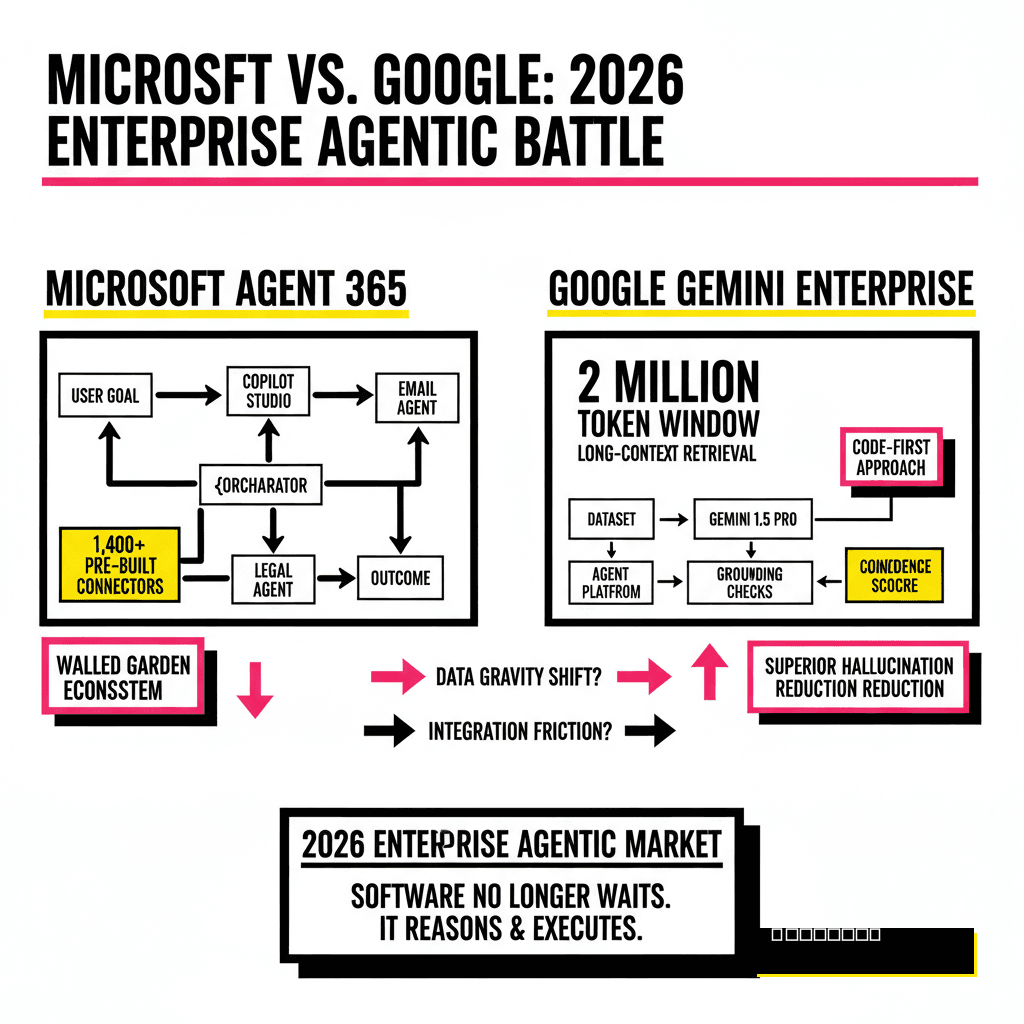
We have officially moved past the era where AI was just a clever chat interface. By May 2026, the conversation in boardrooms has shifted from how to prompt a bot to how to govern thousands of autonomous agents. Our current reality is one where software no longer waits for a human click. Instead, it observes, reasons, and executes complex workflows across entire departments. Microsoft and Google are currently locked in a struggle to become the primary operating system for this new class of digital labor. This competition is not just about who has the better model. It is a fight for the very plumbing of the modern enterprise.
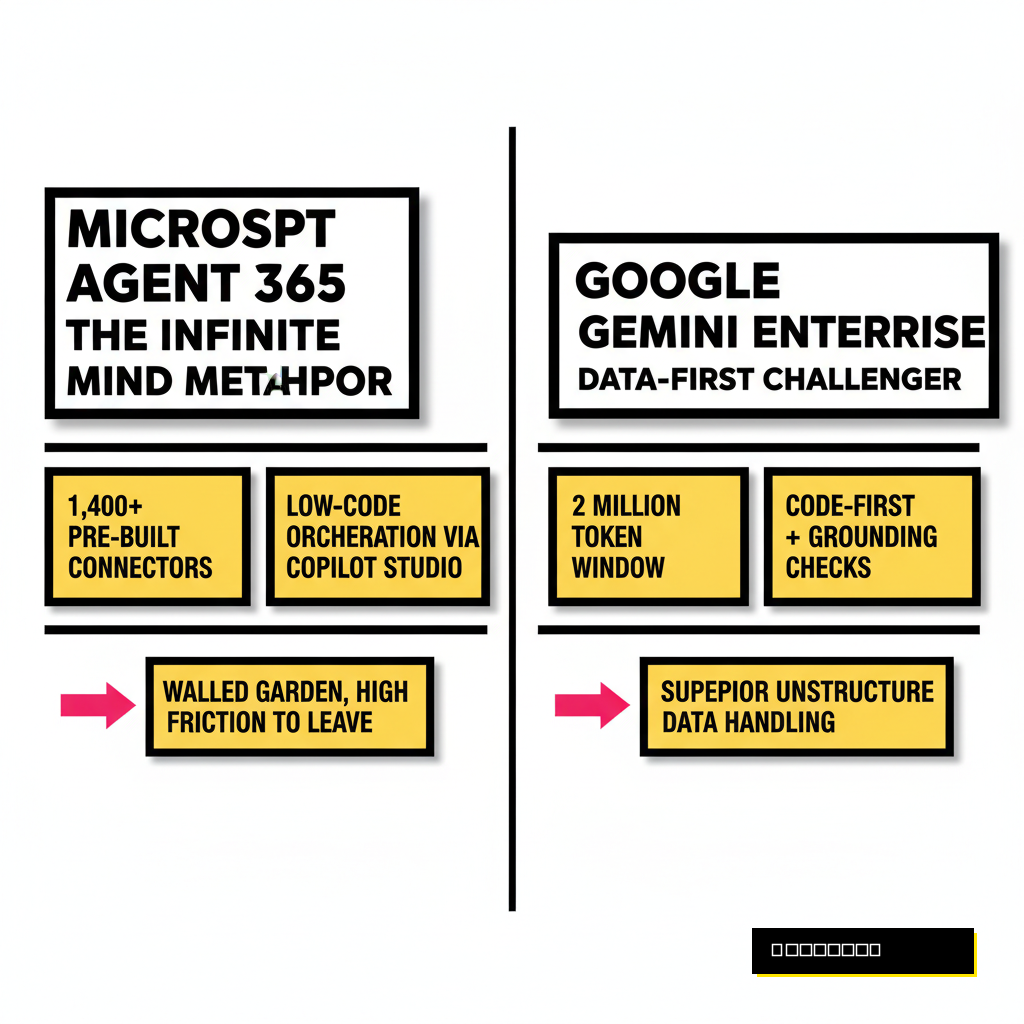
Microsoft Agent 365 and the Infinite Mind Metaphor
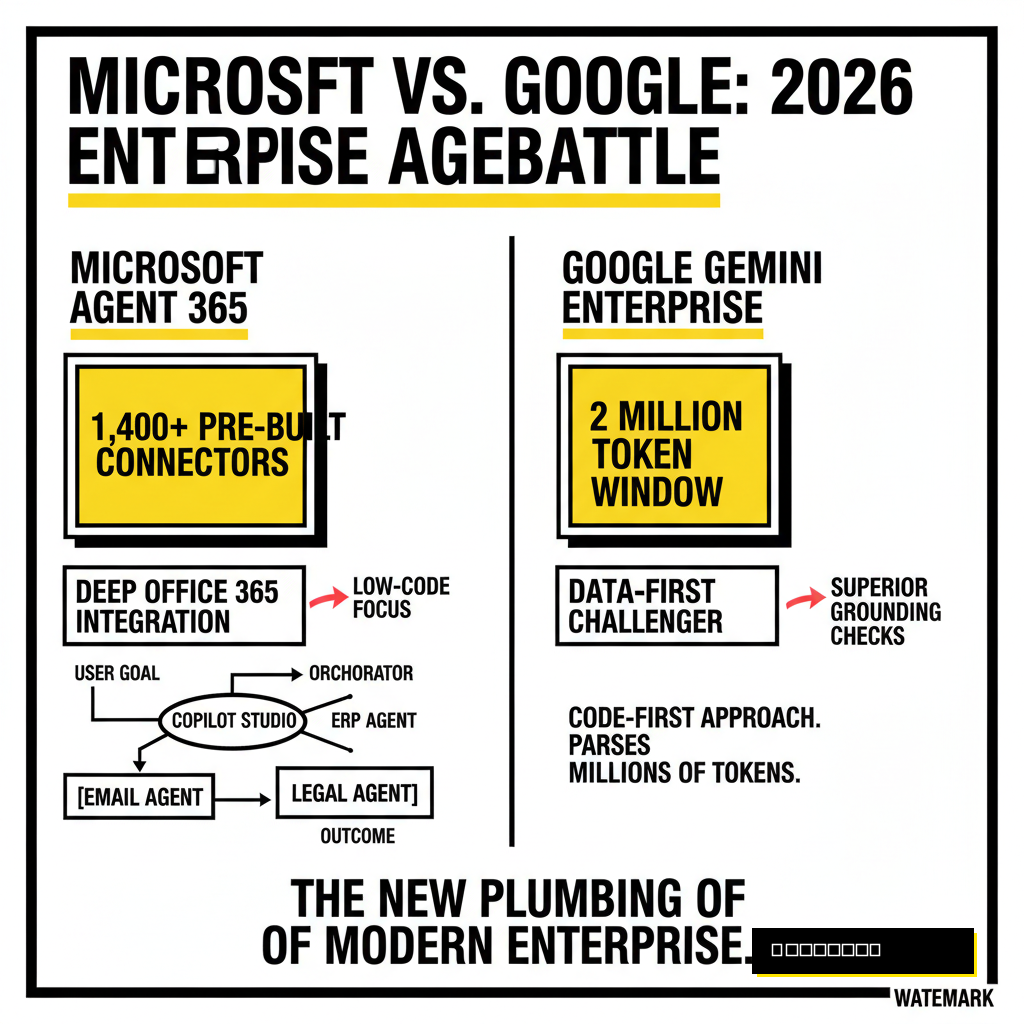
Satya Nadella recently described the 2026 workforce as a collection of managers overseeing an infinite set of minds. Microsoft is betting heavily on its integrated ecosystem to make this a reality. The launch of Agent 365 earlier this month signals a pivot away from the old per-user SaaS model. Organizations now use Copilot Studio to build custom agents that live inside Teams and Outlook, effectively turning every employee into an orchestrator. These agents inherit the security protocols of Microsoft Purview and Entra ID automatically. While the walled garden approach remains, the sheer scale of the 1,400 pre-built connectors makes it hard for competitors to dislodge them. Businesses find that the friction of moving data out of the Microsoft Graph is often too high to justify switching.
Google Gemini Enterprise: The Data-First Challenger
Google has taken a different route by focusing on the raw power of long-context retrieval and data grounding. The rebranding of Vertex AI into the Gemini Enterprise Agent Platform at Google Cloud Next 2026 was a clear signal to the market. Sundar Pichai is doubling down on the idea of recursive self-improving paradigms. Google agents excel in environments where they must parse millions of tokens across messy datasets. The Gemini 1.5 Pro model allows for a 2 million token window, which remains a massive advantage for companies with deep archives of unstructured data. Developers often prefer Google for its code-first approach and superior grounding checks. These checks provide a confidence score for every claim an agent makes, reducing the risk of hallucinations in high-stakes financial or legal environments.
Microsoft Agent 365
- Deeply integrated with Office 365 apps
- Low-code focus for citizen developers
- Strong native governance via Purview
- Best for employee productivity tasks
Google Gemini Enterprise
- Massive 2M token context window
- Developer-first with high customization
- Superior grounding and citation tools
- Best for deep data analysis and RAG
The Economics of the Agentic Tax
We are seeing a radical shift in how enterprises budget for technology. According to a 2026 IDC report, worldwide spending on AI infrastructure is on track to surpass $223 billion by 2028. This growth is driven by what many are calling the Agentic Tax—the continuous inference costs associated with agents that run 24/7. Traditional seat-based pricing is dying. In its place, we see outcome-based models where you pay for the successful completion of a task. Microsoft has already begun rolling out pay-as-you-go pricing for agents in Dynamics 365. This change forces companies to think of AI as a variable labor cost rather than a fixed software expense. Managing this spend requires new strategies, similar to how agentic SEO tactics have redefined marketing budgets over the last year.
Portfolio Implications: Where the Smart Money is Moving
Investors must look beyond the hyperscalers to find the true winners of this era. While Microsoft and Google capture the platform layer, the real alpha is found in the companies providing the connective tissue. We are watching the rise of Agentic Ops (AgOps) startups that help businesses monitor and kill runaway agents. Infrastructure providers that focus on energy-efficient inference are also seeing massive inflows. The move toward digital labor means that legacy SaaS companies without a clear agentic story are at risk of being replaced by lightweight AI extensions and autonomous scripts. Your portfolio should reflect a balance between the giants providing the foundation and the agile players building the governance tools.
| Investment Sector | Key Driver | Risk Level |
|---|---|---|
| Hyperscalers (MSFT/GOOG) | Platform dominance and CAPEX scale | Low |
| AgOps & Governance | Agent sprawl and security needs | Medium |
| Custom Silicon (NVIDIA/TPUs) | Inference demand at production scale | Low |
| Legacy SaaS Integrators | Professional services for agent builds | High |
Constructing Your Agentic Infrastructure
Leaders should not rush to pick a single winner today. Most successful 2026 enterprises use a hybrid stack. They employ Microsoft for general employee productivity and Google for data-heavy intelligence. The critical task is ensuring these agents can communicate through emerging standards like the Model Context Protocol (MCP). Without interoperability, you risk creating new silos that are even harder to manage than the old ones. Focus on building a robust governance layer first. This includes real-time monitoring and automated kill switches to prevent agents from violating policy. The organizations that win this decade will be those that treat digital labor with the same rigor they apply to their human workforce. We are no longer just buying software. We are hiring an infinite set of minds.