The Post-Smartphone Mirage Meets Reality
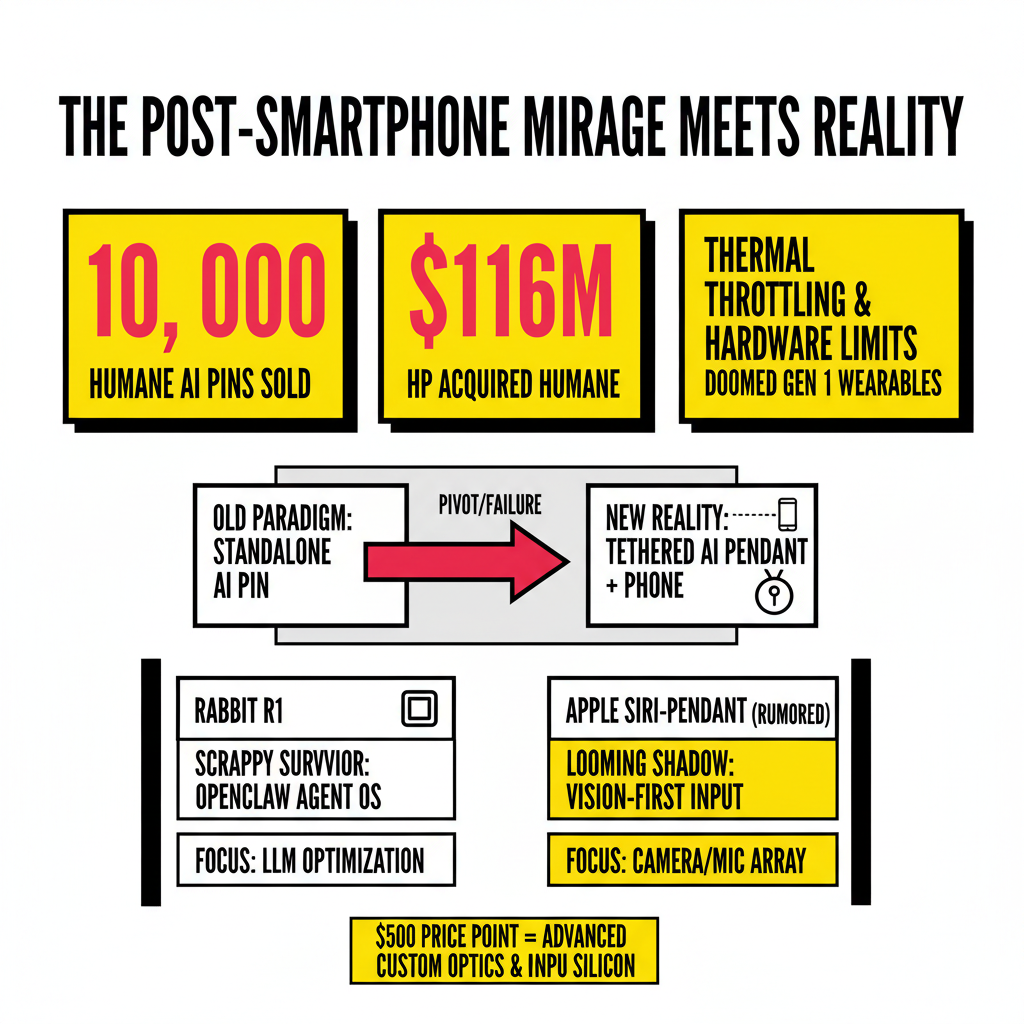
Silicon Valley's obsession with killing the smartphone has finally hit a wall of hard economics and thermal throttling. For three years, we watched startups promise a screenless utopia where a pin or a puck would handle our digital lives through ambient voice commands. By April 2026, the dust has settled on the first generation of failures, leaving us with a market divided between scrappy survivors and the looming shadow of Cupertino. Developers who once dreamed of building for a new OS now face a fragmented landscape where the hardware is finally catching up to the LLM hype.
Hardware remains the ultimate gatekeeper for agentic workflows. While software agents like those discussed in our analysis of 9 AI coding extensions outperforming Copilot can live in the cloud, a wearable must survive the physical world. It needs to see what you see without melting against your chest or running out of juice by noon. The current $500 price point reflects the cost of high-density NPU silicon and custom optics required to make these devices more than just glorified Bluetooth microphones.
The Fall of the Pin: Why Humane Became an HP Patent Farm
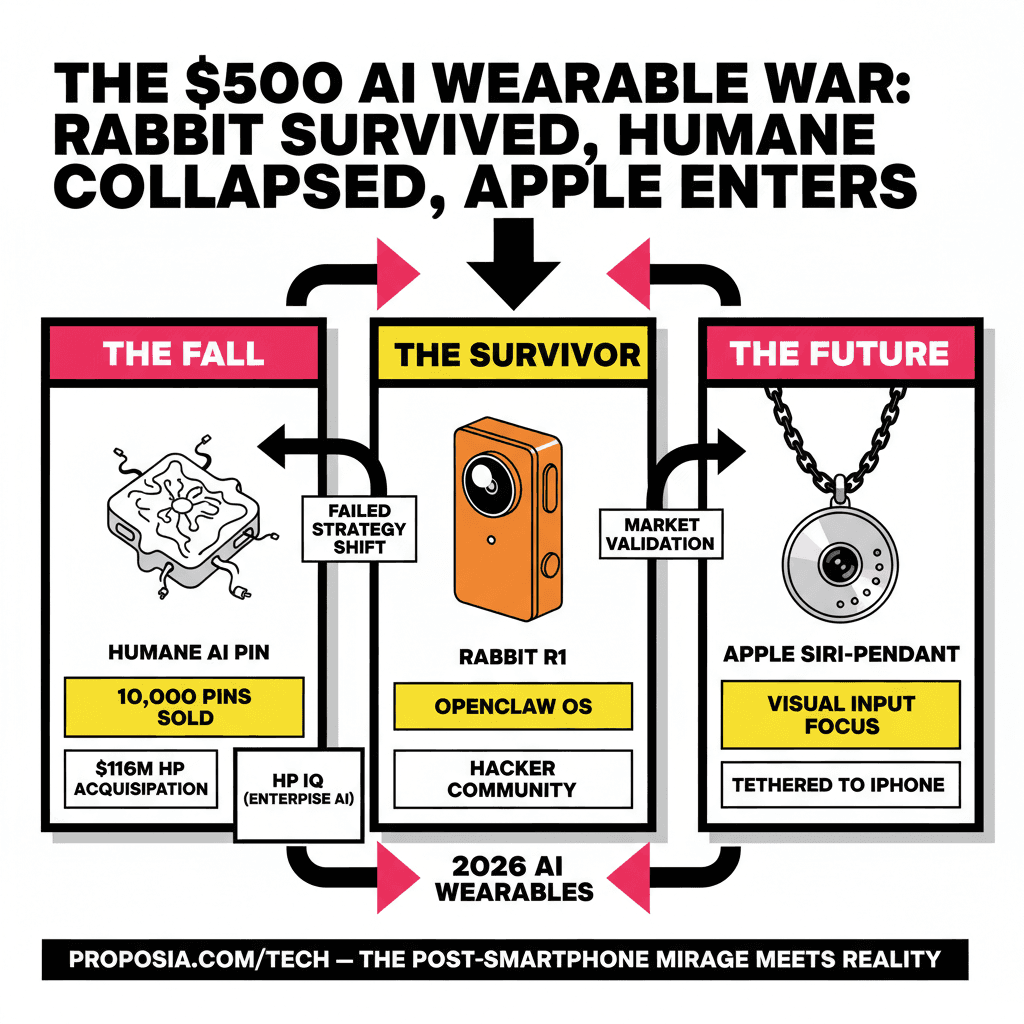
Humane’s trajectory serves as a mandatory case study for any hardware founder. Their AI Pin was supposed to be the iPhone of the 2020s, yet it ended its life as a cautionary tale of over-engineering and poor thermal management. According to a February 2025 report from The Decoder, HP acquired Humane’s assets for $116 million after the startup failed to hit even 10% of its sales targets. The devices were permanently bricked on February 28, 2025, leaving early adopters with expensive titanium paperweights.
Technical debt and a stubborn refusal to tether to a phone killed the device before it could find an audience. By trying to cram an entire cellular radio and a laser projector into a tiny chassis, Humane created a device that spent more time cooling down than processing queries. HP has since folded the remaining team into a division called HP IQ, focusing on integrating the CosmOS orchestration layer into enterprise laptops rather than consumer wearables. For developers, this was a clear signal: the standalone wearable dream is dead, at least for now.
The Rabbit Pivot: From LAM Hype to OpenClaw Agent
Rabbit survived the initial backlash by leaning into the hacker community and rapid-fire software updates. While the original Rabbit R1 was panned for its latency, the 2026 Revision has found a niche as a dedicated interface for autonomous agents. The launch of Rabbit OS 2.1 on April 6, 2026, introduced the Desktop Large Action Model (DLAM), which allows the R1 to act as a plug-and-play controller for Windows and Mac systems via USB. This shift from a "phone replacement" to a "physical macro key for your life" saved the company.
Integration with OpenClaw has been the real turning point for power users. OpenClaw, the open-source agent that hit 60,000 GitHub stars in late 2025, provides the logic that Rabbit’s original LAM lacked. Developers are now using the R1 as a voice-to-action bridge for self-healing pipelines, a concept similar to what we explored in our guide on building self-healing pipelines with Copilot. Instead of a closed ecosystem, Rabbit is pivoting toward becoming the default hardware for the "vibe coding" movement.
- Agentic Bridge: Rabbit now supports local OpenClaw gateways, allowing users to execute shell commands via voice.
- DLAM Control: The device can see your desktop screen and perform multi-app workflows like researching stocks and writing reports in Word.
- Hardware Refresh: The 2026 edition features a more robust processor and an upgraded camera array for better visual grounding.
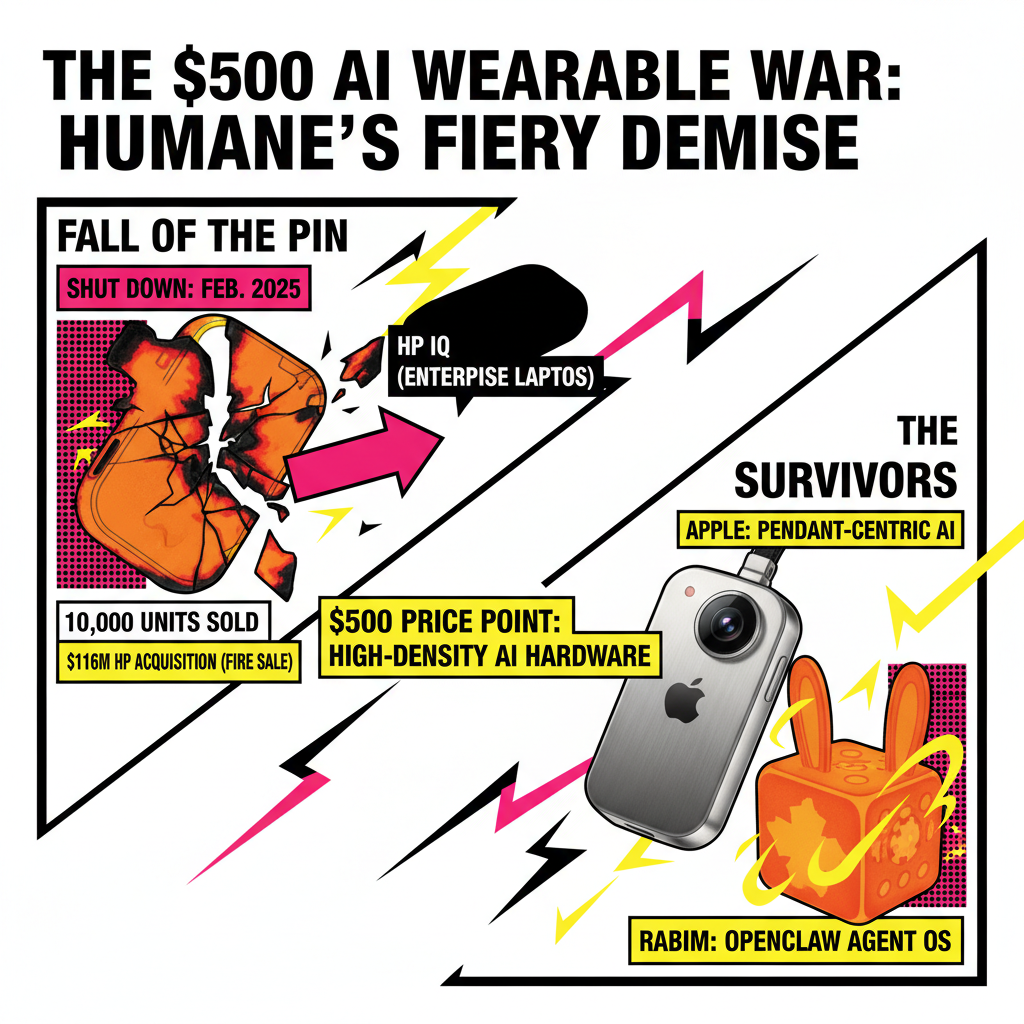
Apple’s 'Siri-Pendant': The Eyes and Ears Strategy
Apple is taking a diametrically opposite approach to the startups. Recent reports from Bloomberg’s Mark Gurman suggest that Apple is accelerating three new wearable form factors: smart glasses, camera-equipped AirPods, and an AirTag-sized AI pendant. Unlike the failed Humane Pin, Apple’s pendant is strictly an iPhone accessory. It offloads all heavy processing to the phone’s A-series chip, acting only as a high-fidelity sensor for "Visual Intelligence." This avoids the thermal and battery issues that plagued standalone attempts.
Internal teams reportedly refer to these devices as the "eyes and ears" of the iPhone. The pendant features an always-on camera and microphone array designed to feed real-time environmental context to Siri. If you’re looking at a broken engine or a complex code snippet on a monitor, the pendant sees it and provides proactive suggestions through your AirPods. This tight integration makes it a formidable competitor for the $500 price bracket, as it leverages the existing iOS developer ecosystem rather than forcing a new one.
| Feature | Rabbit R1 (2026) | Apple 'Siri-Pendant' |
|---|---|---|
| Connectivity | Standalone 5G + WiFi | iPhone Tethered (UWB) |
| Compute Strategy | On-device NPU + Cloud LAM | Full iPhone Offloading |
| Developer Access | OpenClaw / Community Skills | App Store / SiriKit |
The Verdict: Choosing Your Development Stack
Choosing between these platforms depends entirely on your stance on ecosystem lock-in. Rabbit offers a playground for developers who want to experiment with raw agentic control and open-source models. It’s the hardware equivalent of a Linux laptop: powerful and flexible, but prone to rough edges. If you're building a tool for the $500 AI engineer to interact with the physical world, Rabbit’s DLAM and OpenClaw support provide the lowest barrier to entry.
Apple’s entry will likely win the mass market by sheer friction reduction. By treating the wearable as a sensor rather than a computer, they’ve solved the reliability problem that killed Humane. Developers already comfortable with Swift and CoreML will find the Siri-Pendant to be a natural extension of their existing apps. As the market reaches a projected $30.7 billion in 2026, according to 24 Market Reports, the winner won't be the device that replaces the phone, but the one that makes the phone's AI finally see the world.
Sourcing Log
- Statistic: Global Wearables AI market size projected at $30.7 billion in 2026. - 24 Market Reports (2026)
- Fact: HP acquired Humane for $116 million in February 2025; AI Pin discontinued. - The Decoder
- Statistic: Humane AI Pin sales estimated at only 10,000 units before shutdown. - PYMNTS
- Product Update: Rabbit OS 2.1 launched April 6, 2026, featuring DLAM and journal cards. - Rabbit.tech
- Expert Quote: "2025 is the year where dark data lights up... [enabling] businesses to analyze unstructured data in ways that transform reasoning." - Andi Gutmans, VP/GM Google Cloud via Fast Company
- Rumor Data: Apple accelerating "Siri-Pendant" and smart glasses (N50) for 2027 release. - MacRumors (April 2026)