The Great Decoupling: From Systems of Record to Systems of Agency
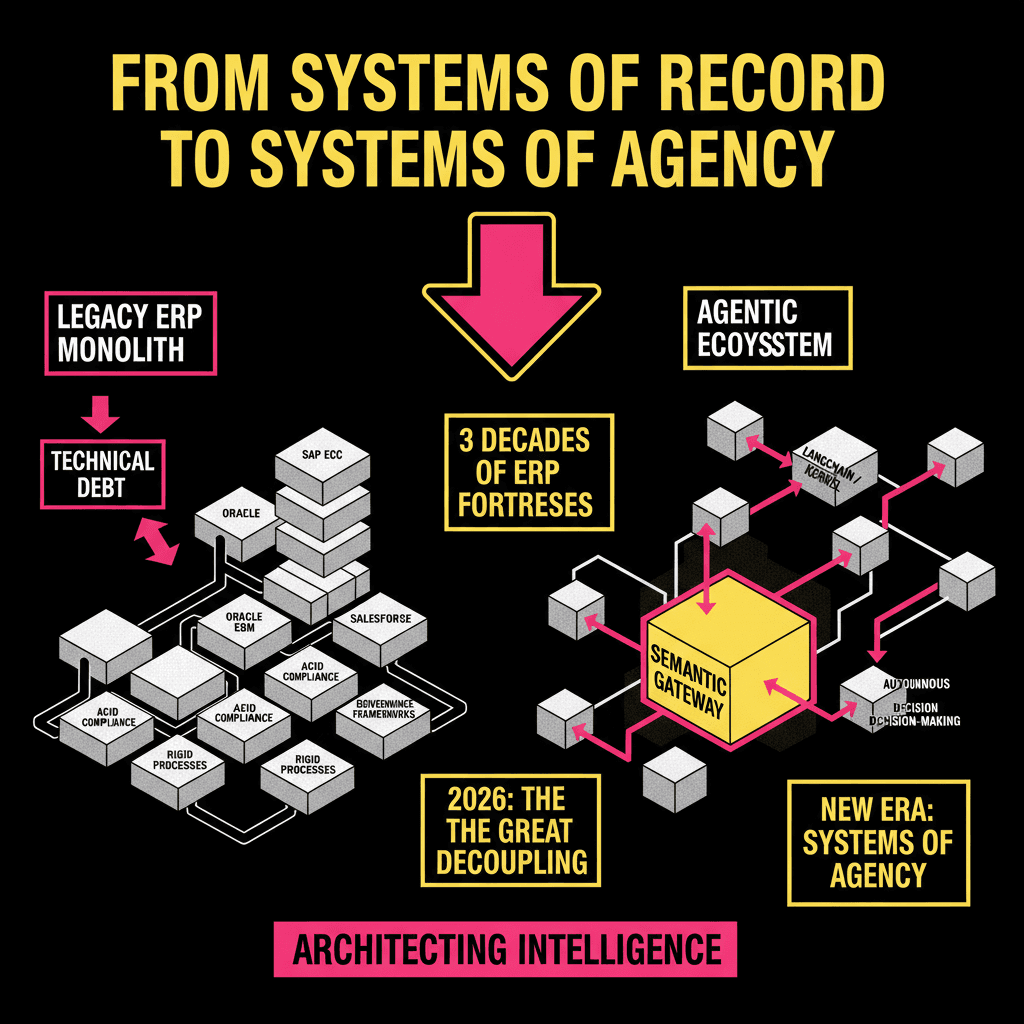
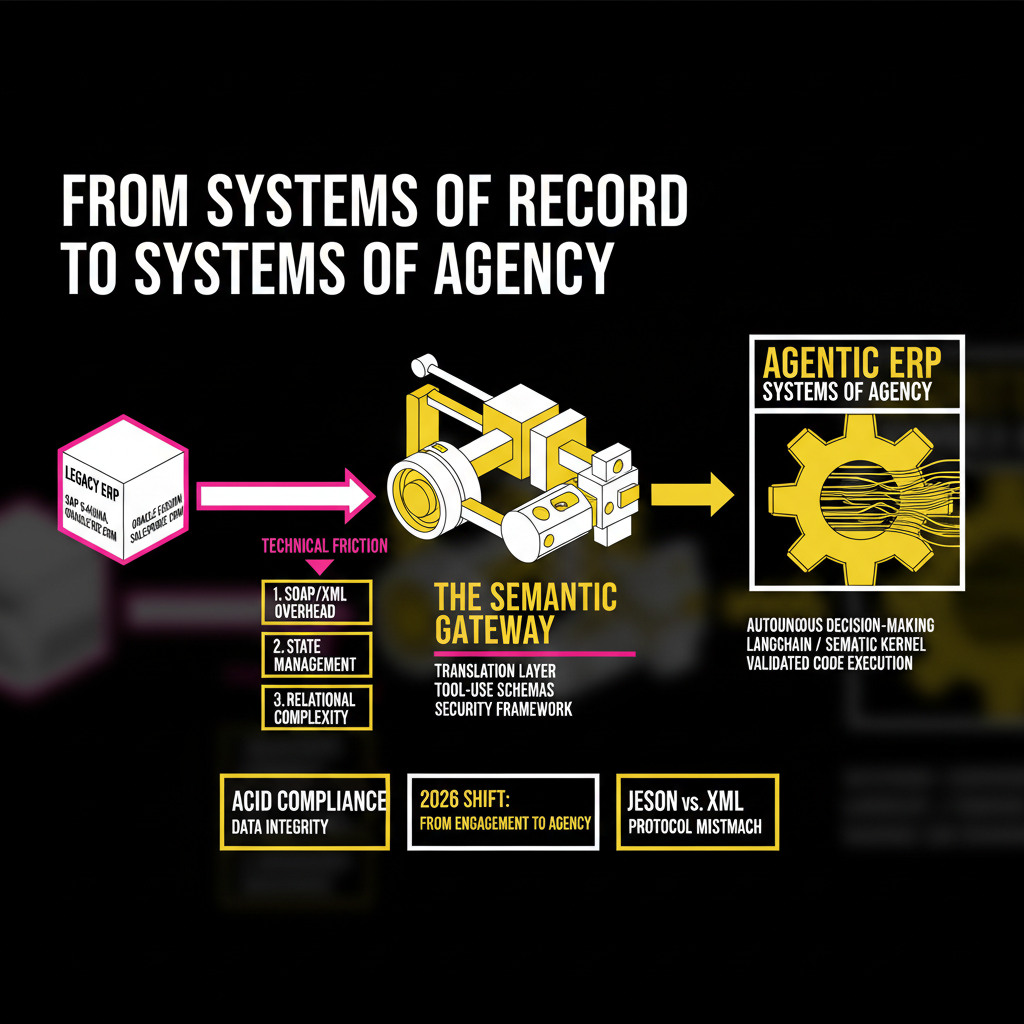
For three decades, the Enterprise Resource Planning (ERP) system has been the 'fortress' of the corporate world. Whether it is SAP S/4HANA, Oracle Fusion, or Salesforce’s vast CRM-centric ecosystem, these platforms were designed for ACID compliance, data integrity, and rigid process adherence. However, as we move through 2026, the industry is witnessing a fundamental shift. We are no longer satisfied with 'Systems of Record' or even 'Systems of Engagement.' We are building Systems of Agency.
Integrating Agentic AI into these legacy ecosystems is not merely a matter of slapping a chatbot on top of a database. It requires a sophisticated re-architecting of the middleware layer, a robust approach to tool-use schemas, and a rigorous security framework that can handle autonomous decision-making without compromising the financial or operational integrity of the organization.
The Technical Friction: Why Agentic AI Struggles with Legacy ERP
To understand the integration challenge, developers must first acknowledge the technical debt inherent in ERP systems. Most legacy platforms rely on protocols and data structures that are fundamentally 'AI-unfriendly':
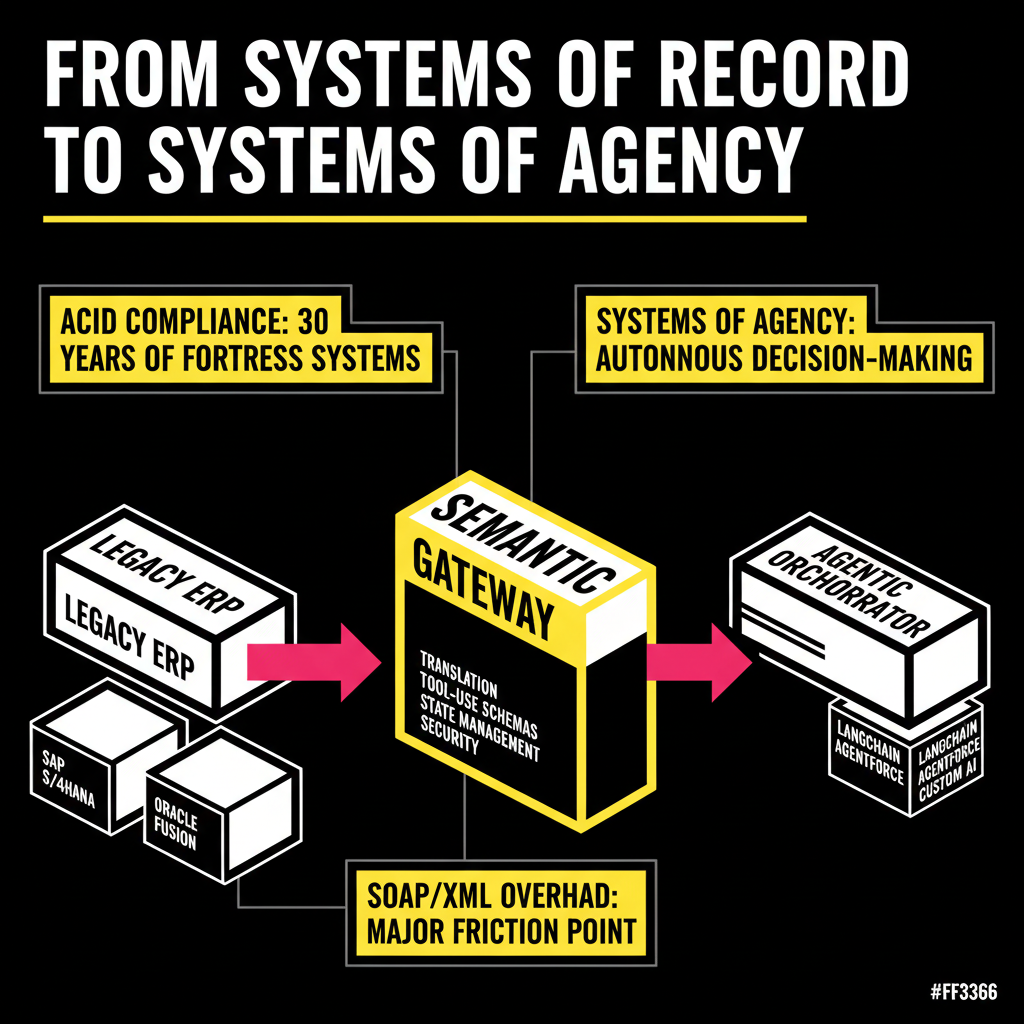
- SOAP and XML Overhead: Many SAP and Oracle instances still rely on heavy SOAP-based web services. Agentic LLMs, which excel at generating JSON, often struggle with the verbosity and strict schema requirements of XML without significant transformation layers.
- State Management: ERP processes are state-rich. An agent attempting to execute a multi-step 'Quote-to-Cash' workflow must maintain state across multiple API calls, handling partial failures in a way that doesn't leave the ERP in an inconsistent state.
- Relational Complexity: A single 'Customer' object in SAP might span dozens of linked tables. Agents need a semantic layer to navigate this complexity without hallucinating non-existent joins.
Architectural Pattern: The Semantic Gateway
The most successful integration pattern in 2026 is the Semantic Gateway. This layer sits between the Agentic Orchestrator (e.g., LangChain, Semantic Kernel, or a custom Agentforce instance) and the ERP’s REST/OData APIs. Its primary job is to translate high-level natural language goals into sequences of executable, validated code.
| Feature | SAP (Joule / BTP) | Salesforce (Agentforce) | Oracle (OCI / Fusion) |
|---|---|---|---|
| Primary Protocol | OData / ABAP SDK | REST / GraphQL | REST / PL/SQL Wrappers |
| Vector Support | SAP HANA Cloud Vector Engine | Data Cloud Vector DB | Oracle AI Vector Search |
| Agentic Framework | BTP AI Core | Atlas Reasoning Engine | OCI Generative AI Agents |
Case Study: SAP S/4HANA and the 'Self-Healing' Supply Chain
Consider a supply chain agent tasked with mitigating a shipping delay. In a traditional setup, a human analyst would identify the delay in a report, manually check inventory in SAP, and then create a new purchase order. In an agentic ecosystem, the agent identifies the delay via a webhook, uses a Tool-Use Schema to query A_PurchaseOrder via OData, and reasons through alternative suppliers based on historical performance data stored in a vector database.
The technical implementation involves a ReAct (Reason + Act) loop. The agent must first confirm its understanding of the current state before attempting a 'Write' operation. This is where Function Calling becomes critical. Instead of generating raw code, the LLM generates a JSON object that matches the ERP’s internal API constraints.
Bridging the Data Gap with Salesforce Data Cloud
Salesforce has pivoted aggressively toward Agentic AI with its Agentforce initiative. The core challenge here isn't the API—Salesforce's APIs are modern and robust—but rather the fragmentation of data. By 2026, the 'Data Cloud' has become the mandatory substrate for any Salesforce agent. It provides a unified, harmonized view of the customer, allowing agents to ground their reasoning in real-time data from external sources like Snowflake or BigQuery without data movement (Zero-Copy).
The Importance of Grounding
An agent is only as good as its context. For a Salesforce agent to handle a complex refund request, it needs more than just the CRM record; it needs the transaction history from the ERP and the interaction history from the support logs. Using Retrieval-Augmented Generation (RAG), the agent fetches these disparate data points, constructs a prompt context, and only then decides on the appropriate action.
Oracle's 'Autonomous' Advantage
Oracle’s strategy focuses on the database layer. With Oracle AI Vector Search integrated directly into the 23c/25c database, developers can perform similarity searches alongside standard SQL queries. This allows an agent to ask: "Find all invoices that look like this fraudulent one and cross-reference them with the current vendor list in Fusion."
This 'In-Database' AI approach minimizes the latency typically associated with calling external LLM services. For developers, this means writing PL/SQL procedures that can invoke LLM reasoning directly on the data, reducing the need for complex middleware and maintaining a tighter security perimeter.
Governance, Security, and the 'Agentic Kill-Switch'
The most significant hurdle for developers in 2026 is not the code, but the Governance Framework. When an agent has the power to write to an ERP, the stakes are existential. Organizations are adopting a 'Multi-Layered Guardrail' approach:
- Deterministic Validation: Every output from an LLM-based agent must pass through a traditional validation engine (e.g., SAP's Business Rules Framework) before being committed.
- RBAC for Agents: Agents must be assigned their own identities with Least Privilege access. An 'Inventory Agent' should never have the permissions to modify 'Payroll' records.
- The Audit Trail: Every thought, search result, and action taken by the agent must be logged in an immutable ledger for compliance (SOX/GDPR).
"The goal of agentic integration is not to replace the ERP's logic, but to provide a cognitive interface that can navigate its complexity at scale."
Conclusion: The Road Ahead
Integrating Agentic AI into SAP, Oracle, and Salesforce is the defining challenge of enterprise engineering in the mid-2020s. By focusing on Semantic Gateways, Zero-Copy data strategies, and Deterministic Guardrails, developers can unlock the dormant value within these legacy monoliths. The gap is narrowing, and the era of the autonomous enterprise is no longer a roadmap item—it is the production reality.