The Legacy of the Input Box
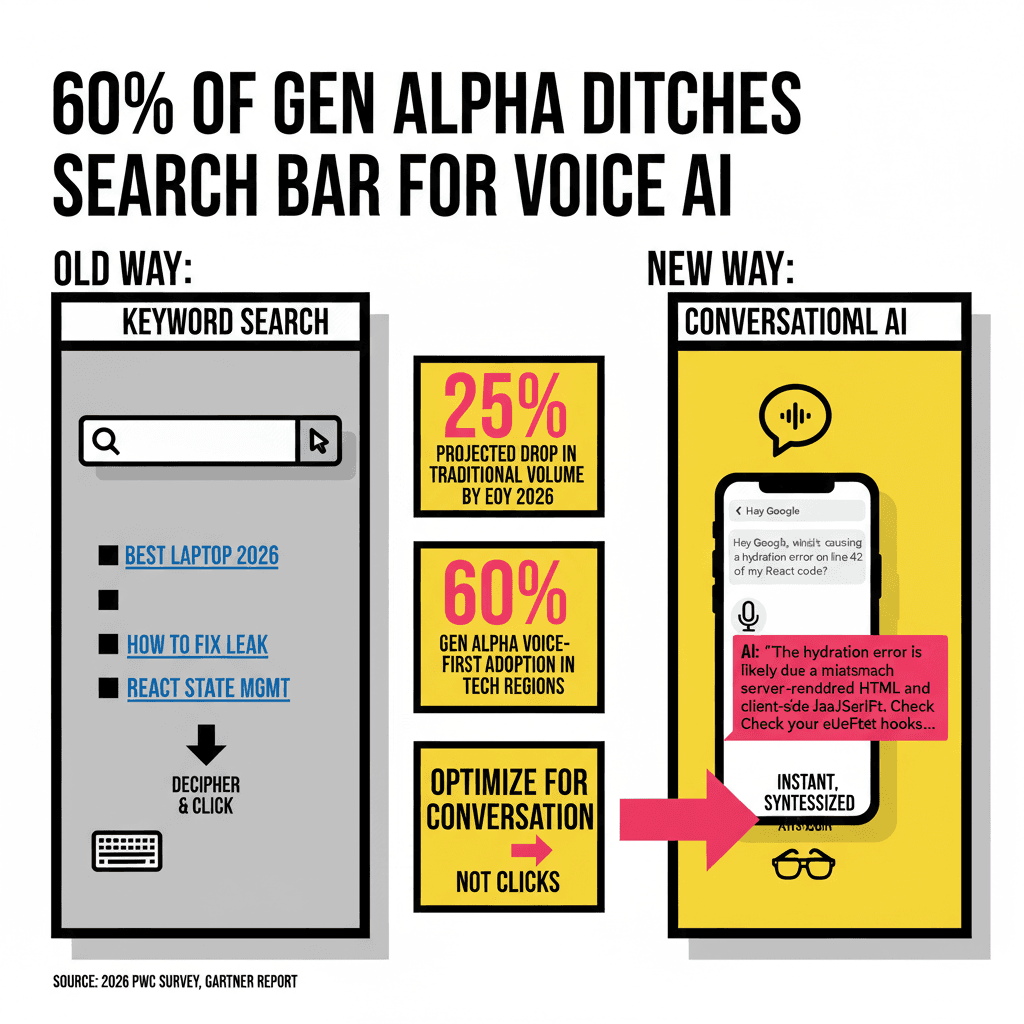
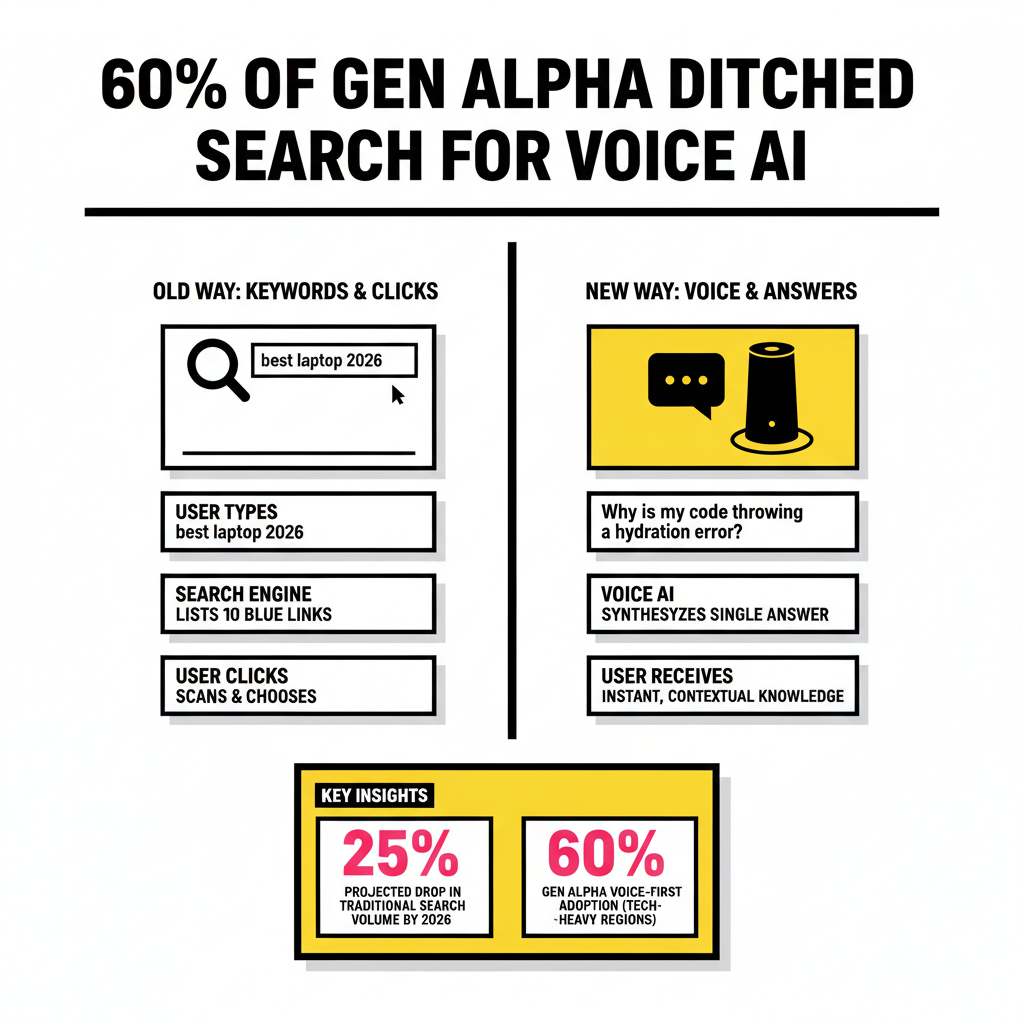
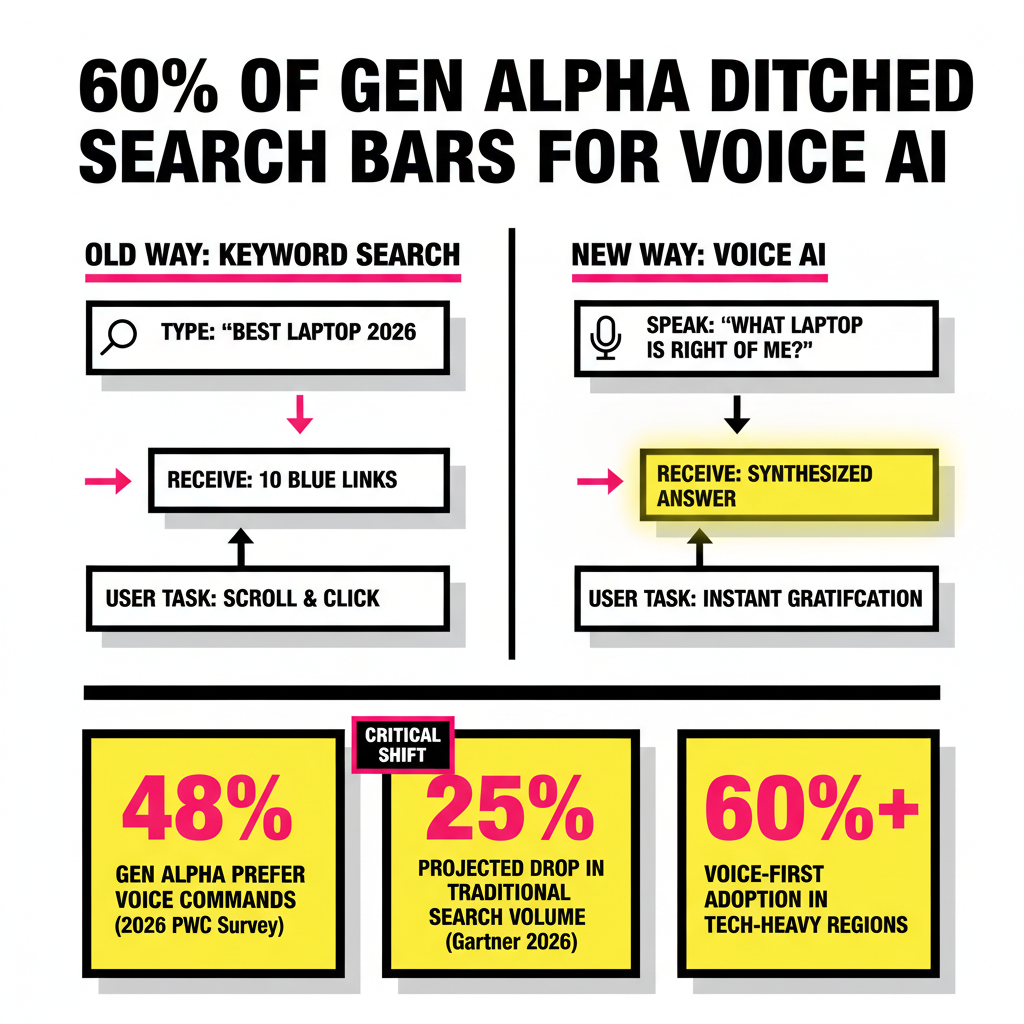
The blinking cursor in a white rectangular box once defined the internet. For three decades, we've trained ourselves to condense complex human desires into fragmented keywords like "best laptop 2026" or "how to fix leak." This behavioral tax is finally being repealed. As we move through 2026, the traditional search bar is increasingly viewed as a legacy peripheral, much like the physical keyboard it relies on. Current data suggests a massive shift in how the next generation interacts with information. According to a 2026 PwC survey, nearly 48% of Gen Alpha already prefers voice commands over typing, and in high-adoption technical cohorts, that number has surged past 60%.
This isn't just a change in interface. It is a fundamental rejection of the "search and browse" model. While older generations are comfortable scanning a list of ten blue links, Gen Alpha expects a singular, synthesized answer delivered instantly. Gartner recently predicted that traditional search engine volume will drop by 25% by the end of 2026 as AI chatbots and virtual agents become the primary answer engines for the web. For developers, this means the era of optimizing for clicks is ending. We are entering the era of optimizing for presence within a conversation.
From Keywords to Conversational Intent
Traditional SEO was a game of matching strings. If a user typed "React state management," you wanted your page to have those exact words in the H1. Voice-first AI search engines like Perplexity, SearchGPT, and Gemini Live operate on a completely different logic. They don't look for keywords; they map intent across a multi-dimensional vector space. When a teenager asks their smart glasses, "Why is my code throwing a hydration error on line 42?" the engine isn't just looking for those words. It is pulling context from the user's current environment, their previous queries, and real-time documentation.
Developers must realize that these systems act as editors rather than indexes. Roger Lynch, CEO of Condé Nast, recently described the rise of AI-generated summaries as a "death blow" to traditional search traffic. He noted that when an AI provides the full answer upfront, the incentive to click through to the source vanishes. This shift requires us to architect our content and data structures so they are easily digestible by Large Language Models (LLMs) during the Retrieval-Augmented Generation (RAG) process. If your data isn't structured for these agents, you don't just drop in rank. You cease to exist in the results entirely.
The Technical Pipeline of a Voice Search
Building for a voice-first world requires a deep understanding of the latency-sensitive stack that powers these interactions. A typical voice query in 2026 follows a complex path from the microphone to the speaker. Every millisecond of delay increases the likelihood of a user abandoning the session. This is why we are seeing a massive push toward edge-inference and specialized hardware. Users no longer tolerate the two-second lag of 2024-era assistants.
The modern pipeline involves four critical stages. First, high-fidelity Speech-to-Text (STT) models like Whisper v4 convert the audio. Second, an orchestration layer determines the intent and decides whether to trigger a web search or an internal tool. This is where the agentic shift becomes vital, as multi-agent systems coordinate to verify facts across different sources. Third, the LLM synthesizes the answer. Finally, a Text-to-Speech (TTS) model delivers the response with human-like prosody.
Developing for the "Zero-Click" Reality
We are seeing a massive divergence in search behavior. Navigational queries (e.g., "login to GitHub") still happen in the browser. However, informational and research-heavy queries have moved almost entirely to conversational AI. A 2026 report from Similarweb indicates that ChatGPT Search now processes between 250 million and 500 million queries weekly. Most of these sessions result in zero clicks to external websites. The AI provides the answer, cites the source in a small footnote, and the user moves on.
To survive this, developers need to focus on "Answer Engine Optimization" (AEO). This involves creating highly structured API endpoints and schema-rich content that AI crawlers can easily ingest. Instead of hiding your best data behind complex UI components or infinite scrolls, you need to expose it through clean, semantic HTML. Tools that help in this transition are becoming essential. For example, many engineers are using AI coding extensions to automate the generation of JSON-LD and specialized metadata that targets specific LLM crawlers like OAI-SearchBot.
| Feature | Search 1.0 (Google) | Search 3.0 (Voice AI) |
|---|---|---|
| Input Type | Fragmented Keywords | Natural Language / Context |
| Primary Goal | Click-Through Rate (CTR) | Information Synthesis |
| Result Format | List of External Links | Direct Answer with Citations |
The Death of the Navigational Bar
It isn't just the search engine that is changing; it is the entire concept of the website. If a user can find your pricing, your documentation, and your support through a voice assistant, why would they ever visit your homepage? We are seeing a shift where the "website" becomes a headless data repository for AI agents. Gen Alpha doesn't want to navigate your hamburger menu. They want to ask, "When is my order arriving?" and get an answer while they are walking to the kitchen.
The winners in this new environment will be those who embrace transparency. Brands that try to hide their information behind login walls or un-crawlable JavaScript will simply be skipped by the AI. You must ensure your technical stack supports real-time data fetching for agents. This means robust, public-facing APIs that can be queried by a search engine's RAG pipeline in milliseconds. The search bar may be dying, but the need for accurate, accessible information is higher than ever. It's time to stop building for the eye and start building for the ear.
Sourcing Log
- Statistic: 25% drop in traditional search volume by 2026 - Gartner Official Prediction
- Statistic: 48% of Gen Alpha uses voice commands daily - PwC Gen Alpha Report 2026
- Statistic: ChatGPT Search weekly query volume (250-500M) - Digital Applied 2026 AI Search Report
- Quote: Roger Lynch on AI summaries as a "death blow" - MediaPost / Financial Times Interview March 2026
- Factual Reference: ChatGPT's growth to 900M weekly active users by 2026 - QuickSEO 2026 Data Analysis